Showing posts sorted by relevance for query BLUE + Hostetter. Sort by date Show all posts

Wednesday, November 10, 2010

A Committed Writer

Last February I had the privilege of reading a rough draft of Committed! (working title) by Joyce Hostetter, my fellow Talking Story partner and my inspiration for writing historical fiction. Although Joyce hadn’t signed a contract for it, she had already spent two years writing it. I finished reading it with tears in my eyes and thought that it was close to being ready to be sent to the publisher.

I was wrong.

Joyce has a proclivity for serious subjects. In two of her previous books, Blue and Comfort, she writes about a girl who loses a little brother to polio, contracts polio herself, and then recuperates at Warm Springs, Georgia. In a third book, Healing Water, she tells the story of a Hawaiian boy whose life is devastated by leprosy.

Now, Joyce takes on another serious topic: a young man who follows his Mennonite beliefs and becomes a conscientious objector (CO) during World War II. For over a year he serves in a mental hospital becoming a part of a group who successfully lobbies to get the horrendous conditions in the hospital alleviated.

Working from memoirs, letters, and interviews with conscientious objectors who worked in a variety of mental hospitals, Joyce incorporated details of how they worked to instigate change in these institutions. Their attitudes towards their work and compassion towards their patients deeply influenced this story and her fictional character’s motivations.

Joyce has skillfully woven together her CO’s story along with the story of Kelsey, his granddaughter, who decides to tell his story for her senior project. After I read the rough draft in February, Joyce decided to tell the contemporary story line in the form of a blog, in which Kelsey reflects on personal dilemmas related to modern day wars. This added layers and layers of details which then needed to be integrated into the story

Intertwining the two stories and time periods was part of Joyce’s challenge. After several months had passed when she thought it would be ready to send, I asked her how she would knew when the manuscript would be “done.” She replied, “I think there’s always room for improvement. But right now, I just see missing elements. I’m trying to make sure themes, characters, and subplots are evenly woven throughout the story. And tweaking of course. There’s always that obsession over the perfect word choice.”

Finally, months after she had hoped to submit the manuscript, Joyce finished tweaking word choices, cleaned up her bibliography, (which she accumulates as she writes,) and mailed her story to her editor.

I try not to feel overwhelmed by the amount of work and tweaking that Joyce put into her manuscript. I try not to think of the mountains of work and time and revisions that are in front of me as I push through a rough draft of my first novel.

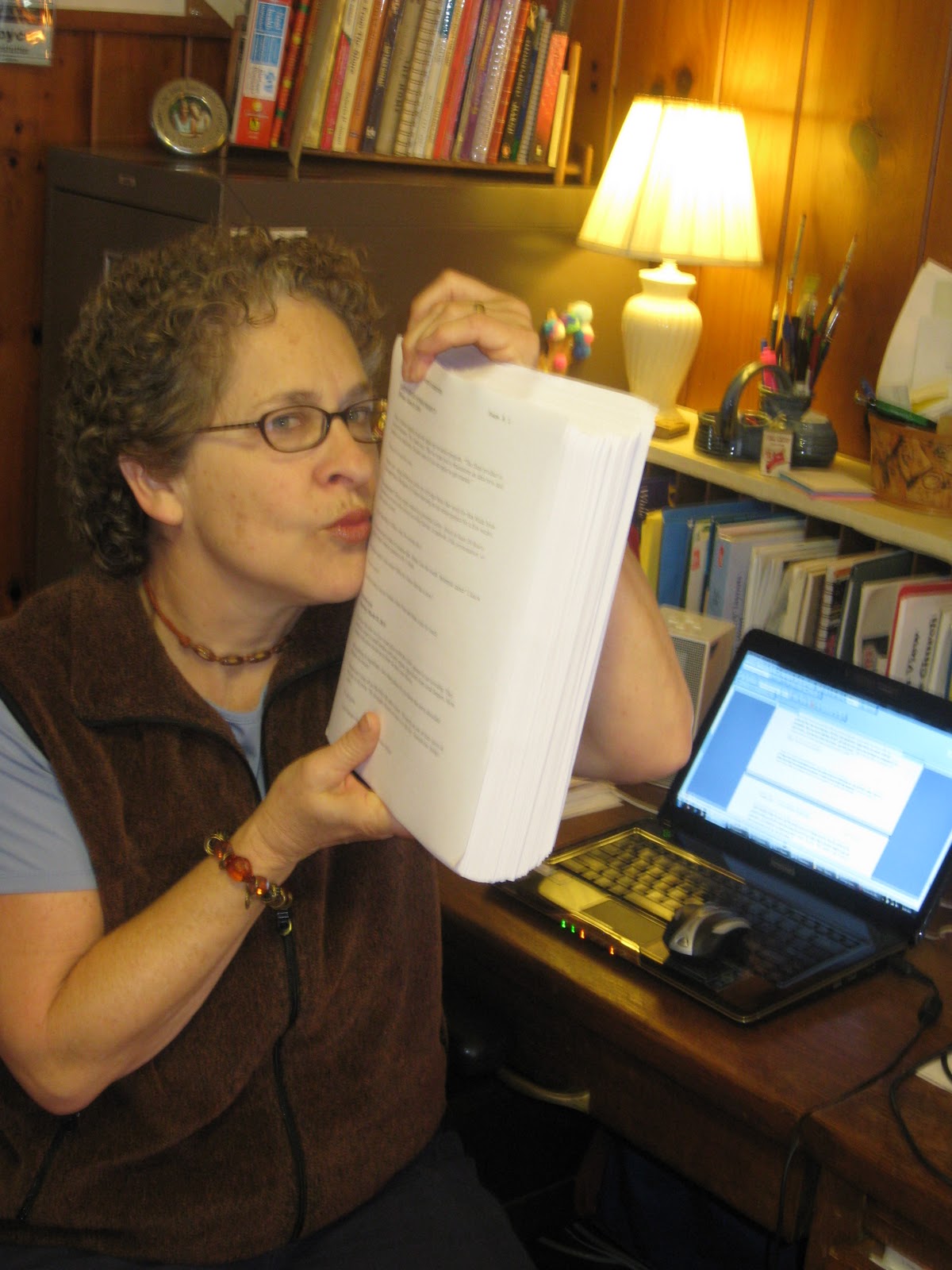
I try to think of the day that someone will take a picture like this of me—kissing Half-Truths  goodbye and getting ready to mail it to a publisher.

I try to just write.


Thursday, March 3, 2011

Write2Ignite Teens Ignite Me and Inspire a Giveaway!

It never fails. When I teach teens I feel as if I receive as much as I give. That was my experience teaching twelve teens at the recent Write2Ignite conference.


Picture courtesy Sean Earnhardt

We came together as a group of strangers- some more tentative than others- but we all had the same passion: a love for writing.


Picture courtesy Sean Earnhardt


Using activities from my book, Teaching the Story: Fiction Writing in Grades 4-8, students learned how to exercise muscle words, welcome revision, and jazz up their writing. Here is a sample of what they came up with:

The sentence, "I walked through a cemetery and heard eerie sounds."

Became, "I stalked through a graveyard and I heard bat wings flapping at the beat of my heart."

Pretty spooky, huh? I guess they had cemeteries on their brains because I said I was stuck on trying to create a simile for one of my scenes in Half-Truths. The setting is a graveyard that is being bulldozed to make room for houses. To a student they all said "eeew!"  and then proceeded to give me ideas on what they thought that toppled gravestones would look like. One student thought they might look like fallen dominoes, but nixed that idea because it wouldn't create the right mood. (right on!) Another said the graves would look like faces looking out on the cemetery. As we talked about the effort that goes into a writer finding just the right simile to convey an image, they got the point. Writing takes time, work, and revision.

Interspersed between learning how to create original characters, settings, and plots, the teens also did a variety of dramatic activites. When we discussed character they mingled like old people, kindergartners, and their parents; when we talked about settings they pretended to walk through a swamp, a busy street, and on a mountain. 

                                   They collaborated,


opined, 

Photograph courtesy Sean Earnhardt

                                                                       and wrote.


By the end of the day, we left as friends and co-writers who had a day of fun together.

Photograph courtesy Sean Earnhardt

That weekend I realized something profound. I am writing a book for teen readers but I don't have many teen followers on this blog. To rectify that situation, I am going to start giveaways that are geared directly to my intended audience. If you are between the ages of 12-16, start following my blog and send me an email at cbaldwin6@carolina.rr.com. On March 15 (the ides of March) I will pick a winner. That person will receive an autographed copy of Blue by Joyce Hostetter


Parents, please note that you can't enter...but your children can!


Tuesday, March 4, 2014

Blue Willow: A Book That Lillie and Kate Read

After reading What I Saw and How I Lied, I contacted the author, Judy Blundell through Facebook. I was impressed with Judy's knowledge of the books that Evie Spooner, her post WWII character, read. Including this literature brought historical accuracy and greater depth to Evie's character. Judy told me how she located her resources. She inspired me to find a few books that Lillie Harris and Kate Dinsmore, my two protagonists, would have read. 

As some of my faithful blog readers know, my story includes Lillie and Kate discovering a cup with the same china pattern that has been passed down for generations in both their families. Over the process of writing Half-Truths, I've played with different china patterns. My friend and writing mentor, Joyce Hostetter, suggested the popular Blue Willow pattern. When I posted this picture on Facebook, several friends commented about their grandmothers' collections. 

Becky Levine and Joyce chimed in that I really needed to read the book, Blue Willow, which they remembered from their own childhoods. After reading it I realized I'd found a book which both girls would have enjoyed and a story that could provide rich subtext for Half-Truths.

Winner of the Newbery Honor in 1941, Blue Willow recounts the story of a family shaped by the Great Depression. Ten-year-old Janey Larkin longs for a permanent home for herself and for her most beloved possession, a blue willow china plate that belonged to her great-great grandmother. Her father is an itinerant farm worker who struggles to support Janey and her step-mother.  When the family moves from one farm to another, the plate goes with them but stays packed away. "…never, Mrs. Larkin had declared long ago, would it be put out as a household ornament until they had a decent home in which to display it. In the meantime it was kept sadly tucked away, a reminder of happier days before its owners had become wanderers in search of a livelihood." (p. 23)

Because the plate had belonged to Janey's mother, it had become a part of her memories that were mixed up with "Mother Goose rhymes and gay laughter and a home of their own.  And because the willow plate had once been a part of all this, it had seemed actually to become these things to Janey. It was the hub of her universe, a sold rock in the midst of shifting sands." (p.23)

Fast forward twenty years, and like Janey, Lillie is enthralled with the story depicted in the blue willow pattern. Here will be my readers first introduction to the china in Chapter 1:
I tackle the breakfast dishes, washing and stacking them so they dry nice. I take special care with Big Momma’s china cup. There’s a chip along the rim and I don’t know how many times my grandmother has glued the handle back on. Daddy teases her that he’s going to get her a new cup for her birthday, but she says her coffee won’t taste right coming out of any other cup. She never lets anybody else drink out of that cup neither. The way she prizes it, you’d think a boyfriend gave it to her.
I rinse and wipe the cup dry, tracing my finger around the blue doves flying over the pagoda. When I was little, Big Momma told me the legend of the young Chinese lovers who were turned into doves when they eloped against the girl’s Daddy’s wishes.  This was one of Big Momma’s favorite stories. Mine too. A girl loving a boy when her Daddy didn’t think he was good enough for his daughter?  You can’t get more romantic than that!

Later in Half-Truths, Kate's little sister Maggie discovers a blue willow tea set in their grandmother's attic. 
     Maggie pulls out crumpled sheets of yellowed newspaper and throws them on the floor. I start to gather up the paper but then stop. Maggie holds up a blue-patterned tea pot for us to admire. I gasp and put my hand over my mouth. But it’s too late. The girls look at me questioningly.  
“What’s the matter, Lillian?” Maggie ask.  “You look like you seen a ghost!”
“It’s Blue Willow,” I blurt out.  “Big Momma’s got a cup just like it at. The pictures on it tell an old Chinese love story.”
“Ain’t that something!” Maggie pulls out a creamer, sugar bowl, and two cups. Who would have figured that Grandmother and Big Momma would have the same tea cup?”
Miss Anna Kate looks from me to the china and back to me again. “It’s just like the china in the book.” Her voice is slow and thoughtful.
“You mean Blue Willow?” I ask.
“It was my favorite book in fifth grade,” Miss Anna Kate gets a faraway look in her eyes as if she’s recollecting the story. “You read it?”
I nod. “I love the part when Janey pays the rent with the plate so they can stay in their shack…”
Miss Anna Kate interrupts me, “…but then in the end, finds it on the mantle in their new home.”
“What are y’all talking about?” Maggie’s crosses her arms across her chest and looks perturbed.
I shrug. “Just a book.”

Miss Anna Kate corrects me. “Just the best book ever."
We smile at each other. I’m surprised we’ve got something in common. But I gotta admit, it feels good.
********
Blue Willow china: generations old. 
Facebook friends: generations new.

Saturday, June 25, 2022

BLUE WILLOW: A Book that Lillie and Kate Read-- Part II and Insight into Revision

 Back in 2014, I posted this:

As some of my faithful blog readers know, my story includes Lillie and Kate uncovering a china cup that belongs to both their families. Over the process of writing Half-Truths, I've played with different china patterns. My friend and writing mentor, Joyce Moyer Hostetter, suggested the popular Blue Willow pattern. When I posted this picture on Facebook, several friends commented about their grandmothers' collections. 


Becky Levine and Joyce chimed in that I really needed to read the book, Blue Willow, which they remembered from their own childhoods. After reading it I realized I'd found a book that both girls would have enjoyed and a story that could provide a rich subtext for Half-Truths.


Winner of the Newbery Honor in 1941, Blue Willow recounts the story of a family shaped by the Great Depression. Ten-year-old Janey Larkin longs for a permanent home for herself and for her most beloved possession, a blue willow china plate that belonged to her great-great-grandmother. Her father is an itinerant farm worker who struggles to support Janey and her stepmother.  When the family moves from one farm to another, the plate goes with them but stays packed away. "…never, Mrs. Larkin had declared long ago, would it be put out as a household ornament until they had a decent home in which to display it. In the meantime, it was kept sadly tucked away, a reminder of happier days before its owners had become wanderers in search of a livelihood." (p. 23)

Because the plate had belonged to Janey's mother, it had become a part of her memories that were mixed up with "Mother Goose rhymes and gay laughter and a home of their own.  And because the willow plate had once been a part of all this, it had seemed actually to become these things to Janey. It was the hub of her universe, a solid rock in the midst of shifting sands." (p.23)

That draft was from both girls' POVs. As I wrote in 2017, I returned to writing from Kate's POV alone.  In the current draft, Blue Willow china is still an important link between the girls. But my young beta readers and Deborah Halverson said that the china did not clearly reveal how the girls were related. If more than one reader has a problem with something in my manuscript--I need to fix it!

So, how to tackle this? I did some brainstorming and side writing. I started a new document and recorded every time I mentioned the china. That helped me to see the gaps where Blue Willow fell off the story radar and where I needed to build more connections between the china and the characters. 

I found several places where I could add internalization and dialogue showing Kate's assumptions and false conclusions. It was like figuring out where the puzzle pieces should fit. By the time I had worked through this brainstorming exercise, Blue Willow had gained more importance in the story. In the end, the girls discover how the china is the clue that solves their ancestry mystery.

This blog took a few hours to write. Inserting more information about the china connection took many more; it is just one of the story threads I am deepening in Half-Truths.

And that my friends, is what re-vision is all about. 

By the way, during a recent visit to Joyce's house, I ate from Blue Willow,


and discovered that the pattern adorns other things besides plates!


Do you have a favorite revision story? Or, maybe you enjoy Blue Willow too. Please share in the comments!


Friday, May 6, 2022

STORIES IN JOYCE'S BACKYARD: A "PICK-YOUR-OWN" GIVEAWAY!

 "This is the house that the Hinkle sisters lived in, and that's the muddy river where Thomas and Jackie fished together." Joyce Hostetter pointed out the car window as we drove around around her hometown, Hickory, NC--the setting for her Bakers Mountain Series. "See that old building? That's the hosiery factory where Junior worked for a few days. Over there is where the car mechanic lived who helped him fix his truck."


The Honeycutt family and their friends, who already had a special place in my heart from reading AIM, BLUE, COMFORT, DRIVE and EQUAL, became even more real as I saw the places where they lived, played, and worked--all within sight of Bakers Mountain. 

Bakers Mountain, photo courtesy Joyce Hostetter

How did Joyce end up writing a series of books that rose up out of what was once a rural community? It all began when Carolyn Yoder, senior editor at Calkins Creek, suggested that Joyce find the story in her own backyard. When Joyce began researching the history of Hickory, NC, she discovered the Miracle of Hickory at her local library.

Mural in downtown Hickory. Do you see Joyce?

She researched, read old papers, interviewed polio patients...and BLUE was born. Read some of Joyce's thoughts on the process of discovering her stories here

Part of Joyce's real backyard. Photo courtesy Joyce Hostetter

A few years after BLUE was published, I met Joyce in Birmingham, Alabama at a literacy conference. She was presenting on BLUE, I was presenting on Teaching the Story: Fiction Writing in Grades 4-8.  


We bonded over reading and writing. We co-presented several times and continue to publish a quarterly newsletter, Talking Story. We are critique partners and good friends. 

I felt Joyce's influence when I began brainstorming my own first novel. I rode my bike, walked, and drove through neighborhoods. What could have happened here? Half-Truths incubated. Ideas hatched. A novel slowly took shape. It changed. Got revised (many times!). Was reborn. 

What did Carolyn mean when she gave Joyce that assignment? Possibly she was not only talking about an actual backyard but was also encouraging Joyce to reach inside of her own experiences to find something she could relate to and authentically show in her writing.  

Let's face it. There might not be a compelling story about polio or pre-civil rights tension in your community, city, or state. Or, maybe you write science fiction or fantasy that's not even rooted in this continent or world--let alone in your neighborhood! How are you going to find that "backyard" story?

At the foot of Bakers Mountain and staring at Joyce's budding trees and the grass turning green I thought--my backyard is bigger than the crazy intersecting streets of Myers Park, NC. where my characters live. 

It's my whole life. 

It's writing what I know with a twist. 

It's taking my grief over losing someone I loved and embedding that in Kate, my protagonist's heart when she leaves home. It's realizing how making choices is not always very linear and conveying it on the page; it's understanding how gut-wrenching it is to feel betrayed--or be the betrayer. 


How about you? What have you used in your life--whether it's a place, person, event, or experiences--that has made it's way into your book? 

What is in your own backyard? 

Some backyards are under construction,
like mine is!

GIVEAWAY

For the first time on my blog, one fortunate blog reader will be able to pick which book in the Bakers Mountain Series they want to win! Leave me a comment by May 11 to enter this giveaway and tell me which book you are interested in. U.S. addresses only. Make sure you leave me your full name and email address if you are new to my blog.

Make sure you check out the other great books on Greg Pattridge's MMGM blog! 


Friday, September 9, 2011

BLUE's News

Several writers I know are reposting previous book reviews as a part of Random Acts of Publicity Week.  Since Joyce Hostetter's book trailer came out today celebrating the new cover of her book, I figure this was an opportune time to republish my review of BLUE and share Joyce's book trailer. 


This review is from July, 2007. In the four years since I met Joyce, we have co-taught at NCCAT, NWRESA, NCAIS, and NCRA; are co-publishing Talking Story, but best of all, have become good friends. The Lord blessed me tremendously when He brought her into my life!


My review is followed by the trailer, made by Joyce's talented daughter, Wendy Hostetter Davis. To top it all off, Joyce has a giveaway  on her blog that you don't want to miss!


In addition to meeting educators at the Mid-South conference, I also met Joyce Hostetter, the author of Blue (Calkins Creek Books, 2006). This award-winning novel is set in Hickory, NC in 1944 and the story is well-shown through the eyes and heart of 13-year-old Ann Fay Honeycutt. Whether she likes it or not, the end of World War II and the polio epidemic impact Ann's life and leaves her a young woman who has faced heartache and pain—in her family and in her own body. These changes, along with how she overcomes entrenched family prejudices against African Americans, make this novel an excellent read for students in grades 5-8. I also recommend this book to my fellow writers. I am writing historical fiction that takes place in Charlotte during the 50's and it is inspiring (and educational!) to read other books in the same genre. (Boyds Mill Press, 2006)


Wednesday, May 19, 2010

Bragging On My Buddies

In our last issue of Talking Story for this academic year, Joyce Hostetter and I offer some fun family and classroom activities, four cool giveaways, and several book reviews.  If you haven’t already subscribed, you can still do so by clicking here.

In addition, we announce two book developments. Joyce’s book Blue has just been released in paperback which is a huge step for an author. “Blue in paperback is more affordable for the reader who doesn’t have deep pockets.” Joyce explained. “And paperback also travels better on vacations!  Also, certain reading lists or programs like ‘Battle of the Books’ favor titles that are available in paper.” You can find a brief review of Blue on my blog here, or more lengthy reviews here


Secondly, Clay Carmichael, whose book Wild Things I reviewed this spring, is excited that her book was just released in audio format. "I'm thrilled and grateful to see that Wild Things continues to enjoy such success and to see the audio format expand readership.” Clay wrote in an e-mail. “Last week the book was named a 2010 Bank Street College Best Children's Book and nominated for the 2010-11 North Carolina Children's Book Award--nominated by NC, which please me no end."


I’m proud of both of these North Carolina authors. Both books are great reads for upper elementary school students and if you’re looking for good summer reading for your students or children, I heartily recommend both.


Technorati Tags:
, , , ,


Monday, September 26, 2016

Guest Post by Joyce Hostetter: On Writing a War Series

Congratulations to Michelle Leonard for winning Radioactive! on last week's blog.
If you read my blog regularly, than you are no stranger to my friend Joyce Hostetter who I have featured on my blog many times. It is my privilege to host her today as she shares her reflections on some behind the scenes thoughts on writing a war series. Take it away, Joyce!
*********

When I wrote BLUE I thought I was writing a book about polio. I had no idea that it would grow into a series that would make a statement about war and its effects on family.   However my hometown’s polio epidemic took place in 1944 so it was a natural for my protagonist’s father to be drafted.

Ann Fay is exceptionally attached to her wise, affectionate Daddy when he leaves home, asking her to be “the man of the house” in his stead.  While Leroy is away at war, she faces multiple challenges while longing for the day he returns. She hopes against hope that he will come out alive and unscathed.
But is it possible to survive the battlefield, emotionally unscarred?  
After publishing BLUE, I did not intend to write a sequel.  However, Ann Fay’s voice kept echoing in my head.  And other things echoed there too—memories of childhood friendships with children whose fathers had served in WWII and The Korean Conflict.  War Trauma and PTSD were not yet identified in the 1960s.  I don’t know all the factors that contributed to these men’s personalities, their alcoholism, and abuse of spouses and children but I knew they all had combat memories in common.  
I suspect they each had war going on inside their heads.  
Later, much later, one of those friends told me what a gentle man her father was before going to war.  “He never wanted to kill people,” she said.  I thought about that man with the soul of a poet who played guitar and composed original music.  I considered the times I’d been in his presence and how gentle he still appeared to be. And I remembered that when his family was growing up he was unable to hold down a job.  My friend told me that, while she was still a child, one morning, in an attempt to motivate him to go to work, she actually took his bed apart with him in it.   
So having published BLUE, I decided to listen to the echoes.  I began to ask myself how Ann Fay’s relationship with her father would be changed by his war experiences. The result was the publication of COMFORT, a story about a girl and her father each on their own post-trauma journeys and how they begin to heal.

Ann Fay is much like the friend I mentioned above.  The one who tried to prod her father into going to work.  You would think such an action would have provoked abuse.  But I don’t know that my friend’s father was abusive to her.  Apparently he saved that for one of her brothers. And I see the devastation in that grown son’s life today. 
I see the pain of war moving down the family lines of my other friends.
When my publisher asked me to write a prequel to BLUE and COMFORT I knew immediately who the story would be about—Junior Bledsoe, Ann Fay’s neighbor.  I would explore his emotional journey after his father’s death. And as I began to listen again to those echoes I discovered the story of four generations of men traumatized by war. That story, AIM, will be released on October 4.

I’m not a sociologist but my reflections on life, my research on wars, and war trauma lead to me believe that war begats war. Trauma gives rise to more trauma and the cycle is in great danger of repeating itself.
How do we stop that cycle?  
I believe stories, historical fiction, in particular, help us to listen to history.  As a historical novelist, my task is to find the universal truth or emotion that will hold a reader and focus attention on history that might otherwise be overlooked. 

Although I don’t set out to write anti-war novels, I hope that my stories encourage readers to reflect on the effects of war and to consider alternatives.  I trust that even in their personal lives they will observe that anger and arguments give rise to more of the same. After all, change begins at home and the ripples spread.  Better that they be ripples of peace than those that lead to war.
********
Next week I am reviewing AIM using material from a workshop I took with Jillian Sullivan at Highlights Summer Camp. PLUS I'll be giving away two ARCS.  Stay tuned!

THE NIGHT WAR: A MG Historical Novel Review

  By now you should have received an email from my new website about my review of THE NIGHT WAR by Kimberly Brubaker Bradley. (It'll com...