Showing posts with label Writing Barn. Show all posts

Tuesday, February 8, 2022

TWO FUN PICTURE BOOKS with IMPORTANT MESSAGES: ROCK AND VOLE and WHERE'S MY COW?

 I recently attended a webinar "Feel the Feelings: Crafting Picture Books" with Bethany Hegedus, author and founder of The Writing Barn. As a result, Social and Emotional Learning (SEL) is front and center in my brain.  Bethany emphasized that readers should be able to take away kindness, empathy, understanding, bravery, and inclusion after reading picture books. 

Here are five SEL components: 

            • Self-Management
            • Social Awareness
            • Relationship Skills
            • Responsible Decision-Making
            • Self-Awareness

Pay attention to these--because there will be a test!

Without further ado, here are two picture books from Sleeping Bear Press.

ROCK and VOLE 


Author-illustrator Jennifer Sattler is no stranger to my blog. Her illustrations are dynamic and there's always a cleverly disguised "message" within a playful story that children will understand--without being preached to.

Here's the first page:


Vole, (like many of us) followed her comfortable, predictable routine. 

But, one day when she woke up, she wanted something different--she
wanted an adventure!

In her organized fashion, 


She set off, backpack ready with all of her essentials, and everything went according to plan. Until she met,


Rock. 

Vole tried everything to get the rock to move out of her way so she could complete her adventure. She talked to it. She showed it her map. She tried to cajole it.


Nothing worked.

Until the sun started setting and Vole realized that the rock was lovely.
 

After Vole redid her map, she rested against the rock.


Which SEL skills does Jennifer Sattler subtly communicate to the reader in ROCK AND VOLE? Leave me your thoughts in the comments.

WHERE'S MY COW?


This fun picture book was inspired by author, Susan Blackaby's observations of the symbiotic relationship between egrets and cows. The dynamic illustrator, Scott Brundage was featured on my blog here

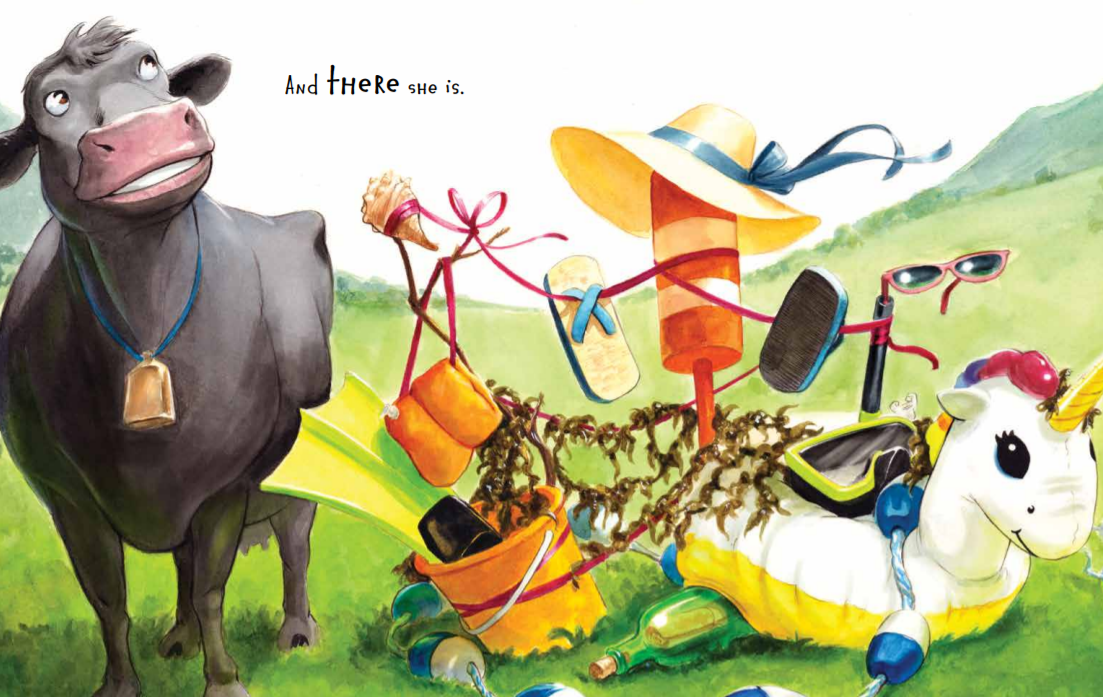
Here is the opening spread:


When the flock of egrets whirled off to explore the sea, one little egret preferred sticking close to his cow.

While the egrets were gone, the cow told him stories about the places she'd seen and the food she'd eaten. All the talk about kites and kayaks and toasted marshmallows gave the little egret ideas. With his cow encouraging his explorations, the egret flew off and found a view of the ocean that took his breath away!

But, he looked down, saw the herd far below and thought, 

"Where's my cow?"
Queasy, the egret gulped.
Sputtered. Plunged.
Ker-thump.

Fearing he'd never find his cow, he wouldn't fly far from home.

His cow encouraged him to try again and look for the cow with twitching ears.

As the following illustration shows, that didn't work!


While cow suggested other unworkable plans about how his egret could find her,


the egret gains confidence in flying further and further away. Each time the egret returned with a gift for his cow: a shell, a string, and a twisty stick. 

Finally, egret came up with a solution that would help him find his cow. When he looked from high in the sky and wondered where she was, he spotted...


Test time! Which SEL components are expressed in WHERE'S MY COW? Leave your answers in the comments below.

GIVEAWAY

For a chance to win, leave a comment with your email address, or send me an email if you prefer. If you share this on social media, you will get one extra chance; if you follow my blog you will get another chance. Tell me what you have done and I will enter your name accordingly. Winner must live in the continental U.S and please let me know which picture book you are interested in winning. Giveaway ends Friday, February 11 at 6 PM. 


Wednesday, September 15, 2021

Without Separation: Prejudice, Segregation, and the Case of Roberto Alvarez- Picture Book Biography and Giveaway

I am happy to be part of the Calkins Creek blog tour for Larry Dane Brimner's new informational book, Without Separation


INTRODUCTION

Since I'm interested in writing nonfiction picture books, I've taken several webinars recently with The Writing Barn. (BTW, they're affordable and a fantastic way to learn a new genre!). The last one I took was with Liz Garton Scanlon on "Openings and Endings".

According to Scanlon, the opening of the book is a "promise to the reader. This is a story about a problem and we’re going to get to the end and it’ll be okay." After looking at several picture book beginnings, she showed how the ending brings the story full circle and fulfills that initial promise. In fact, if you only read the beginning and the ending of a picture book, you can guess what you might find in the middle. (Try it sometime with a picture book off your shelf. You'll be amazed at how this works!)

Why am I explaining all of this? Because that's what I found in Without Separation.

REVIEW

On January 8, 1931, Roberto was happy to go back to Lemon Grove Grammar School outside San Diego California.

His friends were happy to see him, but he and his Mexican friends were not welcomed by the principal. He told them that their teachers were waiting for them in the Mexican school on Olive Street.


As it turns out, in the summer of 1930, the board of trustees of the school district had met and complained about the Mexican children. They claimed that they held back the white students, were unclean, and a danger to the health of others. A decision was made to build a separate school--but no one told the Mexican parents.

Roberto and his friends refused to go to the new school which they called la caballeriza--the barnyard.  Roberto was a good student and didn't want to attend a separate school. His family agreed. The Mexican families met and recognized that the new school was meant to segregate--not to provide English language instruction. 

Roberto was chosen to be the lead plaintiff in the case against the school district. Roberto was perfect for the job: he had been turned away from Lemon Grove, was a good student, and fluent in English. His case could prove that the school board's justification for a new school was false. 


On March 11, 1931 a Supreme Court Justice of California ruled: "The Lemon Grove School District had no power to set up a separate school for Mexican children." 

Roberto had won! Not only was this a victory for him, but also for all the Mexican and Mexican American children within the school district. 


The story comes full circle. At the end, all are welcomed.

As I mentioned in the introduction, Larry Brimner fulfilled his promise to the reader. There is a problem that gets solved and in the end...everything is okay. 

CURRICULUM RESOURCE

This book can be used in 2-4th grade classrooms as classes discuss immigration, prejudice, and segregation. The Author's Note is geared towards older readers and goes into extensive detail about Roberto's case and the historical and geographical context of the court decision. In particular, the author mentioned that this ruling was cited as a precedent before the US Supreme Court made its historical landmark decision of 1954 known as the Brown v. Board of education of Topeka (Kansas).

The acrylic illustrations by Maya Gonzalez are vivid and colorful in keeping with Mexican art and Mexican folk art.


GIVEAWAY

Leave a comment by 6 PM on Friday, September 17 to enter. PLEASE leave your email address if you are new to my blog. In honor of National Hispanic American Heritage Month, if you are Hispanic let me know and I'll enter your name twice.

                                                    ****

Congratulations to Margo Jantzi, a librarian who took advantage of having two chances to win last week. She won June Almeida: Virus Detective from last week's blog.

THE NIGHT WAR: A MG Historical Novel Review

  By now you should have received an email from my new website about my review of THE NIGHT WAR by Kimberly Brubaker Bradley. (It'll com...