
In my last post I shared Monica Roe's debut middle grade novel, Air. Today you're going to hear why Monica was uniquely prepared to write this book, her path to publication, and why bees and Alaska each have special roles.
In the author note at the end of Air, Monica relates that in her job as a pediatric physical therapist, she looks at what physically disabled children can do--with or without help. Once she was asked to help determine if a junior high student needed a one-on-one aide. Once you read Air, you'll see how coming alongside of that student and evaluating what he could do and what the school needed to provide, helped provide the framework for Air.
AUTHOR INTERVIEW
CAROL: How long did you think about this idea before you started writing Air?
MONICA: I'm a bit of a squirrel when it comes to ideas. I grab onto bits and pieces (often quite randomly) and sort of burrow them away for later. I originally started thinking about the first bits of the story back in 2014. Other glimmers and scraps came to me for a few years after that, including the experiences I recounted in the author's note.
CAROL: I’m curious—are you a plotter or pantster? Mostly I want to know if you “saw” the story pretty quickly because of working with that student, or did the idea evolve. If it evolved—how long was your brainstorming process?
MONICA: I have to write from a plot outline, I've learned, or else I find myself endlessly writing myself into corners and dead ends. But the bits-and-scraps of idea collecting that I do beforehand generally takes quite a long time---I might jot down notes for months (or years) before I ever sit down to write that first outline.
CAROL: The ending is brilliant and unexpected. Without giving away the ending, did you know what it was when you started, or did that evolve also?
MONICA: Thank you! The ending actually evolved rather unexpectedly to me, as well. I honestly can't remember when or how it came about, but I was pleasantly surprised when it did. I think that nailing down the title helped a bit--as I wrote and revised, it become a sort of repeating motif of sorts, which led me to all sorts of fun little moments of connection that I hadn't expected.
I can only chalk it up to the magic that can sometimes happen when we as writers really let ourselves trust the process--and our subconscious.
CAROL: How long did it take to write?
MONCA: I honestly don't remember how long the actual writing process was. I know that I drafted the last half of the book fairly quickly (over three very intense weeks). But the initial outline and the first half of the draft took a lot longer, I think.
CAROL: How did you find your agent?
MONICA: I'd spent some time in the query trenches back in 2015-2016 with another novel and promptly racked up an impressive stack of close to 50 rejections. Jacqui and I met at VCFA and had been in workshop sessions together while there. We knew one another's writing and had traded pages here and there after graduating. We reconnected after she began agenting and she reached out to me when she was building her client list. I was very, very lucky. It was one of those lightning-strikes moments I least expected.
CAROL: From PW, it seems as if the book is getting published in about a year, which is incredible! Is that true?
MONICA: The pandemic played a bit of havoc with that timeline. I think the book sold back in May 2020 and it was originally slated for a Fall 2021 release. COVID ended up pushing that back to Winter 2022, which ended up being a good thing. As an added bonus, Air is now launching on the ides of March, which is fun.
CAROL: Can you tell us anything about signing with FS&G?
It was a pre-empt--the editor who initially offered asked my agent and me if we'd put a brief hold on considering any other pending offers to allow a window for some negotiating. We were pleased with what FSG came back with and were thrilled and grateful to sign with them.
MONICA: What helped you most in writing this book?
I suppose this book really arose fairly organically over time, drawing upon various facets of my professional and personal life, my research and advocacy interests, my own rural background, and--at the end of the day--just the plain old desire to write a story about an ordinary kid full of big dreams and determination who wants to do things in her own time on her own terms.
CAROL: How did you nail Emmie’s voice?
MONICA: I'm very much a character-driven author (which is why I have to force myself to work so hard on plot!). Quite often, it's a character's voice that comes to me first--long before I have any inkling of a storyline or other more concrete details. It usually comes to me fairly unbidden and I'm often surprised by what my characters have to say and how they say it. I was born and raised in a very rural and working-class community, so rural voices are often the ones that I hear most clearly in many of my characters.
CAROL: You obviously have the credentials to write this book. But have you wondered/worried if anyone would question you writing it since you’re not disabled?
MONICA: Worried, no. Rather, I'd say that I feel a great responsibility to do this particular story justice. Air takes aim at a lot of tropes, stereotypes, and assumptions that still exist far too widely regarding disability and those who identify as disabled--most of which I've encountered or observed firsthand either in society at large or in my own professional career, research/advocacy, and personal life. I do absolutely feel the gravity of my choice of POV character and I both expect and hope for all the questions and feedback as to why I chose to write Emmie as I did. There are many, many identities and backgrounds which I would never consider myself equipped or appropriate to write and I feel strongly that we as writers must fully embrace and thoughtfully consider the question of which stories we are best (or not) equipped to tell. (Also, any day I get to talk about the social model of disability is a good day, as far as I'm concerned!).
I am very grateful to the two excellent authenticity readers who read the manuscript with a specific eye to my portrayal of Emmie and provided thoughtful and insightful feedback.
I think that sometimes there's a default assumption that all help is helpful as long as intentions are "good." But plenty of clear feedback from within the disability community begs to differ. At its heart, Air is a story about community and accessibility--and how hard it can be to change longstanding assumptions, especially within one's own largely loving community, and how hard it can be to speak up for oneself in the face of well-intentioned ableism. I knew from the start that the main character was a young girl and aspiring athlete who comes to realize that her school's lack of architectural accessibility--and her community's assumptions about her abilities--have actually (if unintentionally) led to her being held to a higher level of scrutiny than her peers. And then she takes action to help them see that! Had I told that story from the point of view of a character who didn't ride on wheels (and therefore wasn't the one directly affected by the school's policies), I think the story would have risked cutting far too close to saviour-ish territory, which I absolutely did not want. It was very important to me that Emmie be the one to both face this unjust (and unfortunately all-too-common) situation--and also that she be the one who gains the agency and the assertiveness to be the change-maker (as opposed to having someone else come in and do it for her).
CAROL: What type of research did you do?
MONICA: I did do a fair amount of research on WCMX, since I--sadly!--do not share either Emmie's athleticism or her passion to become involved in that particular sport. I also brushed up on some of the finer details of the historical timeline of the disability rights movement in the United States, particularly the 504 sit-ins.
CAROL: What did you think of the cover?
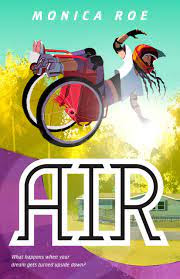
MONICA: It exceeded my hopes in every way. I was also quite surprised and pleased with the amount of input I was given on the cover, especially in the fine-tuning stages of the process. Before any illustrations were made, my editor asked me to make a Pinterest mood board for the team with some images and ideas that captured how I imagined the cover might look, which was a lot of fun.
Mallory Grigg (cover designer) and Oriol Vidal (cover artist) were phenomenal to work with. They were extremely responsive to the input I offered on early versions of the cover and ultimately captured the energy, ethos, and place of the story in a pitch-perfect way. I couldn't have been more delighted or grateful for their amazing skill and vision.
CAROL: Why bees?
MONICA: My husband and I have kept bees for about ten years now-- just a small apiary next to the Congaree Swamp. We've kept as many as 24 hives and as few as 2, depending upon the year and what else we've got going on. These days, since we divide our time between Alaska and South Carolina, we only have a handful of active hives and are fortunate to have family nearby who help care for the bees when we're not around.
CAROL: Why Alaska?
MONICA: I wanted to create a character who lived far away from Emmie, yet became an unexpected confidant and mentor. Alaska seemed a logical choice--it seems to have a bit of a mystique, particularly among those who've not experienced it firsthand, and I thought that a fiesty, independent grandma who lived life her way on a tiny Alaskan island would be someone Emmie would find fascinating--and perhaps a potential role model in some ways.


