Showing posts with label Plotter vs. panster. Show all posts

Thursday, January 13, 2022

INTERVIEW WITH MONICA ROE, AUTHOR OF AIR, and a GIVEAWAY- PART II

 In my last post I shared Monica Roe's debut middle grade novel, Air.  Today you're going to hear why Monica was uniquely prepared to write this book, her path to publication, and why bees and Alaska each have special roles.

In the author note at the end of Air, Monica relates that in her job as a pediatric physical therapist, she looks at what physically disabled children can do--with or without help. Once she was asked to help determine if a junior high student needed a one-on-one aide. Once you read Air, you'll see how coming alongside of that student and evaluating what he could do and what the school needed to provide, helped provide the framework for Air.

AUTHOR INTERVIEW

CAROL: How long did you think about this idea before you started writing Air? 


MONICA: I'm a bit of a squirrel when it comes to ideas. I grab onto bits and pieces (often quite randomly) and sort of burrow them away for later. I originally started thinking about the first bits of the story back in 2014. Other glimmers and scraps came to me for a few years after that, including the experiences I recounted in the author's note.  

CAROL: I’m curious—are you a plotter or pantster? Mostly I want to know if you “saw” the story pretty quickly because of working with that student, or did the idea evolve. If it evolved—how long was your brainstorming process?


MONICA: I have to write from a plot outline, I've learned, or else I find myself endlessly writing myself into corners and dead ends. But the bits-and-scraps of idea collecting that I do beforehand generally takes quite a long time---I might jot down notes for months (or years) before I ever sit down to write that first outline.  


CAROL: The ending is brilliant and unexpected. Without giving away the ending, did you know what it was when you started, or did that evolve also?


MONICA: Thank you! The ending actually evolved rather unexpectedly to me, as well. I honestly can't remember when or how it came about, but I was pleasantly surprised when it did. I think that nailing down the title helped a bit--as I wrote and revised, it become a sort of repeating motif of sorts, which led me to all sorts of fun little moments of connection that I hadn't expected. 


I can only chalk it up to the magic that can sometimes happen when we as writers really let ourselves trust the process--and our subconscious. 


CAROL: How long did it take to write?


MONCA: I honestly don't remember how long the actual writing process was. I know that I drafted the last half of the book fairly quickly (over three very intense weeks). But the initial outline and the first half of the draft took a lot longer, I think. 


CAROL: How did you find your agent? 


MONICA: I'd spent some time in the query trenches back in 2015-2016 with another novel and promptly racked up an impressive stack of close to 50 rejections. Jacqui and I met at VCFA and had been in workshop sessions together while there. We knew one another's writing and had traded pages here and there after graduating. We reconnected after she began agenting and she reached out to me when she was building her client list. I was very, very lucky. It was one of those lightning-strikes moments I least expected.  


CAROL: From PW, it seems as if the book is getting published in about a year, which is incredible! Is that true?


MONICA: The pandemic played a bit of havoc with that timeline. I think the book sold back in May 2020 and it was originally slated for a Fall 2021 release. COVID ended up pushing that back to Winter 2022, which ended up being a good thing. As an added bonus, Air is now launching on the ides of March, which is fun.  


CAROL: Can you tell us anything about signing with FS&G?


It was a pre-empt--the editor who initially offered asked my agent and me if we'd put a brief hold on considering any other pending offers to allow a window for some negotiating. We were pleased with what FSG came back with and were thrilled and grateful to sign with them. 


MONICA: What helped you most in writing this book?


I suppose this book really arose fairly organically over time, drawing upon various facets of my professional and personal life, my research and advocacy interests, my own rural background, and--at the end of the day--just the plain old desire to write a story about an ordinary kid full of big dreams and determination who wants to do things in her own time on her own terms.  


CAROL: How did you nail Emmie’s voice? 


MONICA: I'm very much a character-driven author (which is why I have to force myself to work so hard on plot!). Quite often, it's a character's voice that comes to me first--long before I have any inkling of a storyline or other more concrete details. It usually comes to me fairly unbidden and I'm often surprised by what my characters have to say and how they say it. I was born and raised in a very rural and working-class community, so rural voices are often the ones that I hear most clearly in many of my characters. 


CAROL: You obviously have the credentials to write this book. But have you wondered/worried if anyone would question you writing it since you’re not disabled?


MONICA: Worried, no. Rather, I'd say that I feel a great responsibility to do this particular story justice. Air takes aim at a lot of tropes, stereotypes, and assumptions that still exist far too widely regarding disability and those who identify as disabled--most of which I've encountered or observed firsthand either in society at large or in my own professional career, research/advocacy, and personal life. I do absolutely feel the gravity of my choice of POV character and I both expect and hope for all the questions and feedback as to why I chose to write Emmie as I did. There are many, many identities and backgrounds which I would never consider myself equipped or appropriate to write and I feel strongly that we as writers must fully embrace and thoughtfully consider the question of which stories we are best (or not) equipped to tell. (Also, any day I get to talk about the social model of disability is a good day, as far as I'm concerned!). 


I am very grateful to the two excellent authenticity readers who read the manuscript with a specific eye to my portrayal of Emmie and provided thoughtful and insightful feedback. 


I think that sometimes there's a default assumption that all help is helpful as long as intentions are "good." But plenty of clear feedback from within the disability community begs to differ. At its heart, Air is a story about community and accessibility--and how hard it can be to change longstanding assumptions, especially within one's own largely loving community, and how hard it can be to speak up for oneself in the face of well-intentioned ableism. I knew from the start that the main character was a young girl and aspiring athlete who comes to realize that her school's lack of architectural accessibility--and her community's assumptions about her abilities--have actually (if unintentionally) led to her being held to a higher level of scrutiny than her peers. And then she takes action to help them see that! Had I told that story from the point of view of a character who didn't ride on wheels (and therefore wasn't the one directly affected by the school's policies), I think the story would have risked cutting far too close to saviour-ish territory, which I absolutely did not want. It was very important to me that Emmie be the one to both face this unjust (and unfortunately all-too-common) situation--and also that she be the one who gains the agency and the assertiveness to be the change-maker (as opposed to having someone else come in and do it for her). 


CAROL: What type of research did you do?


MONICA: I did do a fair amount of research on WCMX, since I--sadly!--do not share either Emmie's athleticism or her passion to become involved in that particular sport. I also brushed up on some of the finer details of the historical timeline of the disability rights movement in the United States, particularly the 504 sit-ins. 


CAROL: What did you think of the cover?
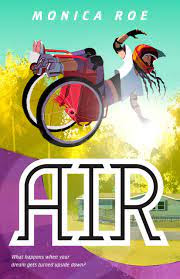


MONICA:  It exceeded my hopes in every way. I was also quite surprised and pleased with the amount of input I was given on the cover, especially in the fine-tuning stages of the process. Before any illustrations were made, my editor asked me to make a Pinterest mood board for the team with some images and ideas that captured how I imagined the cover might look, which was a lot of fun. 


Mallory Grigg (cover designer) and Oriol Vidal (cover artist) were phenomenal to work with. They were extremely responsive to the input I offered on early versions of the cover and ultimately captured the energy, ethos, and place of the story in a pitch-perfect way. I couldn't have been more delighted or grateful for their amazing skill and vision. 


CAROL: Why bees?


MONICA: My husband and I have kept bees for about ten years now-- just a small apiary next to the Congaree Swamp. We've kept as many as 24 hives and as few as 2, depending upon the year and what else we've got going on. These days, since we divide our time between Alaska and South Carolina, we only have a handful of active hives and are fortunate to have family nearby who help care for the bees when we're not around. 


CAROL: Why Alaska?


MONICA: I wanted to create a character who lived far away from Emmie, yet became an unexpected confidant and mentor. Alaska seemed a logical choice--it seems to have a bit of a mystique, particularly among those who've not experienced it firsthand, and I thought that a fiesty, independent grandma who lived life her way on a tiny Alaskan island would be someone Emmie would find fascinating--and perhaps a potential role model in some ways. 


GIVEAWAY 

You have THREE chances to enter this giveaway. Leave a comment here and you get one chance. Leave a comment on the review for a second chance. If you click here and discover how I met Monica and leave a comment there--your name goes in the hat three times! U.S. addresses only. Giveaway ends January 17th at noon. If you don't want to leave your email address, please email me and I'll enter your name. Make sure you leave your name and email address if you are new to my blog!

And if you don't win, I hope you consider purchasing this book for yourself, a young reader in your life, or a library. Pre-orders help authors!

Monday, March 21, 2016

Plotting," Pansting", and the Act of Discovery

Congratulations to Linda Phillips who won WONDER and Mary Jane Nirdlinger  who won ORCHARDS. Thanks to all of you for leaving comments here and in Talking Story. More great giveaways coming up!

In the ongoing conversation about plotter vs. panster I've discovered that I work somewhere in between these two camps. On the one hand, I can't work without an outline next to my computer.


My current 33 page
chapter-by-chapter outline

Perhaps this is because Half-Truths is my first novel. Or maybe it's because it's from 2 POVs and I needed to create character arcs for each girl, plus an arc for their friendship. How in the world could I do that without a road map?

My outlining process two years ago.
(I guess I've come a long way since then...)

Given the state of my brain, I am happiest when I can open Scrivener, consult my outline, and see where I'm supposed to go.
But... in the last few weeks I've discovered the joy of not knowing everything ahead of time. I've been surprised by the things my characters do, say, feel, and remember within the confines of each chapter.

A few months ago I realized that after my daily writing time, I enjoyed reviewing in my mind what I had discovered that day. I started posting these discoveries on Facebook and thought I'd share several of them here--just in case you missed them. 

In no particular order:

http://www.retro-fashion-history.com/html/1948_fashion_and_vintage_clothing.html 
  • Kate's grandmother bought her this tweed suit and hung it in her wardrobe. Kate hates the suit but wears it in order to wheedle something out of her grandmother. (Author's note: I just figured out she was wearing this in the scene I wrote today while I was composing this post!)
  • Lillie represents the New South where women aren't necessarily maids and servants to whites. But as much as her grandmother, Big Momma, supports Lillie's dreams of making something of herself, she is still grounded in the Old South where blacks serve whites and white is right. 
  • "This quilt is soft with washing and at night sometimes I still curl up and hug it to my chest." Kate
https://www.etsy.com/listing/104509779/vintage-ohio-star-quilt-with-blue?utm_source=OpenGraph&utm_medium=PageTools&utm_campaign=Share
  • Kate's first "half-truth" covers up one of Lillie's secrets.
  • Lillie's realization that Kate lives in a family divided by the Civil War.
  • Kate's realization that her father (an engineer in the US Army in Korea) is making money in a job involving killing people. She associates that with Lillie's father, an undertaker, making money off people dying.
  • From Lillie's POV: "The library is quiet. The only sounds are Mr. Dinsmore turning the pages of his paper and tapping his pipe occasionally into the ashtray and Miss Anna Katherine scribbling in her notebook. Every so often she pauses with the pencil by her mouth, looks over at me, smiles, and starts writing again. We’re certainly nowhere near being friends like Big Momma’s frets about. But there’s a thread between us that I think we both feel. Maybe it’s that we both want Eileen to get better. Or, maybe it’s just because we’re both teenage girls. Either way, when I imagine working here without Miss Anna Katherine being around the place, it wouldn’t be the same.
  • When Kate doodles she draws open and closed eyes. 
  • Kate loved hearing The Ugly Duckling read to her and Granddaddy has some half-truths of his own.
"The Ugly Duckling"
The original uploader was LaSylphide at English Wikipedia - Transferred from en.wikipedia to Commons., Public Domain, https://commons.wikimedia.org/w/index.php?curid=401801

This is my FIFTH full draft of Half-Truths and I'm still finding out new things. And you know what? This act of discovery is one of the most fun and rewarding parts of writing. 

At least...until I get a publishing contract! 

For more of my WIP discoveries, friend me at Carol Federlin Baldwin on Facebook. Meanwhile, are you a plotter or panster? Have you found any recent discoveries in your WIP? Please share them in the Comments section. 

Did you ever stop to consider if you are a plotter or panster in "real" life? In this recent blog post by Becky Levine she considers some of the surprises she's discovered in her life as a writer. 

Monday, February 2, 2015

Writing Resources Part III: Panster vs. Plotter and a Giveaway!

Congratulations to Vijaya Bodach who won James Scott Bell's book, The Art of War for Writers.
*******
I recently completed reading, My Brother's Shadow by Monica Schroeder. When I wrote to Monica and asked her if she would share a few nuggets of wisdom for my readers, she sent the following article which first appeared on writingteennovels.com.

It has been said that there are those writers who plan and those who “fly by the seats of their pants.” I am part of the second group and before I began working on my novel, My Brother’s Shadow, I only had a rough idea of who Moritz, the main character, was and what would happen in the story. 

I encountered a surprise in the first few pages. Moritz was telling his story in first person and used the present tense. Hadn’t I read in many books about writing that the first person, present tense point-of-view was difficult to write? My first two novels were told in the voice of third person omniscient narrators reflecting on past events, and I had no intention of changing from what I knew by writing in first person and in present tense.


I rewrote the beginning in past tense but couldn’t force Moritz to tell his story in hindsight, so I stuck to the immediacy of present tense. The story is set in 1918 Berlin. I needed to convey a lot of background information. It seemed such a daunting task to introduce the reader to starvation and despair in Berlin as well as the anticipation of military defeat without the omniscient perspective of third person POV. 

In the first chapter I needed to set the stage, let Moritz introduce himself and his family, and find an intriguing ending to the chapter that would entice readers to go on. Moritz came to my rescue. As an apprentice in a print shop of a Berlin newspaper he could read the headlines of the paper he just helped print and thereby inform the readers of my novel of the state of affairs in Germany in October 1918.  The newspaper became a vehicle to disseminate information about the setting without interrupting the flow of the narrative. Moritz also meets Herr Goldman, a journalist with the paper who takes a liking to Moritz and ultimately helps him to fulfil his dream to become a reporter.  Moritz is able to tell the reader about the most pressing and newsworthy current events through his conversations with Herr Goldman. Apparently there was a way for me to write in first person, present tense and still give the reader a sense of the setting.


About halfway in, the story took an unexpected turn and once again I had trouble letting myself deviate from my original plan. Moritz had met a girl who had completely flummoxed him with her wit. Granted, it was not so unlikely that a 16-year old boy would take an interest in a girl but I had not anticipated a romance.

I had never expected to write about young love. Now here was Rebecca, the smart daughter of a Jewish bookseller who attended the same political meetings as Moritz’s mother and sister. After their first encounter on the train, it was clear that they had to meet again. Yet the book takes place in 1918, so they wouldn’t go “all the way.” I was able to braid his discovery of love together with the story of Moritz’s relationship with his brother, who returns from the trenches a maimed and bitter veteran. Rebecca’s presence even gave me the opportunity for a hopeful conclusion to leave readers satisfied after Moritz’s intense final confrontation with his brother.

Writing My Brother’s Shadow has taught me to trust the process along the way. A quote by E. L. Doctorow showed me that I am not alone with this approach: “Writing is like driving a car at night. You never see further than your headlights, but you can make the whole trip that way.”
Monika with her dog, Frank.
******************
I enjoy hearing other writers describe their journeys and find it interesting to compare them to my own. When I first started Half-Truths I was definitely a panster--I had no idea where I was going or what I was doing. Unlike Monika though, I had several years of false starts and finding my way. Somewhere between the second and third draft I realized I need an outline so that both girls could have their own stories.  Now, I can't operate without one! These roadmaps help me to see where I'm going and how to get there--but I still discover some surprises along the way.

I also experimented with point of view and tense until I settled on two protagonists, each written in first person and present tense. None of these decisions have been easy. 
*****
To win an autographed copy of In My Brother's Shadow please leave me your name along with your email address if you are new to this blog. Let me know some of the difficult decisions you've had to make with your WIP and I'll enter your name twice. Hurry! I'm drawing a name on Thursday, February 5!

THE NIGHT WAR: A MG Historical Novel Review

  By now you should have received an email from my new website about my review of THE NIGHT WAR by Kimberly Brubaker Bradley. (It'll com...