Showing posts with label Monica Roe. Show all posts

Wednesday, April 13, 2022

UNICORNS OF THE SECRET STABLE: Early Chapter Books Review and TALKING STORY


REVIEW OF UNICORNS OF THE SECRET STABLE

I'm joined by my granddaughter, Eleanor Edgar, in this review.


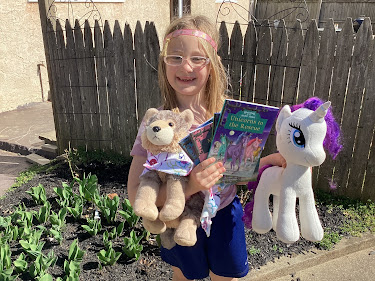
Almost 7-year-old Eleanor, with
her new books, unicorn, and favorite dog. 

It’s been a long time since I’ve read early chapter books. But when my fellow SCBWI-Carolinas friend, Laurie Edwards, reached out to me with the promise of books, how could I say no?

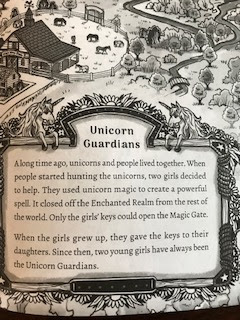
Below you’ll find a review of four of Laurie's newest stories (Books 9-11) in the Unicorn of the Secret Stable series. Each book includes this introduction to the series, so the books can also be read as stand alone books. 

The books are perfect for girl readers who are new to chapter books; they're each around 70 pages. The large font, few words on the page, and occasional illustrations by Jomike Tejido, help readers make the transition from picture books to chapter books. 

The stories are an interesting mix of fantasy and reality. The two protagonists, Iris and her younger sister Ruby, received the key to the Magic Gate from their mother, who no longer remembers the unicorns. She insists that her daughters have active imaginations--which is a wonderful theme within all the stories. 

The author does a good job of differentiating the "real" world from the fantasy world as the characters must unlock a gate and go into the Enchanted Realm to interact with their unicorns. There's a C.S. Lewis feel to the books as the characters go through this portal into an imaginary world. In the "real" world the girls experience modern-day problems and have typical sibling and friend issues. 

Each book ends with three sets of "Think About It" questions that encourage readers to delve more deeply into the story's message. 


UNICORNS TO THE RESCUE

Carol's thoughts: Ruby and her favorite unicorn, Tempest, is gone! Iris is desperate to find her and asks the flying unicorn, Ember Shadow. to help with the search. After a time of worry and distress, Iris finds Ruby imprisoned in a cave. Iris uses her wits and the unicorns' help to engineer her sister's rescue. 


Eleanor’s thoughts: “This story is about a unicorn and a dragon. The unicorn, Lucky, defends the herd of unicorns from a dragon, Spitfire, who flew down and tried to hurt the unicorns.  But he did not hurt him because Lucky scared him by standing on his hind legs and looking like he would fight. In the end they got along well because Spitfire said he was sorry and Lucky forgave him. I loved it!” ❤️❤️❤️

Carol's thoughts: This story had an interesting parallel between the
unicorn story and Ruby's struggles to make a new friend. 


Carol's thoughts: The "real world" problem in this book is a nosy reporter who wants to obtain a unicorn horn.  He says he wants to find out if they have magic healing powers, but the girls don't trust him as he shadows them and tries to get into Magic Moon Stable. They outwit him (of course!) and the end questions reinforce messages of protection and true friendship. 


Carol's thoughts: Ruby is sad when her best friend leaves for summer vacation. Iris encourages her to keep an open mind about their vacation. When the girls meet two new unicorns, they're surprised at the places their new friends take them. They explore the snowy Northlands and discover--of all things--a mermaid and narwhals. 

I wish I had these books when I was a first grader! The interaction of imagination with the characters' "real lives" is clever. I hope many readers stretch their imaginations as they enter into the Enchanted Realm and the adventures that lie there.

Since Eleanor is now enjoying these books, I have three different giveaways for you instead. As promised, the spring issue of Talking Story, is on "How to Empower Disability Through Kid's Lit." Here's another chance to win Monica Roe's book, AIR; A.B. Donahue's book, NO CLUES YOU LOSE; and a picture book illustrated by SCBWI-Carolina's own Vanessa Brantley Newton, MY THREE BEST FRIENDS and ME, ZULAY. Giveaway ends April 16,--Make sure you leave a comment through the email address in the newsletter. 

Congratulations to Theresa Milstein who won a copy of No Clues You Lose from my last blog. 

Thursday, January 13, 2022

INTERVIEW WITH MONICA ROE, AUTHOR OF AIR, and a GIVEAWAY- PART II

 In my last post I shared Monica Roe's debut middle grade novel, Air.  Today you're going to hear why Monica was uniquely prepared to write this book, her path to publication, and why bees and Alaska each have special roles.

In the author note at the end of Air, Monica relates that in her job as a pediatric physical therapist, she looks at what physically disabled children can do--with or without help. Once she was asked to help determine if a junior high student needed a one-on-one aide. Once you read Air, you'll see how coming alongside of that student and evaluating what he could do and what the school needed to provide, helped provide the framework for Air.

AUTHOR INTERVIEW

CAROL: How long did you think about this idea before you started writing Air? 


MONICA: I'm a bit of a squirrel when it comes to ideas. I grab onto bits and pieces (often quite randomly) and sort of burrow them away for later. I originally started thinking about the first bits of the story back in 2014. Other glimmers and scraps came to me for a few years after that, including the experiences I recounted in the author's note.  

CAROL: I’m curious—are you a plotter or pantster? Mostly I want to know if you “saw” the story pretty quickly because of working with that student, or did the idea evolve. If it evolved—how long was your brainstorming process?


MONICA: I have to write from a plot outline, I've learned, or else I find myself endlessly writing myself into corners and dead ends. But the bits-and-scraps of idea collecting that I do beforehand generally takes quite a long time---I might jot down notes for months (or years) before I ever sit down to write that first outline.  


CAROL: The ending is brilliant and unexpected. Without giving away the ending, did you know what it was when you started, or did that evolve also?


MONICA: Thank you! The ending actually evolved rather unexpectedly to me, as well. I honestly can't remember when or how it came about, but I was pleasantly surprised when it did. I think that nailing down the title helped a bit--as I wrote and revised, it become a sort of repeating motif of sorts, which led me to all sorts of fun little moments of connection that I hadn't expected. 


I can only chalk it up to the magic that can sometimes happen when we as writers really let ourselves trust the process--and our subconscious. 


CAROL: How long did it take to write?


MONCA: I honestly don't remember how long the actual writing process was. I know that I drafted the last half of the book fairly quickly (over three very intense weeks). But the initial outline and the first half of the draft took a lot longer, I think. 


CAROL: How did you find your agent? 


MONICA: I'd spent some time in the query trenches back in 2015-2016 with another novel and promptly racked up an impressive stack of close to 50 rejections. Jacqui and I met at VCFA and had been in workshop sessions together while there. We knew one another's writing and had traded pages here and there after graduating. We reconnected after she began agenting and she reached out to me when she was building her client list. I was very, very lucky. It was one of those lightning-strikes moments I least expected.  


CAROL: From PW, it seems as if the book is getting published in about a year, which is incredible! Is that true?


MONICA: The pandemic played a bit of havoc with that timeline. I think the book sold back in May 2020 and it was originally slated for a Fall 2021 release. COVID ended up pushing that back to Winter 2022, which ended up being a good thing. As an added bonus, Air is now launching on the ides of March, which is fun.  


CAROL: Can you tell us anything about signing with FS&G?


It was a pre-empt--the editor who initially offered asked my agent and me if we'd put a brief hold on considering any other pending offers to allow a window for some negotiating. We were pleased with what FSG came back with and were thrilled and grateful to sign with them. 


MONICA: What helped you most in writing this book?


I suppose this book really arose fairly organically over time, drawing upon various facets of my professional and personal life, my research and advocacy interests, my own rural background, and--at the end of the day--just the plain old desire to write a story about an ordinary kid full of big dreams and determination who wants to do things in her own time on her own terms.  


CAROL: How did you nail Emmie’s voice? 


MONICA: I'm very much a character-driven author (which is why I have to force myself to work so hard on plot!). Quite often, it's a character's voice that comes to me first--long before I have any inkling of a storyline or other more concrete details. It usually comes to me fairly unbidden and I'm often surprised by what my characters have to say and how they say it. I was born and raised in a very rural and working-class community, so rural voices are often the ones that I hear most clearly in many of my characters. 


CAROL: You obviously have the credentials to write this book. But have you wondered/worried if anyone would question you writing it since you’re not disabled?


MONICA: Worried, no. Rather, I'd say that I feel a great responsibility to do this particular story justice. Air takes aim at a lot of tropes, stereotypes, and assumptions that still exist far too widely regarding disability and those who identify as disabled--most of which I've encountered or observed firsthand either in society at large or in my own professional career, research/advocacy, and personal life. I do absolutely feel the gravity of my choice of POV character and I both expect and hope for all the questions and feedback as to why I chose to write Emmie as I did. There are many, many identities and backgrounds which I would never consider myself equipped or appropriate to write and I feel strongly that we as writers must fully embrace and thoughtfully consider the question of which stories we are best (or not) equipped to tell. (Also, any day I get to talk about the social model of disability is a good day, as far as I'm concerned!). 


I am very grateful to the two excellent authenticity readers who read the manuscript with a specific eye to my portrayal of Emmie and provided thoughtful and insightful feedback. 


I think that sometimes there's a default assumption that all help is helpful as long as intentions are "good." But plenty of clear feedback from within the disability community begs to differ. At its heart, Air is a story about community and accessibility--and how hard it can be to change longstanding assumptions, especially within one's own largely loving community, and how hard it can be to speak up for oneself in the face of well-intentioned ableism. I knew from the start that the main character was a young girl and aspiring athlete who comes to realize that her school's lack of architectural accessibility--and her community's assumptions about her abilities--have actually (if unintentionally) led to her being held to a higher level of scrutiny than her peers. And then she takes action to help them see that! Had I told that story from the point of view of a character who didn't ride on wheels (and therefore wasn't the one directly affected by the school's policies), I think the story would have risked cutting far too close to saviour-ish territory, which I absolutely did not want. It was very important to me that Emmie be the one to both face this unjust (and unfortunately all-too-common) situation--and also that she be the one who gains the agency and the assertiveness to be the change-maker (as opposed to having someone else come in and do it for her). 


CAROL: What type of research did you do?


MONICA: I did do a fair amount of research on WCMX, since I--sadly!--do not share either Emmie's athleticism or her passion to become involved in that particular sport. I also brushed up on some of the finer details of the historical timeline of the disability rights movement in the United States, particularly the 504 sit-ins. 


CAROL: What did you think of the cover?


MONICA:  It exceeded my hopes in every way. I was also quite surprised and pleased with the amount of input I was given on the cover, especially in the fine-tuning stages of the process. Before any illustrations were made, my editor asked me to make a Pinterest mood board for the team with some images and ideas that captured how I imagined the cover might look, which was a lot of fun. 


Mallory Grigg (cover designer) and Oriol Vidal (cover artist) were phenomenal to work with. They were extremely responsive to the input I offered on early versions of the cover and ultimately captured the energy, ethos, and place of the story in a pitch-perfect way. I couldn't have been more delighted or grateful for their amazing skill and vision. 


CAROL: Why bees?


MONICA: My husband and I have kept bees for about ten years now-- just a small apiary next to the Congaree Swamp. We've kept as many as 24 hives and as few as 2, depending upon the year and what else we've got going on. These days, since we divide our time between Alaska and South Carolina, we only have a handful of active hives and are fortunate to have family nearby who help care for the bees when we're not around. 


CAROL: Why Alaska?


MONICA: I wanted to create a character who lived far away from Emmie, yet became an unexpected confidant and mentor. Alaska seemed a logical choice--it seems to have a bit of a mystique, particularly among those who've not experienced it firsthand, and I thought that a fiesty, independent grandma who lived life her way on a tiny Alaskan island would be someone Emmie would find fascinating--and perhaps a potential role model in some ways. 


GIVEAWAY 

You have THREE chances to enter this giveaway. Leave a comment here and you get one chance. Leave a comment on the review for a second chance. If you click here and discover how I met Monica and leave a comment there--your name goes in the hat three times! U.S. addresses only. Giveaway ends January 17th at noon. If you don't want to leave your email address, please email me and I'll enter your name. Make sure you leave your name and email address if you are new to my blog!

And if you don't win, I hope you consider purchasing this book for yourself, a young reader in your life, or a library. Pre-orders help authors!

Sunday, January 9, 2022

AIR: A MIDDLE GRADE REVIEW AND GIVEAWAY-- PART I

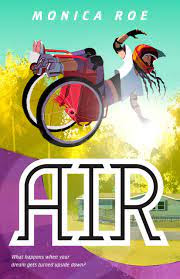
I am thrilled to share with you my friend Monica Roe's, upcoming novel, Air (Farrar Straus Giroux Books for Young Readers, March 15, 2022). Today you are going to hear about a book that her publisher describes as,
"a smart, energetic middle grade debut about thinking big, working hard, and taking flight."

On Thursday you'll get a glimpse behind the scenes in my interview with Monica. She'll share the book's backstory and her road to publication.

But for now, sit back and enjoy hearing about a book that I hope, will fly off the bookshelves.


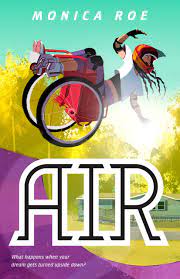
                                    (Is this an amazing cover, or what?)

REVIEW

From the second page of this book for boys and girls, the reader hears voice, courage, and a good dose of Southern chutzpah, and a touch of sadness. The main character, Emmie, and her best friend, Ale, are setting her up for a launch off of the wheelchair ramp her father built.  As they prepare she thinks, 

"We [her father and her] used to be out here together, instead of me having to sneak around." 

I read that sentence and thought, "What happened to change things?" 
What a great way to insert backstory to make the reader keep going! 

The internalization continues:

I pull on my padded gloves, bring my front wheels to the edge, and breathe. The view from the top of a drop--even a basic one like this--gets me going every time. Those tadpoles swimming in my chest and the sweat on my palms are the best kind of rush. Now that added jump waiting at the bottom makes my guts fizz like I ate a handful of live bees and chased them with a bottle of Coke.

Right. Let's do this. (p. 4)

A few pages later the chapter ends with:

I'm Emelyn Ethridge. I'm twelve-and-a-half years old. Alejandra Che is my best friend.

I like Flamain' Hot Cheetos.

And I love speed. (p.8)


As a reader, I'm hooked. And I won't let go until I find out what this daring young wheelchair athlete is going to do.

As speedy as Emmie herself, this book moves. The author doesn't take much space on the page to let the reader know, "Baby Emmie's spinal cord left the factory with a design glitch." Her parents "never let me get away with acting like I was some miracle for getting out of bed...They put me on wheels, had me popping curbs by the time I was six." (p. 19-20)

Early on the reader discovers that her mom recently died and her father  has changed--he doesn't seem to believe in her anymore. "He was my biggest cheerleader--my partner in high-speed mischief. Since Mom's been gone, he's so...different. Cautious. Scared even. (p. 22) Her father's work, night classes, and overtime hours don't give them the time together she wants. 

I admire the way in which Monica uses deep point-of-view to show who Emmie is and what she wants. For example, when she witnesses an argument between her father and Nonny, her maternal grandmother, she thinks:
Sometimes I think it's too bad Dad and Nonny don't have wheels, too. Moving fast is the best way I know to keep ahead of feelings you'd rather shake off. (p. 34)

When she dresses up and attends a fairy festival with Ale, she observes:
Nobody's paying us any mind. One thing I love about the festival is that pretty much nobody pays attention to my chair. It's almost like it's a part of my costume--like those people riding in the wooden troll wagon or bounding around on their spring-loaded stilts while telling fortunes. Everyone blends right in. (p. 101)
Without knocking the reader over the head and telling her that Emmie wants to be treated like a kid--not a person with a disability--Monica shows it. This theme is deeply embedded in Air and is crucial to the ending which I didn't foresee. Afterwards, I realized it is a perfect conclusion to a story where the character reaches both her internal and external goals. 

In addition to a well-developed character, Monica includes some terrific secondary characters who contribute mightily to the plot. There's a budding romance with a cute, rodeo "prince" (with all the miscommunication that comes with a first-time crush); an annoying aide who is assigned to Emmie but who proves her worth as a friend; and a spit-firing Alaskan Granny who orders custom wheelchair bags from Emmie.  (I forgot to tell you--Emmie and Ale have an online shop to raise money: Emmie craves a high-end, multi-link-suspension stunt chair and Ale is working towards getting a new hive. They sell bags that Emmie sews and natural stuff which they salvage from the South Carolina scrub between their houses).

Did I love this book? Guess that's obvious. Am I going to study it to see how Monica portrayed Emmie's voice so well? You bet.

Come back on Thursday and find out more about Monica and why she was in a unique position to write about a young person with a disability and why bees and Alaska found a perfect place in the world of Air. 

GIVEAWAY

You have THREE chances to enter this giveaway. Leave a comment here and you get one chance. Leave a comment on Thursday's author interview with Monica and you get a second chance. If you click here and discover how I met Monica and leave a comment there--your name goes in the hat three times! U.S. addresses only. Giveaway ends January 17th at 6PM. If you don't want to leave your email address, please email me and I'll enter your name. Make sure you leave your name and email address if you are new to my blog!

And if you don't win, I hope you consider purchasing this book for yourself, a young reader in your life, or a library. Pre-orders help authors!
Congratulations to Danielle Hammelef who won SEEKING FREEDOM. 


Monday, February 12, 2018

Four Writers and Four Writing Stages-- Part I

I recently hung out with three other writers for several days of writing, critiquing, eating chocolate and yummy food. (What is it about writers who must have the latter two to validate the first two?) Since each of us was at a different place in our manuscript, I thought it would be interesting to share a few of the stages writers go through when writing a novel. 

I asked each writer to describe the present draft, how long she has been working on her novel, what the previous draft looked like, and what she was expecting to do next. I'm sharing two writers' stories this week and two next week. 


BARBARA CHARLES


I would consider this to be my third draft. The first two drafts were different POV’s. I finally decided on John’s POV in the first person. It seems to be working better for the story.

I have been working on this book for about five years (off and on). My goal is to get John’s story about his pirating days out to the many adventurous readers out there.

I had two previous drafts that were just not working – the story was flat and the characters lacked motivation. When I switched to John’s first person POV, this breathed new life into an otherwise “blah” manuscript.

I continue to delve into John’s motivations and deepen his character. John and the runaway slave will set aside their differences later in the story.

Here is the pitch and a snippet from Barbara's book:

In "The Brotherhood of Pirates," young John King sets sail on a journey that will forever change his life. Set in 1716 and based on true events, when John's ship is attacked by pirates, he is compelled to run away with them and live the pirate's life.


Brotherhood of Pirates
November, 1716 

What ten year old boy wants to travel with his mother? Not me. But what did it matter now? I am already sailing on the Bonetta with her and have been for several weeks. This is the final leg of our journey as we head home to Antigua. 

“John King! Get down from there right this instant!” 

“Yes, Mother.” I jumped down from my perch, a rickety brown crate, and dutifully stood beside her. Her lips were moving but I paid her no mind. All I heard was endless chatter, the kind that could give a lad quite the headache. 

“Stand right here,” she said, pointing to an imaginary line on the deck. “I will return momentarily.” She adjusted her sunhat with one of her white-gloved hands and wagged the finger of her free hand in my direction as a warning. She walked away, her high heels clippety-clopping on the deck, like horse hooves on cobblestone.

Barbara lives in Hickory, NC and works with her husband in their two businesses. She enjoys writing in her spare time and is anxious to send Brotherhood of Pirates out into the world of readers looking for new adventures.

 MONICA ROE


I'm on the home stretch of what I call the first hard revision. I'm working to fill in the plot holes, timeline gaps, and overall inconsistencies that I try not to get too distracted by when I'm pushing to get a rough draft onto the page. The hard revision takes me awhile--I've been working on this one for almost three months and I still have about 38 pages to tackle. It's also a tougher draft, in many ways than the rough--because I have to go back and actually make all the big, creative leaps of the rough draft fit into a reasonable plot and narrative framework. But once this pass is complete, revisions become much more joyful and manageable. 

I let an idea roll around and compost in my brain for awhile before actually putting my fingers on the keyboard. So I'd say the initial idea occurred to me about a year and a half ago. I really got started on rough drafting almost exactly a year ago. The start-to-finish rough draft took me from September--late November of 2017 and I've been in revisions ever since. 

First drafts, in my opinion, are pretty much always awful--or at least mine are. This may not be the case for more skilled writers! The challenge, I think, is to give yourself the freedom to not get too distracted by first-draft crumminess. You're just laying the track at the point for better things to come in subsequent drafts. 

I hope to push through the rest of the hard revision in about 1-2 weeks. Then the manuscript will go out to 2-3 of my regular critique partners. Once I receive and incorporate their feedback into another 1-2 (much lighter) revision passes, I will seek out someone who hasn't read any of my early drafts or heard anything about the story. Fresh eyes are very important at this stage of the revision. I work with several trusted critique partners, who know my work well and have offered invaluable thoughts and feedback on all stages of the draft. When I (and they) feel like the manuscript is getting close, that's the time to find a reader who hasn't heard a thing about the story. 

Originally from upstate New York, Monica now lives in central South Carolina, where she, her family, and their honeybees own and operate Old Swamp Apiary. When she isn't beekeeping, Monica travels between the Alaskan bush and southern Belize as a physical therapist. Her first novel, Thaw, was published by Front Street Books and was a Cybils finalist. 

**********
Those of you who are writers know that it seems as if there are an infinite amount of drafts and revisions before reaching "The End." What stage are you in? Brainstorming? Outlining? A messy first draft or a final-before-I-send-it-out-into-the-world draft? Are you querying agents? I'd like to hear your comments--and maybe I'll incorporate your answers into a future blog!

THE NIGHT WAR: A MG Historical Novel Review

  By now you should have received an email from my new website about my review of THE NIGHT WAR by Kimberly Brubaker Bradley. (It'll com...