Showing posts with label Vermelle Diamond Ely. Show all posts

Tuesday, December 21, 2021

Revision Revisited

 If you're a writer, then someone has probably said to you: "So, are you done with your book yet?" If the person who you are talking to loves you then he may say, "How's the book coming along?" Which is a softer, kinder way of saying the same thing. 

Either way, most people who are not in the writing/publishing world have NO idea how much writing and re-writing goes into creating a book. And either way, you'll feel a little defensive as you try to explain why it's taken years to create a finished product.

REVISION BLOGS

Revision happens on so many levels. There are drafts when a writer is just getting the story out. There are big picture revisions when a writer has to re-vision her entire novel. And then of course, there are a host of "minor" revisions to make your characters and story authentic.
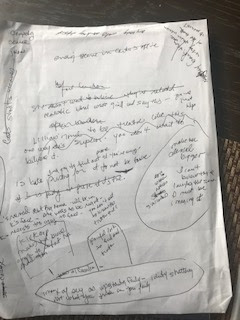

A page of side notes on Kate's character development.

I've blogged about the revision process several times. Here is one from the Free Expressions workshop I took ten years ago. And here is a blog with Harold Underdown's advice on not submitting until your work is ready. Mary Jane Nirdlinger wrote an excellent post about revision for the SCBWI-Carolinas region. I highly recommend it.

TRUE CONFESSION

I started Half-Truths over 15 years ago. I knew I could write, but I'd never written a novel AND I took on a topic that was much bigger (and more difficult to write) than I realized.  Here is the updated blurb for my middle grade book:

In the Jim Crow south, thirteen-year-old Kate Dinsmore meets two people who challenge her world view: a small-town newspaper editor determined to stop the KKK and a young Black maid who proves to be her second cousin. Told through narrative, letters, newspaper headlines, and poetry, Kate comes to grips with her identity, decides what she will stand for, and takes risks to become a journalist who will make a difference. 

Although I imagined the girls' relationship since the book's inception, I went off in many different directions as I wrestled with writing the book. Rebecca Petruck, one of my early critiquers, kept encouraging me to return to that relationship--even when I included murders, boyfriends, and information about the Korean war. (Did I say this was my first novel?)

Joyce Hostetter, a wonderful historical middle grade author has been my mentor throughout the process. Under her guidance, I researched widely and found tremendous experts who informed my knowledge of the time period and the plot. I visited places on the Charlotte African American tour. I talked to people who went to the same high school as my characters, Meet My Experts III- Vermelle Diamond Ely and Meet my Experts

In 2016 I sent the manuscript to beta readers (check out the picture of of my technique for plotting my book). I incorporated their feedback and kept on going. Along the way I received editorial advice to write the book from both girls' POV's. I was reluctant to do that since I'm white, but Rebecca encouraged me in that direction. By the time I was ready to submit that version, the publishing industry had changed and that was no longer an option. In 2017 I made the difficult decision to start over from Kate's POV.

It was hard to give up all the work I had done to write Lillian's story, but it was the right decision. I re-outlined the book and started a new version focusing on Kate's journey. In doing that, I still went off on too many rabbit trails! 

Finally, last year (based on Joyce's encouragement) I took Kathy Temean's whole novel workshop. I received excellent feedback from three peers, incorporated their suggestions, and then sent it to an agent who read the entire 78,000 word manuscript.

The agent's insightful feedback provided a TON of things to work on--including deciding if this is a middle grade or young adult book. Ittook several months to incorporate her suggestions--including showing more of Kate's life before she moves to Charlotte. After re-writing the beginning, I realized that I had painted an overly optimistic ending and that needed changing! I decided the book needed to stretch out over an entire year and that required rearranging chapters.

Yesterday, I reached another milestone. I sent the revised 64,000 word manuscript to Joyce. She will go through it with a fine-tooth comb and I will revise it again.

And only after that--will I send it out.

So, that is why this book has taken me so long to write!
https://www.123rf.com/photo_128021414_word-writing-text-revision-business-photo-showcasing-action-of-revising-over-someone-like-auditing-o.html

Yesterday I texted Kathryn Frye, a Charlotte videographer who produced and directed the documentary, African American Album: Charlotte, NC Mecklenburg History.  She and Vermelle Ely, have been cheering for my book ever since I met them. I told her I feel that it's risky for a white woman to write about race, She responded: 

"It’s a great story from its creator, no matter what shade of human she is! We have always been fully confident that we will hold the book one day."

HOW ABOUT YOU?

Do you have a revision story? Please share in the comments!                                                       

Congratulations to Terri Michels for winning Janine Yordy's book, Jellyfish Wishes and Poems About Fishes. After entering my giveaways many times, she finally won!

ON A PERSONAL NOTE

I have grandchildren coming to visit so I'll be taking a short holiday from blogging. But I'll be back in your inbox soon!

Tuesday, April 11, 2017

Meet My Experts III- Vermelle Diamond Ely

Congratulations to Joyce Hostetter who won the autographed copy of Darlene Jacobson's book, WHEELS OF CHANGE.

As promised several weeks ago, I want to share more about Vermelle Ely, one of my generous experts for Half-Truths, my WIP which takes place in Charlotte, NC in 1950.
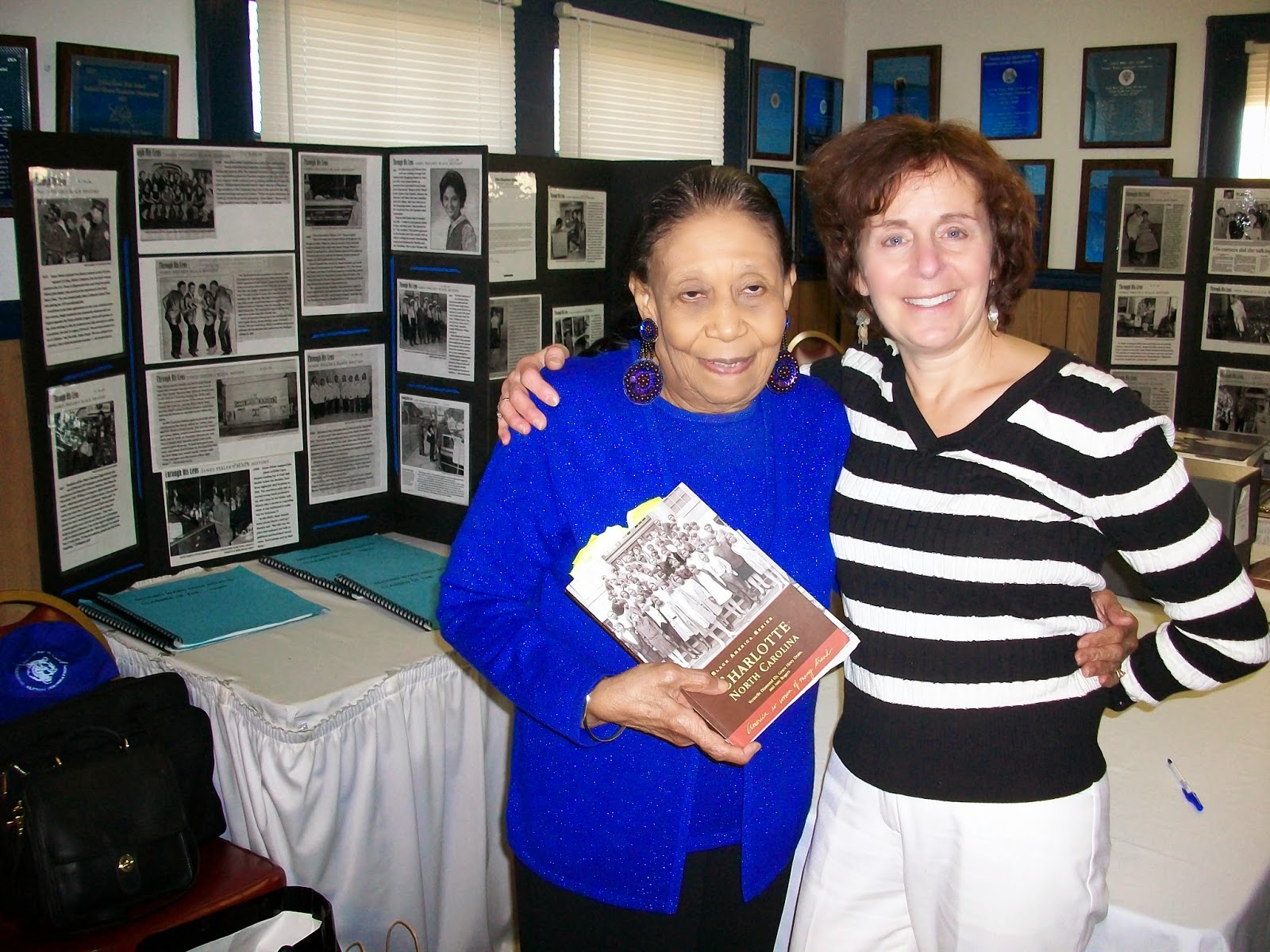
Vermelle and I in her Charlotte, NC home
March, 2017

As anyone who writes historical fiction knows, you can't use every detail you glean from your interviews--no matter how delicious it is. In no particular order, here are some of the snippets I learned from Vermelle which have informed Half-Truths. 
  • In the late 40's and early 50's, a light-skinned African American girl was treated like a queen. If her hair was long and fair, she was even more special.
  • Sometimes people passed for convenience: to go out to eat, get their hair done, get waited on, or to move up to the front of line. Kids at the time might think, "In the movies no one would know know if you’re white or black.  Let’s see if we can do it just for fun."
  • Vermelle commented on my two characters that, "Lillie could have gone anywhere with Kate because she was so light. But Kate would have stuck out in the black community. She would have been accepted, but the police would have questioned her."


I found these posters at Vermelle's house and
photographed them. They were taken in 1968 to commemorate
the Queen City classic rivalry between
Second Ward and West Charlotte High

  • According to Vermelle, the girls would have been too scared to go to the movies or library together, but they may have talked on the phone. 
  • About 100 students who attended Second Ward lived in Biddleville and it took them 30 minutes to walk to school, including going through a cow pasture near Thompson orphanage
  • "We didn’t know, 'separate but equal.' We heard our parents talk about it though. We got all the hand me downs from the white schools. Books would have so many names in them, you couldn’t even put your name in it and the backs were off. We got stuff from Central High and inherited blue and white because that was their school colors."
  • Vermelle’s great-grandfather was from England and her great-grandmother was native American. When her maternal grandmother and grandfather died, the family went to Wilson, NC for the funeral.  She discovered that her great-grandfather  was buried in the white cemetery and her great-grandmother was buried in the black cemetery. “I was grown before I knew it. Nobody talked about race. My mother said her mother’s family was very fair and her father marched in the Elks parade."

Vermelle as Miss Queen City Classic in 1948
  • Vermelle remembered that the black WACS in WWII had to go up the backstairs of Montaldo's (a very expensive department store in downtown Charlotte) to try on their uniforms. 
********
Vermelle has struggled with poor eyesight for years and can no longer read printed material. Recently I read several chapters to her. You can imagine how pleased I was when she nodded and agreed with my descriptions and the characters' interactions. Sharp as ever, she made comments on what was true to life and what wasn't. Happily, she didn't find much that was inaccurate. 

I am indebted to Vermelle and my other experts, who have shared their life stories so that my story is more authentic. 


Tuesday, June 24, 2014

Meet My Experts--Part I

As promised, today you're going to meet four women I have interviewed in the process of writing Half-Truths. I hope you'll enjoy a glimpse at their lives--"back in the day"-- and a few of their insights which have contributed to my book.

Thereasea Elder

T.D.'s Truths by Stanley and Janice Frazier
In 1962, Thereasea was one of the first black public health nurses to 
integrate the white nursing community in Charlotte.


Thereasea as an Army Cadet
in WWII

At JCU's exhibit honoring the African Americans who 
integrated the medical profession in Charlotte. 
June, 2014

Thereasea has given me hours of her time answering innumerable questions about her community growing up, what it was like going into a KKK community as a black nurse, and the challenges which Lillie and Kate (my characters in Half-Truths) could conceivably face. One day when we were talking about race she said, "None of us were the same color. 'If you’re black get back, if you're brown stick around, if you’re light and bright you’re damn near white.' This wasn't said in our home, but it was said the streets. Even though everyone was brown and knew in general what that meant – that white blood was there—the specifics wouldn’t have been shared."


Vermelle Diamond Ely


Vermelle Diamond as Miss Queen City Classic
1948

Vermelle and I at the Second Ward High School
Alumni House, 2010

Although she has been legally blind for all her life, Vermelle is co-author of the book, Charlotte, NC which is part of the Black America Series. When we talked about passing she told me, "Black girls who passed did it for their convenience. To get their hair done, go to the front of the line, get waited on, or go to eat in a certain restaurant. Their parents wouldn't have encouraged them." Speaking of my characters she said, "Lillie and Kate might have tried to see if Lillie could pass--just for fun and to see if she could get away from it." And for the record, "Lillie could have gone wherever she wanted with Kate because she was so light she could pass. Kate would have stuck out in the black community-but she would have been accepted there."


Daisy Stroud
Daisy and Gerson Stroud wedding
Circa 1948 


Outside their home
Circa late 1950's-mid 1960's


Daisy Stroud
December 2010

Daisy talked about the Cherry neighborhood (where Lillie lives): "There was a lot of pride there. They were the strivers who made sure their children had the opportunity to go to college." She remembered Bishop Daddy Grace: "He had beautiful light-skinned girls fanning him when he sat on his throne. It was an honor to be one of his girls; they were attractive and had good hair. They looked more like they were a different race." Similarly, "Young women who represented Second Ward High School were light-skinned….They were the privileged ones…We accepted in our race that some were like this. Then we would try to be like them because their beauty brought them privileges."
 
Dorothy Counts-Scoggins

In 1957, Dorothy Counts was one of the first black
students admitted to Harding High School in Charlotte.

She was met with jeers

and harassment. Her parents withdrew her
after four days. 


Photo taken at Johnson C. Smith University
where Dorothy grew up. 

June 2014
"I wanted to make sure that what happened to me at age 15 growing up in this community wouldn't happen to someone else." Dorothy has spent her life advocating for better education for all children passing along her father's legacy. "We knew separation was wrong but my parents taught me acceptance and tolerance. My father, a professor at Johnson C. Smith and a minister, wasn't able to do anything about the separation. But when Kelly Alexander, Sr. asked him if he would be willing to test the new civil rights legislation, (Brown v. Board of Education in 1954 outlawing segregation in schools), our family agreed."  
***********
I am indebted to these women--and the other experts who have shared their life stories with me. My work is a richer tapestry as a result of their honesty and forthrightness. 

THE NIGHT WAR: A MG Historical Novel Review

  By now you should have received an email from my new website about my review of THE NIGHT WAR by Kimberly Brubaker Bradley. (It'll com...