Showing posts with label war. Show all posts

Wednesday, March 25, 2020

Including "Real" People In Historical Fiction And A Book Review of WAR IN KOREA

One of the cool things about writing historical fiction is the people I have "met" in my research. Some are relatively well-known, some are names buried in history. It is especially cool if I'm able to include their stories in my WIP, Half-Truths.


HALF-TRUTHS

For those of you who are unfamiliar with the plot, Kate Dinsmore, my protagonist, moves to Charlotte, NC in 1952 to live with her paternal grandparents. Her father has just left for the Korean conflict. Soon after moving in, Kate meets Lillian Harris, the granddaughter of her grandmother's cook. The girls uncover family secrets that bind them together in ways neither can ignore. 

There are several "real" people who I've included in my story. Carolina Israelite, published by Harry Golden  is a newspaper that Kate's grandfather reads. Kate is a budding journalist and at the end of the book gets a job working in his office.  Kelly Alexander, the NAACP leader in Charlotte, NC from 1940-1980, is someone Lillian admires; his voice is heard in Half-Truths. The DeLaine case in South Carolina led to the landmark Supreme Court decision to integrate schools in 1957; Mrs. Harris reports about it at a NAACP meeting the girls overhear. (You'll have to read the book to find out how they're able to finagle that!) 

And then there is Marguerite Higgins. 


Kate first reads about Miss Higgins when she reads this quote in the New York Herald Tribune: “I wouldn’t be here if there was no trouble. Trouble is news, and gathering it is my job.” Kate is inspired by Higgins' courage and bravery. 

By the way, Higgins covered WWII, Korea, and Vietnam and in 1951 was the first woman to win the Pulitzer Prize for Foreign Correspondence. The Pulitzer Prize jury wrote, “She is entitled to special consideration by reason of being a woman since she had to work under unusual dangers.”


Now, back to Half-Truths. At one point in my book, Kate chides herself for her lack of bravery. She writes this poem in her steno pad:


Daddy and Marguerite Higgins  
face bombs      
hidden mines       
swarms of enemy soldiers       
that kill, maim, and destroy.    
Thousands of miles away  
I’m safe    
from death’s grenade.  
I wanted to know more about Higgins and ordered her .25 cent autobiography, War in Korea, (Doubleday, 1951) off Amazon (now worth a bit more!) Her reporting was amazing given the dire circumstances within which she worked. As I often do with nonfiction books, I'm going to quote some of her outstanding observations of the war between June and December, 1950.

THE REVIEW

During one long wait, while a scouting party was looking for a place to ferry across the river, Colonel Wright noticed my gloomy air. "What's the matter, kid," he asked, "afraid you won't get your story out?" And after a pause he offered, "Look, stick by this radio truck and we'll try to send out a message for you if you keep it short."

It was now growing light, and in my elation I immediately get out my typewriter, put it on the front of the jeep, and typed furiously. Streams of retreating South Korean soldiers were then passing our stationary convoy. Many of them turned their heads and gaped at the sight of an American woman, dressed in a navy-blue skirt, flowered blouse, and bright blue sweater, typing away on a jeep in the haze of daybreak. I got my copy in all right. But as far as I know, communications were never established long enough  to send it." (p.12)


.....Before long the Americans were leading a ragamuffin army of tattered soldiers, old men, diplomats, children, and a woman war correspondent. (p. 13)


Can't you see these scenes unfold?

I was crouched by the side of the windy airstrip typing a quick story on his visit when the general [Douglas MacArthur] appeared. He was clad in his famous Bataan gold-braid hat and summer khakis with the shirt open at the collar. He smoked a corncob pipe....


On seeing me on the airstrip, the general came over to say hello and then asked if I would like a lift back to Tokyo. Since the Bataan [his plane] was the only means of flying back to communications and getting the story out, I gladly accepted. (p. 14-15)


Or, how about this:


It looked that afternoon, for a few brief moments, as if I would never leave Taejon. Late in the day I was jeeping unconcernedly past the compound of that enclosed division headquarters. Suddenly a roar of voices boomed to me to come back.


Looking back, I saw dozens of soldiers, their guns pointed in my direction, peeping around the compound fence. Tanks in front of headquarters also had their guns trained my way. So I hastily wheeled my jeep about and pell-melled into the compound, heading for the building we had adopted for the press. It was deserted except for Bill Smith of the London Daily Express.


Smitty and I went over to the headquarters building to try to find out the cause of the trouble. But about all we found was a number of headquarters men, how had never been shot at before, under a table... (p.56-57). 

..........

Joining the sad, dusty American exodus over the winding mountain road, we finally turned off at 21st Infantry Regimental Headquarters, located in a Korean schoolhouse. It was close to midnight and already the ain room was filled with snoring officers sprawled on the floor. Everyone slept in his clothes for the simple reason that you had to be ready to move at a second's notice. I quietly put my blanket done on the floor, doused myself thoroughly with flea powder, and went to sleep.

The astonished offer who woke up the next morning and found me next to him on the floor caused considerable amusement around headquarters by dashing into Colonel Stephen's room with the exclamation, "My God, sir, did you know we'd been sleeping all night with a lady?" p. 57

Seventy years later we might think this is funny, but Higgins faced considerable difficulties because she was a woman. 

Ultimately, her writing and reporting were stellar in a fearful and dangerous situation. 

General MacArthur's great gamble at Inchon had paid off. And in the forthcoming days I was able to fulfill the promise I had made myself--I walked back into Seoul.

It was not an easy or a pleasant walk. The United States Marines blazed a bloody path to the city. The going was particularly rough the day that Charlie Company of the 1st Marines seized a Catholic church in the center of Seoul. We did not know that the road was heavily mined until a medic jeep raced ahead of us. The jeep blew up directly in our path. Of the three people in it, only the medic survived. And his torn body and shredded, bloody face were a ghastly sight.

We quickly climbed out of our vehicles. The company commander shouted to us not to step on any freshly up-turned dirt--it might be a mine. On the rough dirt road it was difficult to follow his instructions, so we went forward on our toes. (p. 86)

Before finishing this blog I listened to President Trump's latest updates about the coronavirus. In Half-Truths, Kate Dinsmore is challenged by the courage of this journalist who wasn't afraid to risk her life to get the story right. 

She's also an inspiration to me to be brave in a different type of war. 


Monday, June 10, 2019

The Next to the Last Mistake: Review and ARC Giveaway

For a second week in a row I'm happy to bring you another clean, contemporary YA novel. I requested The Next to Last Mistake by North Carolina author Amalie Jahn from the publisher, Light Messages, because of the racial themes. It was interesting to see how Jahn handled interracial friendships since that is a theme in my WIP, Half-Truths. 

REVIEW


Tess Goodwin's peaceful, uncomplicated life in rural Iowa changes the moment her father announces he has reenlisted in the Army. The family moves to an army base in Fayetteville, NC  and Tess is forced to say goodbye to her not-quite-a-boyfriend, Zander, and her beloved cow, Daisy. 

Conflicts navigating her huge new high school mirrors her conflicts over making new friends. When Leonetta, a black girl, is assigned to be her mentor, Tess is surprised by what they have in common as well as how their friendship develops despite racial differences. 

Tess's eyes are opened when Leonetta receives prejudicial treatment, and when she herself is the recipient of cynical comments because she's Leonetta's friend. Tess is enraged by the way her friend is treated and Leonetta explains the rules about being black. Throughout the book Leonetta guides Tess into a greater awareness of Tess's own hidden biases:
"You said it because you have your own biases you carry around with you. We all do. We can't help it. We're human. But that doesn't give us a free pass. You gotta check your privilege, keep an open mind, and consider other people's feelings before you open your mouth. If you do that you'll be okay." (p. 141)
Jahn based this book on interracial friendships she had when she moved to Fort Bragg and her husband was deployed. Good fiction often comes out of her own life experiences. I appreciate Jahn wanting to honor these relationships by showing what her black co-workers taught her about friendship across racial barriers. But some of the dialogue was heavy with lessons and doesn't sound like teenagers bantering back and forth. 

Despite that concern with the novel, there are scenes that are teen-age authentic. When the girls confront the school bully at the prom; when Tess's father announces that he is being deployed to Syria and he gives a "weary, splintered sort of smile that nearly breaks my heart (p. 227); when Zander and Tess begin to figure out their relationship going forward; and when Tess sees Daisy again and breaks down and sobs. 

The motif of chess threads naturally throughout the book. Tess, who played with her father and Zander, begins a chess club at her new school which does surprisingly well. In one conversation with her father over who will win the war in Syria, we find the reason behind the book's title:
"There's this saying in chess: 'Victory goes to the player who makes the next to last mistake.' It basically means during a game of chess you can make mistakes a long the way and still come out ahead as long as you learn from those missteps and adjust accordingly. You don't need to do things perfectly from the beginning to eventually get it right in the end. I've found over the years the theory applies to life as well. And I'm pretty sure it will be the same for war." (p. 253)

Some readers might find that there is too much backstory in the beginning about Tess's life in Iowa as well as a lot of flashbacks about Zander. But overall, I would recommend this book to teen girls who are interested in exploring interracial relationships. Kudos to Amalie Jahn for sensitively tackling a difficult subject as a white author--and keeping it clean. 


GIVEAWAY

To enter the giveaway, please leave a comment and your email address if you are new to my blog. I'll also be giving this away in conjunction with the summer issue of Talking Story, Celebrate Teens. Please leave a comment by June 14. 


Monday, April 8, 2019

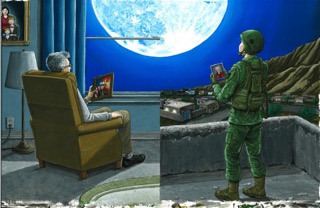
Daddy, Can You See the Moon? A Review and Picture Book Giveaway

Congratulations to Vijaya Bodach who won ONE WEEK OF YOU from last week's blog and to Gretchen Griffith who won A SONG FOR GWENDOLYN BROOKS. 


In Daddy Can You See the Moon? (Spork, 2019) a well-written and beautifully illustrated picture book, author, Gayle Krause, sensitively portrays one of war’s harsh realities: a soldier’s devastating injury. 

Krause's rhymes and Carlos de la Garza's illustrations, demonstrate three constants in the story: the moon, love, and courage. Before he leaves to serve, the father says: 


Though I'll be gone 
I have a way 
For us to share 
Part of each day.
At bedtime,  
Look up at the moon 
And I will too. 
I'll be home soon. 


While his father is away, the little boy counts the days and six full moons pass. Until the day his mother hears alarming news:


She sets down her coffee mug and wraps me in a giant hug.
I wipe her tears, and ask, "What's wrong?"
She answers "Son, you must be strong."
Daddy stepped on unsafe ground. His legs were hurt when he was found.


That night the boy looks out his window and fearfully wonders, 
“Daddy...can you see the moon 
Marching in a dream platoon?”
You're marking time at Soldier's Gate 
But I hope that you can wait. 
cause Baby, Ricky, Mom and me, 
We need you in our family.
His father comes home and the little boy helps his father rehabilitate. Courage—is shown, not told--through the text and illustrations. 


Reminiscent of one of my favorite picture books, I’ll Love you Forever, the book goes full circle ending with the boy having grown up and now a soldier looking at the moon. He holds his father’s picture while his father—back home—gazes at the moon too. 


See Kathleen Temean's blog for more information on Gayle's book journey. 

GIVEAWAY

To celebrate her book birthday tomorrow, April 9th, and in conjunction with the Month of the Military Child, Gayle is giving away an autographed copy of Daddy, Can You See the Moon? Leave me a comment by April 11 (with your email address if you are new to my blog) and I'll enter your name. If you have a family member in the military or plan to give this to a child whose parent is in the military, I'll enter your name twice. 


Monday, October 16, 2017

Blood Brothers: A Review and Audio CD giveaway

The forward of Blood Brothers makes clear Elias Chacour’s purpose in telling his personal story to author David Hazard: he wanted to show an unappreciated side of the Arab-Israeli conflict. First published in 1984, Chacour’s dedication to portray both Palestinian and Jewish prejudices is evident throughout the biography. Another theme is Chacour’s question, “What does it mean to love our enemies and be a peacemaker?” (Note: I listened to this book courtesy of Tantor Media. As a result, quotes might not be exact.)

Beginning with his childhood in the hills of Galilee, Chacour’s faith and life’s work is grounded in his mother’s Bible stories and his father’s recounting the history of the Melkite church. Chacour pictured Jesus walking and working in the hills of Galilee—perhaps even in his own village of Bir’im since after all, the Mount of Beatitudes, was close to their home. He was attracted to Jesus’ fiery nature and the way in which He helped the poor. His father taught him two things: “We should love and respect our Galilean soil. Second, our lives are bonded together with the Jews--our blood brothers from Father Abraham.”
Mount of Beatitudes as
seen from Capernaum.
Even when the Zionist soldiers invaded and took their village, Chacour’s father said, “We do not use violence, even if someone hurts us… The Jews have been hurt by being exiled. They have lived in poverty and fear. They’re afraid. They’re weak because they’ve lost peace within.” Chacour was 8 in 1947 when Palestine was portioned and the armed Zionist solders frightened him. One million Palestinians who had lived there since Christ became refugees and targets of “purification.”  In a moment of painful irony, three years after they were expelled from their village they were hired back to care for their own, beloved olive trees. The army, the Haganah, not the government, ruled Israel. 
By Fred Csasznik - Benny Morris, "Birth of the Palestinian Refugee Problem." ISBN 0 521 33028 9. 1987., Public Domain, https://commons.wikimedia.org/w/index.php?curid=7179966

After the Zionists bombed their village, Chacour was sent away to schools in Haifa and Nazareth. He felt a growing hopelessness and questioned his faith. How could there be peace like Jesus talked about in the Beatitudes? Eventually he was sent to a seminary in Paris to study for the priesthood. In explaining himself to others he attempted to counter public opinion. “We were not terrorists, we were terrorized.” During a visit to Germany he realized the similarity between Hitler’s persecution of the Jews and the persecution against his own people. He hurt for the Jewish people and recognized their need for a homeland but wondered why the persecuted had become persecutors. As he studied the roots of Zionism, he uncovered the political maneuverings behind Israel becoming the Jewish homeland.

His search for a life ministry took Chacour to the small village of Ibillin. He realized that the community was divided between Christian and Arab and that the only answer was forgiveness. He thought about Jesus as the peacemaker and wondered how he could emulate Him. As his work to promote peace grew in notoriety, he was a frequent advocate for bridge building between different people groups. The community center he started in Ibillin grew into a K-12 school of 2,750 of Muslims, Christians, and Druze. Today, Chacour is retired under the charges of sexual harassment and mismanagement. 

Clearly narrated by Jonathan Davis, Blood Brothers--a book for adults and serious-minded teens--provides political and sociological insights into a country that has passed through many hands. But, unfortunately, it doesn’t provide the spiritual solution that is most necessary. 

As a Jewish Christian, I found his Palestinian perspective to be interesting. From childhood, I was taught that Israel was the Promised Land that belonged to the Jews and had never seen Zionism from another angle. Hearing about how Arabs were forced out of their homeland was an eye-opener. Although I applaud Chacour’s wok to build bridges and seek forgiveness between people groups, I found that his work stopped short of the greatest need—forgiveness of sin with God. 

Chacour often quoted Jesus’s words in the Sermon on the Mount: “Blessed are the peacemakers, for they shall be called the children of God.” (Matt 4:9). But he never mentioned what else Jesus said, “Blessed are they that mourn; for they shall be comforted.” (Matt 4:4) Most Biblical scholars agree: Jesus was teaching about our need to mourn our sin. Although Chacour said we must “remember the gospel of Christ” he never once mentioned that the gospel can be summarized with, “Believe on the Lord Jesus Christ, and you will be saved.” (Romans 10: 9, Acts 16:31).

Chacour said he was looking for peace. I’d submit that the only lasting, true peace comes when we find peace with God. “Therefore, since we have been justified by faith, we have peace with God through our Lord Jesus Christ.” Romans 5: 1. 


I’m giving away my copy of this audio book. Please leave a comment by October 20 if you’d like to be included in the drawing. Make sure you leave me your email address if you are new to my blog. 

Monday, November 24, 2014

Liesl's Ocean Rescue and a Giveaway!

Congratulations to fellow blogger, Rosi Hollenbeck, who won an autographed copy of Maggie Dana's book, "Riding for the Stars."
******

Liesl's Ocean Rescue, an historical picture book struck a personal chord for me. It begins with the awful events that surrounded Krystallnacht; an event which deeply affected my paternal grandparents. Like Liesl the main character in Barbara Krasner's story, my mother also escaped Nazi Germany at a young age and took an ocean voyage to America. But unlike Liesl, my mother's ship docked in New York City and her family quickly traveled to Ohio to establish a new home.

Based on the true story of Liesl Joseph Loeb's voyage on the MS St. Louis, Liesl's journey was different. When the ship attempted to enter Havana on the way to America, the Cuban government refused permission to dock. After almost a week of negotiations, the ship--filled with over 900 individuals trying to escape concentration camps--was forced to return to Europe. Although Liesl's family came to America two years later, over two hundred of their fellow passengers did not survive the war. 

Although every page is full of black and white illustrations by artist Avi Katz, this poignant picture book will best be appreciated by children from 8-10 years old. It will enhance classroom instruction about the Holocaust, bring alive the difficulties that immigrants often face, and offer a great starting point for discussions about war and freedom. A teacher's guide can be found here.

I would like to pass along my gently-used Advanced Readers Copy of this book. To enter, leave me a comment by Friday, November 28. If you are a teacher or plan to donate the book to a classroom library, let me know and I'll enter your name twice. 

THE NIGHT WAR: A MG Historical Novel Review

  By now you should have received an email from my new website about my review of THE NIGHT WAR by Kimberly Brubaker Bradley. (It'll com...