Showing posts with label NC author. Show all posts

Monday, July 8, 2019

Projekt 1065: A Review And TALKING STORY Giveaways


Congratulations to Janet Davis-Castro who won HER FEARLESS RUN on last week's blog. 


No giveaway this week, but I hope you'll check out one of Alan Gratz's wonderful books. 


From the Author's Note:
Project 1065 is a work of fiction set against the very real backdrop of Nazi Germany in World War II. Kristallnacht, the Gestapo, the SRD, the concentration camps, the Hitler Youth, the Edelweiss Pirates, the "Aryan" education in German schools--all of this real. Everything Adolf Hitler says to Michael and the other boys in this book is an actual quote from Hitler; I gathered them together from various speeches and interviews so that I wasn't putting words in Hitler's mouth. Adolf Hitler said enough crazy, awful things that I didn't need to make up anything new for him. p.307
I have the privilege of knowing Alan Gratz, the North Carolina author of this middle grade book for boys and girls. That last sentence is pure Gratz--I can hear his earnest voice saying those exact words.

As readers of my blog know, this isn't my first review of one of Alan's well-researched and well-written pieces of historical fiction. Here is my review of Prisoner B-3087 and one of Refugee. Since Alan's latest book, Grenade takes place in Okinawa in World War II, you can see the connection. Hands down, Alan knows how to connect young readers to the facts and realities of war.

REVIEW


"It's hard to smile when you're having dinner with Nazis." (p.1) This attention-grabbing opening line says a lot. The speaker, thirteen-year-old Michael O'Shaunessey lives a life of pretend. The son of the Irish ambassador to Germany, he is in a precarious position: his parents are spies for the Allies and his uncanny ability to memorize words, numbers, and diagrams is one of their secret tools.

Michael's spy work is under the cover of being a member of the SRD, the junior group that will eventually join the Hitler Youth. It's a role he despises but one that grants him opportunities to access information which he passes along to his parents. He is in class with forty other members of the junior Hitler Youth; much of their time is taken up in learning Nazi propaganda and training to die for Germany. 
https://www.history.com/news/how-the-hitler-youth-turned-a-generation-of-kids-into-nazis


SECONDARY CHARACTERS

Fritz Bendler, a new scrawny boy at school who Michael befriends; Michael's teacher, Herr Professor Doktor Major Melcher; and Simon Cohen, a Jewish airman who the O'Shaunessey's hide in the Irish embassy, are all important secondary characters. Although Simon teaches Michael important lessons about facing his fears and being willing to make sacrifices, I'm going to share some excerpts about Fritz and Melcher which help define Michael's journey.


Early in the book Michael provides an observation that is as much about himself, as it is about his teacher:

Even though I wasn't his biggest fan, I had a soft spot for the old codger. I'd gotten the impression he didn't love the Nazis. It was nothing Melcher had said or done--anything that explicit would have gotten him hauled off to a concentration camp or reenlisted in the army, even though he was too old to fight again. it was just the way he talked so lovingly about the way things used to be. I felt he was a kindred spirit. A fellow faker. (p. 29)

Later on, his classmates are taken aback when Doktor Melcher points out that Hitler, and the other Nazi leaders do not fit the blonde, blue-eyed, straight-nosed Aryan ideal.


You could almost hear the classroom gasp. Was Herr Professor Doktor Major Melcher joking? It had to be a joke. It was no secret that the Führer didn't match the Aryan ideal that he'd gone to war to defend, but no one talked about it. To speak of it in public was like saying the emperor wasn't wearing any clothes. It just wasn't done. But Melcher wasn't joking. I could tell, and so could the other boys. I felt as though I could hear the heartbeats of every boy in the room but mine slow to a cool, calculated thrum. They were trained to be on the lookout for dissenters, people who didn't agree with the Nazi party, tuned in like the special radios that Nazis sold that only picked up German radio stations.
.....If he wasn't careful he was going to end up in a concentration camp. (pp. 103-104)

Meanwhile, Fritz is frequently picked on because of his short stature. Michael decides to teach Fritz how to defend himself and the other boys set up a boxing match between the two friends. To his surprise, Fritz doesn't hold back and tries to clobber him. The scene graphically shows Michael's inner turmoil as well as the brutality of the fight. 


I savaged him, fueling each new punch with some new hatred. I hated Hitler for starting this war. I hated the Hitler Youth for their constant bullying. I hated Fritz for making me hit him again. I hated myself for hitting him. 
When at last I stopped, Fritz lay motionless on the ground, completely and totally beaten. All around us was utter silence. I looked up, eyes afire, chest heaving, arms tensed for another fight. Horst took a step back in fear. I had managed to scare even the monsters, and when you can scare monsters, you can be sure you've become one yourself (p. 128).

As the story progresses, the SRD boys--led by Fritz--torture and capture Doktor Melcher while the police stand by. Michael realizes that the police were scared of a group of 13-year-olds who could turn them over to the Gestapo. He is in agony--but chooses not to say anything in order to carry out his vital plan: steal the plans for Projekt 1065 from Fritz's house. 


https://www.history.com/news/how-the-hitler-youth-turned-a-generation-of-kids-into-nazis
In a moment of painful analysis, Michael finally realizes why Fritz has become cruel and calculating.

Fritz stood over me, a look of fierce cruelty in his knitted eye-brows and suddenly I understood. Why Fritz had wanted me to teach him how to fight. Why he'd been so desperate to join the SRD. All his life, Fritz had been the boy with the bloody nose sitting here on the ground, looking up at the bully who'd beaten him. 
He'd joined the SRD so he could become the bully himself. Just like little Hitler. (p. 236-7)
 *******

PERSONAL NOTE

If you haven't already realized it, I believe this book is a must-read for middle school students, teenagers, and adults. It is suspenseful, full of tension and page-turning action. At many points Michael is forced to make difficult choices, to sacrifice beliefs and people he loves, and to conquer his own fears. Although it is a frightening book because of the subject matter, the material is not gratuitously graphic for the sake of displaying violence. It is unfortunately, an accurate description of what life was like for these young boys who were brainwashed and forced to assume responsibilities that even adult solders would abhor. 

https://www.history.com/news/how-the-hitler-youth-turned-a-generation-of-kids-into-nazis


My father was forced to flee Germany in 1939. He remembered the Hitler Youth rallying outside his parents' apartment in Nuremberg and that one boy betrayed his parents. "Either you were in the Hitler Youth--or else," he told me. 

***********

TALKING STORY GIVEAWAYS

The summer issue of Talking Story, Celebrating Young Adults is now live. Our expert and illustrators are young adults and we're giving away four wonderful books: The Perfect Candidate, The Next to the Last Mistake, When Worlds Collide and Don't Blame the Reckless.  Giveaway ends July 11th and don't forget to leave your email address if you are new to my blog. Also, please let me know which book you're interested in too. 

Monday, June 10, 2019

The Next to the Last Mistake: Review and ARC Giveaway

For a second week in a row I'm happy to bring you another clean, contemporary YA novel. I requested The Next to Last Mistake by North Carolina author Amalie Jahn from the publisher, Light Messages, because of the racial themes. It was interesting to see how Jahn handled interracial friendships since that is a theme in my WIP, Half-Truths

REVIEW


Tess Goodwin's peaceful, uncomplicated life in rural Iowa changes the moment her father announces he has reenlisted in the Army. The family moves to an army base in Fayetteville, NC  and Tess is forced to say goodbye to her not-quite-a-boyfriend, Zander, and her beloved cow, Daisy. 

Conflicts navigating her huge new high school mirrors her conflicts over making new friends. When Leonetta, a black girl, is assigned to be her mentor, Tess is surprised by what they have in common as well as how their friendship develops despite racial differences. 

Tess's eyes are opened when Leonetta receives prejudicial treatment, and when she herself is the recipient of cynical comments because she's Leonetta's friend. Tess is enraged by the way her friend is treated and Leonetta explains the rules about being black. Throughout the book Leonetta guides Tess into a greater awareness of Tess's own hidden biases:
"You said it because you have your own biases you carry around with you. We all do. We can't help it. We're human. But that doesn't give us a free pass. You gotta check your privilege, keep an open mind, and consider other people's feelings before you open your mouth. If you do that you'll be okay." (p. 141)
Jahn based this book on interracial friendships she had when she moved to Fort Bragg and her husband was deployed. Good fiction often comes out of her own life experiences. I appreciate Jahn wanting to honor these relationships by showing what her black co-workers taught her about friendship across racial barriers. But some of the dialogue was heavy with lessons and doesn't sound like teenagers bantering back and forth. 

Despite that concern with the novel, there are scenes that are teen-age authentic. When the girls confront the school bully at the prom; when Tess's father announces that he is being deployed to Syria and he gives a "weary, splintered sort of smile that nearly breaks my heart (p. 227); when Zander and Tess begin to figure out their relationship going forward; and when Tess sees Daisy again and breaks down and sobs. 

The motif of chess threads naturally throughout the book. Tess, who played with her father and Zander, begins a chess club at her new school which does surprisingly well. In one conversation with her father over who will win the war in Syria, we find the reason behind the book's title:
"There's this saying in chess: 'Victory goes to the player who makes the next to last mistake.' It basically means during a game of chess you can make mistakes a long the way and still come out ahead as long as you learn from those missteps and adjust accordingly. You don't need to do things perfectly from the beginning to eventually get it right in the end. I've found over the years the theory applies to life as well. And I'm pretty sure it will be the same for war." (p. 253)

Some readers might find that there is too much backstory in the beginning about Tess's life in Iowa as well as a lot of flashbacks about Zander. But overall, I would recommend this book to teen girls who are interested in exploring interracial relationships. Kudos to Amalie Jahn for sensitively tackling a difficult subject as a white author--and keeping it clean. 


GIVEAWAY

To enter the giveaway, please leave a comment and your email address if you are new to my blog. I'll also be giving this away in conjunction with the summer issue of Talking Story, Celebrate Teens. Please leave a comment by June 14. 


Monday, October 22, 2018

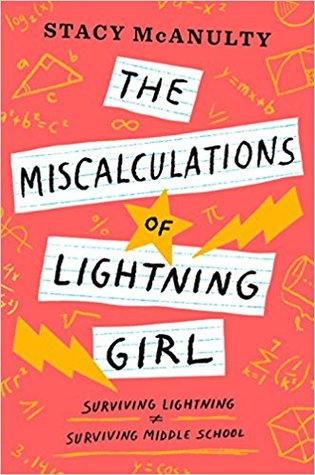
The Miscalculations of Lightning Girl: A Review + a Giveaway!

Congratulations to Rosi Hollinbeck, my California blogger counterpart, who won the E-ARC of Lisa Kline's book, ONE WEEK OF YOU.

REVIEW

Authors are always encouraged to write an opening hook that will make the reader keep on reading. If this opening doesn't make you want to read more, I'm not sure what will:
I don't remember the moment that changed my life 4 years ago. Call it a side effect of being struck by lightning. That bolt of electricity burned a small hole in my memory. It also rewired my brain, transforming me into Lucille Fanny Callahan, math genius. (p. 1)

The Miscalculations of Lightning Girl (Random House, 2018) is by North Carolina writer Stacy McAnulty, a former mechanical engineer. Stacy's previous career explains why she can write a book that seamlessly weaves math into every page of the book.  

Lucy's newly acquired brilliant math skills is central to this middle grade novel that both boys and girls will enjoy. But the book is much more than that. Along with Lucy's new skills, she struggles with obsessive compulsive habits that make her feel different than others and leave her perfectly happy to be home schooled by her grandmother. But, Nana has other ideas. When her grandmother insists she attends East Hamlin Middle, Lucy thinks,
...Nana is forcing me to be part of this germ-infested community where people are called my peers only because we are the same age. My real peers [people she interacts with online] are creating algorithms and solving problems. They'll be changing the world while I'll be wasting time memorizing textbooks and ducking dodgeballs. p. 23
In school, she is cruelly teased for her OCD habits, but, "The dirt and germs bother me more than the nasty comments." (p. 38) 

In an effort to blend in and not be seen as a freak, she deliberately makes mistakes in math class. 
Nana wants 1 year, 1 friend, 1 book, and 1 activity. I calculate this will be easier to achieve without being a freaky genius. I can be normal smart. It's only middle school. This is about survival. (p. 55)
Lucy is grouped with Windy (the girl who knows everything about everybody) and Levi (a quiet photographer who "sees things in an instant that I must miss every day" (p. 113) for a service project. When the unlikely trio bond over their project at a pet adoption agency, for the first time, Lucy has friends who stick up for her. Working at the agency takes this plucky protagonist out of her comfort zone and proves to be a turning point for her. Suddenly, people (and dogs) start mattering to her more than getting the right answer to a math problem. 

In the end, 
Since starting at East Hamlin, I've climbed the 55 steps in the school 232 times and counted all 950 lockers. I've grown 3/4 of an inch and gained 6 pounds. I've had 77 math classes with 1 amazing teacher. I've read 2 books in language arts class (or 91,255 words). I've helped save 23 dogs so far and fallen in love with 1. I've even made 2 friends. I can add it all up, but the total doesn't begin to tell the story. As it turns out, I'm more than just numbers. (p. 283)

Teachers will like the comprehensive Educator's Guide; Educators and Counselors will appreciate the Empathy Guide that stimulates discussion on stereotypes and relating to someone who is different than oneself. 

GIVEAWAY

Random House is giving away a copy of LIGHTNING GIRL. Leave me a comment by October 25 for a chance to win. Make sure you leave me your email address if you are new to my blog. US addresses only. 

THE NIGHT WAR: A MG Historical Novel Review

  By now you should have received an email from my new website about my review of THE NIGHT WAR by Kimberly Brubaker Bradley. (It'll com...