Showing posts with label integration. Show all posts

Monday, November 22, 2021

THE MEANS THAT MAKES US STRANGERS: Author Interview with Christine Kindberg and Giveaway--Part II

Last week in Part I, I reviewed Christine Kindberg's debut novel, The Means That Make Us Strangers. Today she shares her passion for racial equality and her path to publication. And as promised, I'll tell you how she and I are connected. 


AUTHOR INTERVIEW


CAROL: Everyone always wants to know how author’s get their ideas for their stories. What experiences did you have growing up as a TCK (Third Culture Kid) that influenced the creation of this story? Any parts of this autobiographical? Why did you pick this particular time period? 


CHRISTINE: I usually describe the book as exploring questions from my life in more extreme circumstances. A lot of Adelaide's feelings as she navigates the transition from Ethiopia to the US come straight from my experience as a TCK. The disorientation, the desperation to find people to connect with, the grief that sometimes attaches itself to little things, the embarrassment that comes from not understanding a new culture, the anger... I was definitely tapping into some of my own memories when writing about what Adelaide was feeling. I moved several times, back and forth between the US and Latin America, so I didn't have one long-term home the way that Adelaide does in Ethiopia, but I did transition to the US in high school. It's particularly rough moving when you're a teenager.


But the inspiration for the book actually came from a different angle. The original germ was a desire to explore the American rules around race and what would happen if someone broke those rules without realizing. As a TCK, I sometimes feel more comfortable with people who don't look like me, but skin color is too often the cause of deep divisions, changing everything from where someone is likely to grow up to where they go to church or school and how comfortable they feel shopping in certain stores. As a Christian, it matters to me when I see brothers and sisters with darker skin treated unfairly, and I want to know how to live faithfully as a white person, with all the privilege that comes from this skin color.


There are still lots of problems around racial divisions today, but I chose to set the book in the 1960s because I wanted to increase the danger around breaking the racial rules. The consequences for breaking racial barriers then was way higher than it is now, and I knew that would raise the stakes of the story to make it more interesting.


CAROL: Similarly, did any of the characters reflect people you know? 


CHRISTINE: I didn't consciously base any characters on real people...but I've been told more than once that Adelaide sounds a lot like me! I did borrow the name Kinci from a nickname my best friend from high school gave herself.


CAROL: Why did you pick Ethiopia as the country where Adelaide's family lived? 


CHRISTINEMy connection with Ethiopia came through research. I knew I wanted to give Adelaide connections to a rural village somewhere in Africa, and as I researched different countries, Ethiopia stood out as unique in ways I thought would be helpful for my book. It's the only country that wasn't colonized by Europeans, so I assumed Adelaide's white skin would carry fewer political connotations. It also has a history of Christianity that goes back for millenia, and that fascinated me. The more I learned about Ethiopia, the more I wanted to learn. And then the neighborhood I moved to in Chicago had a significant Ethiopian influence, with lots of Ethiopian restaurants, grocery stores, and cultural gatherings--and an Oromo church that met right across the street from my apartment. I read a lot and talked to people for my research, and hopefully someday I'll get to travel there!


CAROL: Why did you choose Greenville, South Carolina as the setting for the story? (I loved the reference to a few locales that I could relate to!). 


CHRISTINE: Greenville has a history of teenagers being on the front lines of the push for Civil Rights, which I found pretty inspiring. This wasn't unique to Greenville, but Sterling High seems to have provided a training ground for emerging leaders. There were a few incidents in particular that caught my imagination, like the desegregation of the library in 1960 thanks to nine black teens who were willing to be arrested over a request for reading materials. The youngest was fifteen at the time. And the court case of Whittenberg v. Greenville County Public Schools, in 1963--spearheaded by the father of seventh-grader Elaine Whittenberg--gave me the historical context I needed for the first steps of school integration that form the backdrop of my book. Greenville is also a beautiful city that I loved exploring and learning more about!


CAROL: As a former Greenville, SC resident--I agree! To switch subjects, I loved the deep first person POV. Was that a choice that came naturally to you, or did you play around with several POV first?


CHRISTINE: Thanks for saying that! I'm glad you enjoyed it. The choice of first-person narration did come naturally, maybe because this was my first book and I unconsciously put a lot of myself in Adelaide. But I did a lot of refining and deepening of the POV as I revised. There were at least four rounds of major revisions, so plenty of opportunities to refine!


CAROL: As I said in my first blog, I’ve never read a self-published book that is so good as yours. Why did you choose to self-publish it? Can you share any aspects of that road to publication? You acknowledge several people who helped with the proofreading and editing process- they did a great job!


CHRISTINE Thank you again! One of the reasons I was willing to consider self-publishing is that my day job is at a publishing house (I'm a Spanish-language editor at Tyndale), and I knew I could get help from friends who are talented professionals. For a long time, I was pretty resistant to self-publishing, so it definitely wasn't my first choice. But after trying for about four years to get the attention of agents and editors, I finally decided to listen to the advice of a mentor and take the risk of publishing it myself. I knew it would be a ton of work to produce and promote a quality self-published book, but I didn't want this story to languish on my hard drive. I decided to dedicate a year or so to giving this a try and seeing what would happen. I filled out the paperwork to register my own imprint as a business, and I called up my friends to ask for help with the cover design, editing, proofreading, typesetting, etc. (I did pay them, for the record!) I also learned everything I could about how to promote a self-published book. I made a lot of mistakes along the way, but I'm glad I went ahead and tried.


CAROL: What response have you received? Is your audience mostly adults? Teens? 


CHRISTINE: It's been such a privilege to hear from readers who have resonated with the story. And I've been surprised at how wide-ranging the readership has been! I've heard from thirteen-year-olds who loved it and from a ninety-seven-year-old who couldn't put it down. My audience is probably mostly adults who enjoy YA books, but their kids and grandkids seem to enjoy it too. I'm passionate about writing for a general audience, but this book seems to have gotten good traction in Christian circles, like when it won the Christy Award for Young Adult and the Honorable Mention for the Selah Award for Young Adult. Those awards have definitely helped with visibility!


CAROL: Did you Christian faith influence the story? If so, how?


CHRISTINE: I'd say everything I do is influenced by my Christian faith--at least, that's how I'm trying to live! My faith definitely influences what I think about the issues of racial justice and why I think everyone should be asking what it means to love our neighbors in a society that's deeply divided by race. That said, faith really isn't a part of the story in The Means That Make Us Strangers--church is mentioned a few times, but it's more of a social backdrop because faith isn't really on Adelaide's radar. Some of that was a conscious choice on my part, like when I chose to make Adelaide's dad an anthropologist rather than a missionary because I didn't want to have elements that could potentially be distracting for readers who aren't Christians. But mostly I wanted to be faithful to the story and true to the characters as I got to know them. With my next two books I wrestle a lot more with questions of faith through the stories, but whatever I'm working on, I'm passionate about writing books that come from a place of deep faith but aren't just for fellow Christians. My dream is to write honestly about faith and life in a way that fosters conversations about faith with people who would never walk into a church or a Christian bookstore.


CAROL: What’s next?


CHRISTINE: I'm currently waiting to hear back from potential publishers about my second book--I'm trying to go the traditional route this next time. Here's hoping there's news soon! That book is historical fiction set in England in the 1530s, about a nun who has to find a new purpose and way of living after the closing of monasteries and convents under Henry VIII. 

And I'm about three chapters in on my third book, which is set in the southern tip of South America in the 1860s-1970s, about the first white family to settle among the indigenous people in that part of the world. Very different settings and time periods for these next books! But a lot of the themes will continue and carry over.

CAROL: Thank you Christine, for writing this beautiful book and providing a giveaway to one of my fortunate blog readers. 

                                                ***

Christine and I emailed back and forth several times after I read her book. Since I read on her website that she went to Queens University in Charlotte, I asked her when she was in my hometown. She replied that she graduated from Covenant Day in 2005-2006 and I asked her if she knew my daughters, Lisa and Lori, who went to school there. 

She wrote back: 

"You’re Lisa’s mom! How funny—I was actually thinking of Lisa when I saw your name and that you were from Charlotte, but I thought there was little chance you’d be related. Lisa and I became friends the year I was at CDS, our senior year, and I remember going over to your house at least a couple of times. I was in the play that year with Lori."

It's a small world!


Christine Kindberg
Photo by Lindsey Bergsma

Christine would enjoy connecting with you on social media: 
Leave a comment on my blog and I'll add your name to the list of readers interested in winning The Means That Makes Us Strangers. (If you entered last week, you can enter again.) U.S. addresses only. If you are new to my blog, PLEASE LEAVE YOUR NAME AND EMAIL ADDRESS. A winner will be drawn on Thanksgiving.

Congratulations to Rosi Hollinbeck who won THE UNIVERSE AND YOU for her great-grandkids. 

Saturday, August 18, 2018

The Hero Two Doors Down: A Review and Audio Book Giveaway

Congratulations to Jo Lyn Worden who won JUNK and to Dorothy Price who won BULLY.

*****

The Hero Two Doors Down is perfectly titled. Written by Sharon Robinson, Jackie Robinson's daughter, this fictionalized account of eight-year-old Steven Satlo's friendship with his hero, is a book that elementary age boys and girls will enjoy.


The year is 1948 and baseball is king. In New York, you are either a Yankees or Dodgers fan and Steve and his father share a great passion for the Dodgers. The author paints an authentic picture of the time period: neighbors sitting out on their front stoops listening to the game on the radio, going to an opening game as a huge occasion for a young boy, and school chums playing stickball together. Although Sharon Robinson says this is a work of fiction, it is based on the stories which Sharon heard her mother and Steve's mother tell. 

Central to the book is Steve's excitement when he hears that Jackie Robinson, his hero, is moving onto his street  Although this section of Brooklyn had been primarily a Jewish neighborhood, the Robinson family is one of the first black families to integrate the area. When some neighbors protest, Steve learns valuable lessons about prejudice from his father. 

Steve is thrilled when Jackie accompanies him to the school yard and teaches his peers how to slide home, provides tickets to a game for his class, as well as when he is invited to decorate the Robinson's Christmas tree. Since he's Jewish, this was a first time experience for Steve. A misunderstanding ensues when Jackie and his wife Rachel buy the Satlow's a Christmas tree--not knowing their friends are Jewish. 

In many ways Jackie Robinson was a role model and inspiration to Steve. Jackie had a rough childhood and encouraged Steve to solve problems peaceably and not with force. The two were lifetime friends and Jackie comforted and encouraged Steve after his father died. 

Chris Andrew Cuilla and Lisa Renee' Pitts both did a great job as narrators. This book would be a good classroom resource for third and fourth graders. 

To entice you, here is an audio snippet of the book and the trailer, narrated by Sharon Robinson.

Younger children will like the picture book Jackie's Gift: A Baseball Tale for the Holidays also by Sharon Robinson.


GIVEAWAY

Leave me a comment by August 23 and your email address if you are new to my blog. If you share this on social media or become a new follower of my blog I'll enter your name in the giveaway twice. 

Monday, March 13, 2017

Meet My Experts - Part II

Congratulations to Kathy Wiechman who won FIRE, COLOR, ONE from last week's blog.

Three years ago I posted a blog about some of the people I'd interviewed for Half-Truths. These experts as well as other men and women willingly shared their life stories with me in order to make my story more authentic. 

Since I'm at the beta/sensitivity reader stage, I'm no longer interviewing folks but I'm still fact-checking and always keeping my eyes and ears open for material that will inform Half-Truths.

For example, I had written a scene about Sam, Lillie's older brother who had enlisted for the conflict in Korea. But as I was re-reading my manuscript I wondered:

    a) Did Sam enlist or was he drafted? How would his choice affect my story? (Lillie's father came home from WWII and met with ridicule in North Carolina. How would he react to his only son enlisting in the service? In turn, how would that affect Lillie?)

   b) Was there even a draft then?

Not finding the answer online, I turned to the Korean Veterans Club in my community. 


KWVA  Chapter 169
I was allowed to speak at one of their meetings and discovered that men could enlist or be drafted. (Whew! I was safe with that part of my story!) When they found out the premise of Half-Truths, the men were quick to tell stories of those first attempts at integrating the armed services. It reinforced, to me, how integration was a process that happened over time. 

  • One vet laughed about being mistakenly assigned to a black truck company. 
  • Another told me of how the troops were integrated during training on Parris Island, SC and Camp Lejeune in North Carolina (during the mid-50's), but as soon as the men stepped off the base, "segregation was rampant." He said that it was as if the blacks lived in two separate worlds. On base they were treated as equals, but if they left camp, they were in a different, biased world. 
  • One man's brother who had served in WWII said, "Treat Negroes with respect because we bleed the same red blood to keep this country free." 
  • One vet said he was accused of being a "McCarthy boy" because he wanted to go to college. The consensus in this group was that Communism wasn't talked about much at home.
  • Truman knew the country wasn't ready for another war, that's why it was called a "police action."
  • I was left with the overall impression that these men worked and fought with black men and that was their "normal".

Of course, I've read some of this accounts online and in articles. But it was different hearing these stories from the men who witnessed and lived them. 
I received this star from one of the vets.
And their stories make mine a little bit richer as a result.

Stay tuned. Soon I'll be sharing stories and pictures of one of my African American experts in Charlotte who has meant so much to me. 


Monday, December 5, 2016

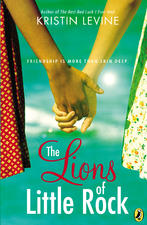
The Lions of Little Rock: A Review

Congratulations to Joyce Hostetter who won LONGBOW GIRL from last week's blog. I had promised you would hear the results of Sydney Kirsch's NaNoWriMo experience. But in typical "I-want-it-to-be-better" mode, Sydney wasn't quite satisfied with her guest post and is continuing to tweak it. Stay tuned, you'll read it soon!
*****
As many of you know, when you're pitching your manuscript to an agent or editor, you're supposed to find comp titles you can compare your work to. Although I read a lot of young adult and middle grade historical fiction, I hadn't found a comp title for Half-Truths.

Until I read The Lions of Little Rock (Penguin, 2012) by Kristin Levine and found these similarities:
  • A friendship between a white girl and a black girl in a time and place when it was unacceptable.  
  • A story that takes place on the eve of civil rights. 
  • A story in which the black girl is light-skinned and passes. 
  • A story of courage and change. 
Of course there are significant differences. The Lions of Little Rock takes place eight years after Half-Truths is set in 1950. Those were eight years when a lot happened in the battle for civil rights. In the historic Brown case in 1954, the Court unanimously ruled that "separate but equal" public schools for blacks and whites were unconstitutional. Practices didn't change immediately.  But in 1957, amidst physical and verbal abuse, nine black students integrated schools in Little Rock, Arkansas.

The year afterwards, both black and white schools were closed as Arkansas Governor Orval Faubus attempted to prevent integration. The Lions of Little Rock is a fictionalized account of that year. 


Here are some scenes I particularly appreciated. 

Marlee, a quiet girl who loves math and has a hard time speaking to anyone besides her family, becomes friends with Liz. Her new friend is light-skinned and Marlee doesn't realize she's a Negro until Liz doesn't come to school one day and the other students reveal her race. 

After school, Marlee asks Betty Jean, their cook:
"Have you ever heard of a light-skinned Negro pretending to be white?" 
Betty Jean stopped what she was doing, her hands full of chicken guts, and gave me a funny look. "Why are you asking that, Marlee?"
The kids at schools said...this girl I know... I was just wondering...I couldn't get any words to come.  Finally, I just stood there, helpless, praying Betty Jean would understand.
I guess she did, because she finally pushed the basting pan aside and went to the sink to wash her hands. She cut two pieces of blueberry pie, then sat down at the table. I sat down too, and she pushed the pie across the table to me.
"It's called passing," she said. "Some Negroes who are really light-skinned and have straight hair try it." 
"Why?" I asked.
"Better schooling. More opportunities." She shrugged. "Maybe they're just tired of being seen as second best."
I didn't say anything. It suddenly seemed like there was more gray around her temples than had been there just a moment before.
"It's a hard life," Betty Jean went on. "You have to give up seeing family and friends. Stop going the places you used to go. And you have to lie--every day--to everyone you meet."
Like Liz had done to me.
"Lying like that, well, it's exhausting. I hope you never have a secret like that Marlee. A secret so big, your whole life depends on it." (p. 68)
For the first time, Marlee begins to see the hatred and prejudice in her city. Marlee's sister, who has been out of school for a month because her school can't open, gets sent away to live with their Grandmother. At a time when she's just beginning to speak what's on her mind, Marlee feels abandoned by her sister and Liz. When her father is angered that the town votes against integration he says, "We are not just a town of racists, but those of us who believe in integration..." He shook his head. "We can't seem to find our voice." (p. 75)

Despite their parents' warnings for them not to see each other, the girls find secret meeting places. Marlee initiates these meetings because of her genuine affection for Liz and the reader senses that in the process, Marlee is learning, growing, and gaining her voice. 

When Liz can't meet her one day because she has to take her little brother to the movies, Marlee has to make a choice.
I knew the Gem was over on West Ninth Street. If I could go to a Negro church, why not a Negro movie theater? I turned the idea over and over in my mind, like a lemon drop on my tongue. I imagined being the only white girl in a room full of Negroes and shivered. It was a little scary. But Liz had been the only colored girl in a whole school full of white kids. Negroes might not be welcome at the white theater, but I didn't think there was a rule against whites going to the Negro theater. If she could do it, so could I. (p. 106)
As Marlee grows in empathy for Liz, she also realizes she's changing. "For so long I'd been the quiet girl. If I wasn't her anymore, who was I?" (p. 113)  Marlee also begins to see that what has worked for her (doing math problems in her head when she's upset) isn't going to work for Liz who loves words more than numbers. A part of Marlee's growth is helping Liz figure out a way to control her temper by writing things down. Seeing how her friend is different than her, takes Marlee beyond their racial differences.

When of my favorite parts is close to the end of the book. The school board members which blocked integration were voted off the board, paving the way for new members and school integration. But Marlee is still upset at school the next day. This is a scene with her Algebra teacher, Mr. Harding. (Who by the way, is an important secondary character.)
"I'm happy we won," I said. "So how come I don't feel better?" 
He looked thoughtful and said nothing for a long moment, then he pulled out a pencil and started to write on the blank piece of paper I had before me. "I think what's happened, Marlee, is that you've realized the world isn't an addition problem." 
He wrote 3 + 4 = 7 down on the paper. "We tell kids that sometimes. We pretend the world is straightforward, simple, easy. You do this, you get that. You're a good person and try your best, and nothing bad will happen." 
"But the truth is, the world is much more like an algebraic equation. With variables and changes, complicated and messy. Sometimes there's more than one answer, and sometimes there is none. Sometimes we don't even know how to solve the problem." (p.270)
I wish I could say that the book ends with a beautiful tying-up-all-the-pieces between Marlee and Liz. But because of circumstances beyond their control, it doesn't. Like Mr. Harding's lesson, books don't always come out the way we want them to. But it is a realistic, hopeful ending that shows how much Marlee has grown. And there is hope for the future--which is vital when writing a book for young people.

Although the two main characters are girls, boys play significant roles in the book. I hope that teachers in upper elementary and middle school use The Lions of Little Rock when they teach civil rights; it will make this time period come alive. 


THE NIGHT WAR: A MG Historical Novel Review

  By now you should have received an email from my new website about my review of THE NIGHT WAR by Kimberly Brubaker Bradley. (It'll com...