Showing posts with label The Boy in the Striped Pajamas. Show all posts

Tuesday, November 16, 2010

Mockingbird

If you want to teach your child or student what the word "empathy" means, then read Mockingbird together. The author, Kathryn Erskine, takes you inside the heart, mind and body of 10-year-old Caitlin who has Asperger's syndrome. The recent recipient of the 2010 National Book Award for Young People's Literature, this book well-deserves the award.
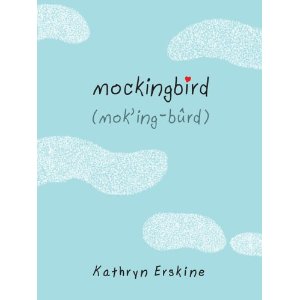
Caitlin's brother Devon was just shot and killed in a random shooting at his middle school. Caitlin and her father are left with a huge weight of grief as well as Devon's incompleted Eagle Scout project, a wooden chest draped in a gray sheet that sits in the middle of their living room. In Caitlin's words it looks like a "...bird that is trying to fly but never getting anywhere. Just floating and falling. Floating and falling." (p. 2) A description that applies equally to Caitlin and her father.

In the world of Asperger's, the reader discovers how difficult it is for Devon to not only make sense of her overwhelming grief, but also how to function in school and relate to other 5th-graders. When her counselor suggests she learn social skills by befriending a younger student, Caitlin is drawn to a first-grader who she figures out is sad. This is Caitlin's first step towards healing and empathy as she befriends Michael whose mother died in the same tragedy.

There are so many wonderful parts of this book that I find it difficult to share just one selection. But since I appreciate how Erskine skillfully used one of my favorite books, To Kill a Mockingbird, in this book; here is a section where Caitlin is remembering watching the movie with Devon, who nicknamed her "Scout."

The first time we watched To Kill a Mockingbird I waited through the whole movie for the dad to shoot a mockingbird. He'd already shot a dog. And he was a good shot. No one shot a bird for the whole entire movie. At the end I said it was the stupidest name ever for a movie. Devon said I didn't know what I was talking about. This year he reads it in English and he said the title makes perfect sense and this is what it means:

It's wrong to shoot someone who is innocent and was never going to hurt you in the first place.

I still don't Get It and said, But you told me the dog was sick and he WAS going to hurt them.

And Devon said, "It's not about the dog! It's about people! You shouldn't hurt innocent people Scout. That's what it means.

I guess the evil school shooters didn't listen in English class because they did not Get the meaning of that book at all. (p. 80)

Typically children read books in which the protagonist is older than themselves. That would put this book in the hands of young elementary students and in Caitlin's own words, I'm not sure they'd "Get it." But like The Boy in the Striped Pajamas that also has a young protagonist, perhaps this book will be read at many age levels--from children through adult--and that each reader will take away something different from the book.

As long as part of what each reader takes away is empathy--then I'm good with that.

Monday, May 26, 2008

The Boy in the Striped Pajamas


"If you do start to read this book, you will go on a journey with a nine-year-old boy called Bruno. (Though this book isn't a book for nine-year-olds.) And sooner or later you will arrive with Bruno at a fence. Fences like this exist all over the world. We hope you never have to encounter such a fence."

This description from the cover flap of The Boy in the Striped Pajamas (or in my case, on the cover of the CD) piqued my curiosity, but I was totally unprepared for the drama that lay in store for me. Told from the perspective of the son of a newly-appointed Commandant, young Bruno's voice of innocence permeates this atypical Holocaust story. The story opens with Bruno receiving the news that his family is packing up his beloved house in Berlin to move to an undisclosed location. The servants will only tell him that the sudden move has something to do with his father's important, yet highly secretive, job. Not pleased with the news that he has to leave his three best friends with whom he goes on exploring adventures, or that his "Hopeless Case" sister Gretel is also coming, Bruno contemplates the events in the unfolding days with a quiet seriousness. He is at the same time inquisitive (the explorer in him) and naïve (why do all of the boys, men, and grandfathers who live on the other side of the fence wear gray-striped pajamas? And if his father knew about the horrible huts they lived in, wouldn't he do something about it?) These traits are both endearing, and his downfall.

As the story develops, the reader sees life though the eyes of this young boy. We meet "The Fury" ("he was the rudest guest Bruno had ever witnessed.... he walked directly into the dining room and sat down at the head of the table—in Father's seat!"); and Shmuel, the boy who "happens to be on the other side of the fence" who Bruno finds out with delight, was also forced to leave his home—solidifying the friendship that Bruno longs for. Bruno struggles to make sense of the fence that separates the two of them, wondering why he can't crawl under it to play with Shmuel and the hundreds of other boys that Bruno imagines are happily living there.

It is this desire for the simple pleasures of boyhood friendships that propels Bruno into his final "adventure". The sad ending, as unfortunately inevitable as war, prejudice, and discrimination; hits the reader with bomb-like force. I would recommend it for 7th graders and up, in conjunction with holocaust studies; or, in language arts, to discuss a character's voice. Bruno's distinct but naïve voice is evident in his comments to Shmuel about his clothing, the camp…even about Poland itself. As the book jacket testifies, this is not a book for nine-year-olds. But it is a book that will certainly prompt thought-provoking discussions in the classroom. (Random House, 2006)Technorati Tags:
, , , ,


THE NIGHT WAR: A MG Historical Novel Review

  By now you should have received an email from my new website about my review of THE NIGHT WAR by Kimberly Brubaker Bradley. (It'll com...