Showing posts with label politics. Show all posts

Monday, February 13, 2023

A TAKE-CHARGE GIRL Blazes Her Way To Congress: The Story of Jeannette Rankin. A REVIEW, 2 INTERVIEWS, and a GIVEAWAY

 From the moment the reader opens this book, she will know that Jeanette Rankin was a hard worker. As a teenager, Jeannette was someone who was as quick to help a hurt horse as she was to help her mother care for her six younger siblings. 

She was a "take-charge" girl.


REVIEW

Jeannette grew up in Montana, but in 1907 when she was 27 years old, she visited San Francisco. When she saw the destitute conditions of the residents in the tenements of Telegraph Hill, she pitched in to help the children. 


That's when she got her first big idea: she would become a social worker and help improve the lives of children and their families.

But, she soon realized that social work alone was not enough to change the lives of suffering families. She wondered, who had the power to improve health care, living conditions, and social services for the poor? Then she realized--it was the lawmakers.  But they were all men and didn't care about these issues.
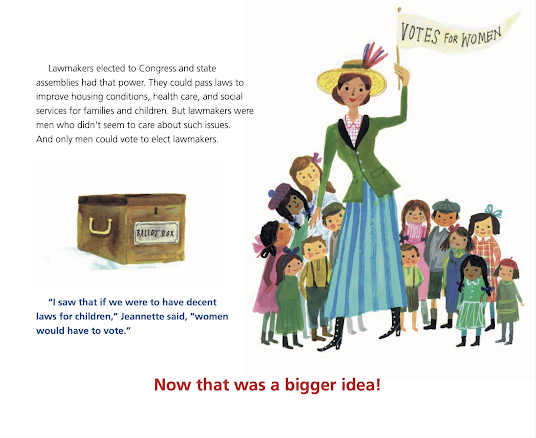
In 1910, Jeannette threw herself into the suffragette movement and spent four years giving speeches all across the country. Along with other like-minded women she printed leaflets and organized meetings.

In 1914 Jeannette wrote to every (male!) voter asking them to support a woman's right to vote. After they won Jeannette had her next BIG idea. 

She decided to run for Congress.


She and her siblings sent postcards to every woman in the state. Jeannette Rankin clubs were formed. She vowed to improve labor, and housing conditions and to improve health care.

After a day of fretting and worrying, Jeannette found out she had won. She was the first Congresswoman in the United States!

On April 12, 1917, Jeannette strode into the Capitol to take her seat in the House of Representatives. 


BACK MATTER

There are seven pages of back matter which teachers and librarians will love. These include a not-so-positive poem that appeared in the NY Times shortly after Jeannette won her congressional seat, a timeline of her life, and a bibliography.

1917
https://en.wikipedia.org/wiki/Jeannette_Rankin

AUTHOR INTERVIEW

Author Gretchen Woelfle is not new to writing about trailblazing women. She has written several other historical books as well as an award-winning middle-grade biography about Jeannette Rankin. 


Carol: Can you tell us a little about your research journey? What were some of the highlights?

GretchenJeannette Rankin lived a long life: from 1880-1973. A TAKE CHARGE GIRL covers just a slice of that life, her childhood through to April 2, 1917, her first day in Congress. 

My research began conventionally, reading biographies and histories of women’s suffrage. Then I ordered the Jeannette Rankin Papers from the Schlesinger Library, at the Radcliffe Institute. They arrived on microfilm at my local library and I spent days browsing through Rankin’s newspaper clippings, official and personal letters, speeches, and articles which gave me anecdotes and quotes to add to the narrative. Photos online from the Library of Congress, the Montana Historical Society, and the University of Montana showed the times, places, and fashions that Rankin favored. 

But best of all were transcripts of hours of interviews she gave in 1972 as part of the Suffragists Oral History Project at the University of California, Berkeley. I read dozens of stories in her own words, describing her Montana childhood, her years in New York studying social work, her four years traveling the country giving thousands of suffrage speeches, enduring insults and abuse from men, befriending other progressive women, feuding with a few women’s suffrage leaders, and collaborating with her brother and four sisters.

I wrote a middle-grade biography, Jeannette Rankin: Political Pioneer, published in 2007 by Boyds Mills/Calkins Creek which covered her whole life.  That book was well-received, winning several awards, and appearing on Best Books lists. But eventually, it went out of print and Jeannette Rankin faded from bookstores and library shelves. 

I didn’t like that one bit! So I asked Carolyn Yoder, my Calkins Creek editor if she’d consider a picture book biography of Rankin. You see the result. 

Carol: That is fascinating! I never heard of an author being able to do that before. What challenges did you face distilling down your middle-grade biography to a picture book?

Gretchen: This format meant focusing on just one period of her life and one of her passions. I bypassed her lifelong commitment to pacifism, feeling that was too complex a subject for younger readers. Instead, I created a narrative arc that began with her caring for her younger siblings, moving to her social work with disadvantaged women and children, to political action to give women a voice in choosing leaders to pass social welfare laws and to become one of those leaders in Congress.

I showed her actions expanding from the personal, to the public, then to the political, driven by her unflinching determination to take charge of her own life, and blaze a trail for others to follow. That is the heart of the story I chose to tell.

ILLUSTRATOR INTERVIEW

Rebecca Gibbon lives in the U.K. but that doesn't prevent her from illustrating subjects from American history and culture.

Carol: Can you tell us about your choice of palette and favorite materials?

RebeccaTo be honest, I don’t actually think about the palette, I’m drawn to different tones of blue and shades of red. I actually used a lot of sepia brown ink, which is quite appropriate as all the photographs from that time period I used for research were in sepia.

I use a combination of acrylic inks, colored pencils, and gouache. The inks are so versatile and a little goes a long way. They can be used neat, like acrylic paint, giving a bright, intense coverage or watered down for more of a loose, watercolor effect. I also like using my fingers & thumbs to make unusual marks, so I look quite a mess after a day in the studio!


Carol: Please tell us about your research process. Is it hard being in Britain and illustrating an American story?

Gretchen: I love the thrill of delving into history when researching a new book, it takes me on a journey and I learn so much from it. I have many books on Edwardian fashion, the History of women’s rights, and old advertising books from the 1900s that I have amassed from past projects. I looked at vintage postcards of Montana & California, magazines, and advertising snippets and I use Pinterest as a scrapbook, trawling through images to find room interiors, fashion, hairstyles, pastimes, anything, and everything. I become completely immersed in that world and become so familiar with the subject, that by the time It’s been sent to the publisher, I feel like I’ve lost a friend, as I’ve spent months drawing and painting them. 


Before the internet, researching a project was trickier & more laborious, as information was harder to find. But so much information is available online, it makes things so much easier. Being British, there were some aspects of American History I had no idea about, such as how many stars and stripes there were on the USA flag in 1910…. But now I know!


My intention is to bring unsung, amazing, and groundbreaking women alive… I hope that I’ve achieved that! 


GIVEAWAY

This past week, Gretchen has been on a blog tour with her publisher, Astra Publishing. I'm happy to have been part of this tour and to offer a copy of A TAKE-CHARGE GIRL. If you want to win this book, please leave me a comment by February 16 along with your name and email address. If you are an educator or librarian, please include that information and your name goes in twice--including homeschool parents. (U.S. addresses only).

WANT TO READ MORE?

As a book reviewer and blogger, I find it interesting to see how others take a different approach to reviewing the same book. Here are three other blog posts highlighting A TAKE CHARGE GIRL.

Picture Book Builders

Behind the Scenes with Beth Anderson (A look at how Gretchen came up with the title)

Nerdy Books (An Illustrious Collaboration)

Monday, June 3, 2019

The Perfect Candidate: Audio Book Review and Giveaway

Congratulations to Theresa Jones who won Emily Out of Focus from last week's blog. Remember, when you don't win a book, check it out of your local library. If it's not in their catalog, you can request a purchase. Another way to support authors!

********


REVIEW

I am always delighted to find a well-written young adult novel to recommend. The Perfect Candidate by Peter Stone passed my "Is it clean?" standards with a book that is entertaining, suspenseful, and will be enjoyed by both girls and guys.

Cameron Carter, a recent graduate of Lagrima High in California, is excited about his Washington, D.C. summer internship with his congressman, Billy Beck. He wants to honor his late mother's memory because she was also an intern on the "Hill." Since he's from a small town and a lower-middle class family, he feels out of place in D.C. but is convinced that this internship will jumpstart his political future and provide an opportunity to "make a difference."

He quickly discovers that there are reasons that D.C. is referred to as the "swamp." His fellow-staffer, Ariel, gives him a mysterious message about contacting a girl named Caitlin if anything should happen to her. When she dies in an apparent drunk driving incident, Cameron is left with a lot of questions--and a dizzyingly fast cover-up by Representative Beck who is accused of having had an inappropriate relationship with Ariel. Who is speaking the truth and who is spinning public opinion? 

When he is contacted by a stranger who turns out to be Memo, an FBI agent, Cameron is both spooked and intrigued. Memo insists that Cameron is in a unique spot as an intern. He has "all the access but no profile" to investigate the apparent suicide of Branson, a pharmaceutical CEO. Cameron reluctantly agrees because of Memo's carrot--Cameron's father will receive a large landscaping bid that will set his business for life.

Cameron's research, interrupted by a romance with the Mexican ambassador's attractive daughter, leads him from one disturbing clue to another. Why did Branson commit suicide? How was his death related to Ariel's? Who was Caitlin and why did Ariel want him to contact her? Why did Ariel's mother (a junior congresswoman who has been assisted by Beck) say, "We all tell the stories we want to believe"? How is this all connected to Congressman Beck, who appears genuinely interested in him and concerned for his constituents? 

Cameron's slightly sarcastic voice is authentic for a rural teen experiencing D.C.'s subterranean train system as well as the inner workings of the political system. The life and death stakes make this a page turner (if you're reading the book) or keep you entertained on a long car trip. And by the way, you'll never guess the surprise ending!

Here is an audio snippet from John Kraft, the able and entertaining narrator: The Perfect Candidate.

GIVEAWAY

To enter to win my copy of this debut YA book by Peter Stone, please leave me a comment by June 10. I'm giving it away in conjunction with the summer issue of Talking Story Celebrate Teens. Please leave your email address if you are new to my blog. 

And remember, "When you don't know who's watching you, you don't know what's being watched."


Tuesday, January 2, 2018

The Pursuit of Italy: A History of a Land, Its Regions, and Their Peoples- An Audio Book Review and Giveaway. Part I

Thanks to so many of you who visited last week's blog on Joyce Hostetter's cover reveal of DRIVE. The post had  1067 opens--which makes it the third most viewed post on my blog!

******
If you are a secret Italophile or dream of touring Venice, Florence, and Pompeii like I do, then this book is for you. Although the talented author, Sir David Gilmour, says that this is not an academic work and is suitable for tourists and amateur historians, the depth and breath of this work is stellar. Almost 20 hours of audio (480 pages) provide the listener with everything you ever wanted to know about "the peninsula." As mentioned before when I review audio books, most of this material is paraphrased.


Audio book provided by Tantor Media

The author opens with the geography of the peninsula providing insight into the role the mountain ranges and rivers (which are less navigable then France or England) to the country’s agriculture and economy. 

From there he delves into mythology as well as ancient Italy including Cicero, Anthony, and other political leaders in the years before Christ. Immigration from other countries brought a variety of peoples to the peninsula including Greeks and Celts.

The Roman Empire was brutal in conquest but granted privileges of Roman citizenship, protection, tax advantages, and the right to stand for office. Around 91 BC the army was the chief agent of the process of Romanization of Italia with the hopes of creating a peaceful, united country. In fact, Italy was a land of city states, not a federation with a national ethnic identity. Empire building was the priority resulting in slavery, corruption, crucifixions, and commonplace murders.

The barbarian and Byzantine period which stretched from 330-1453, was colored by the presence of foreign rule, the memory of the pagan past, and the overwhelming force of the Catholic tradition. This era was marked by wars over territories, vying emperors, the territorial dominion of popes, and struggles for power and control between popes and emperors. Secular rulers who disobeyed the pope were commonly excommunicated. One example was Emperor Henry 4th who dismissed Pope Gregory and called him a false monk. In retaliation, the pope excommunicated the emperor and encouraged subjects to rebel. Although Gilmore didn’t spend much space on origins of papacy, he did comment that the papacy “didn’t care about religion until the reformation.” 

In Gilmour's opinion, Italy's system of city states was predestined to fall. Although the town centers were well preserved, small towns that were close together led to suspicion, anxiety about spies, and large predatory neighborhoods. Fears led to alliances and endless progression of little wars and "endemic factionalism." 

Conflicts with the Hapsburg Empire during the Middle Ages was a history of wars, conquests, divided republics and states. Italy tried to be a great nation and made alliances with France, Prussia, and Austria in attempts to be great.  

At the end of the 18th century, Napoleon led several campaigns to conquer Italy. Although Napoleon successfully carried off many works of art, he was  unsuccessful in conquering the country. Instead, Italy became more unified because the people were disillusioned with his unmet promises. 

Gilmour discusses the origins of words and organizations. The word ghetto was used in Venice to put Jews and other races in separate parts of the city for their protection. Jew wore particular clothing, but were bankers and doctors in a city known to be tolerant of various ethnicities. Caesar led to the Russian word Czar. The International Red Cross was founded because Henry Dunant’s reaction to a bloody battle in Solferino, Italy in 1859.

Gilmore incorporates Italy’s long history of love for written, visual, and musical arts. Virgil’s poetry had impact on Dante and Milton. In fact, Virgil’s description of the Italian countryside has had an enduring visual impact. Over time, art was often a window into politics. 1848, Italian operatic tradition gained a reputation no one would have predicted. The re-emergence of Italian opera was accomplished almost single handedly by Rossini.  


It is difficult to review a book of this length all in one post. Leave a comment this week as well as next when I post Part II and I'll enter your name twice. I'll pick a winner on January 12th. 

THE NIGHT WAR: A MG Historical Novel Review

  By now you should have received an email from my new website about my review of THE NIGHT WAR by Kimberly Brubaker Bradley. (It'll com...