
When a writer begins a work of historical fiction, she must start with research. For me, that means hours of reading Holocaust websites and books.
As I mentioned in my first blog about Escape from Nuremberg, I decided to try my hand at writing a graphic novel. So, of course, that meant reading them to understand the genre. Here are the first few that I found at my library.
GAIJIN by Matt Faulkner


BOMB written by Steven Sheinkin and illustrated by Nick Bertozzi

This graphic novel adaptation of Steve Sheinkin's novel, BOMB: The Race to Build--and Steal--the World's Most Dangerous Weapon, was hard to put down. The recommended reading level is from 10-14, but it's a complicated story with flashbacks and multiple characters. I think it would be challenging for the average ten-year-old although it would show him the immense story behind the bomb's development, and probably demand a second read for true comprehension. Full of science such as physics and chemistry and history, I think it's suitable for older readers and adults as well.
BOMB is a story within a story. The "bookends" of the book are images of the FBI coming to arrest Harry Gold in May 1950 and then showing him put in prison. The story of the bomb's creation is set within the context of Harry telling the FBI agents how he leaked atomic secrets to the Soviets.
A ton of information is included: world politics and politicians, prestigious scientists who played different parts, places where the bomb was tested, the spies and unsung heroes, and the men who dropped the bomb are all mentioned. Although Sheinkin clearly shows why the bomb was developed and detonated, he and Bertozzi also show the devastation and destruction in Hiroshima and Nagasaki.
In keeping with the serious nature of the book, the colors are dark and foreboding.
 |
| BOMB_Excerpt_p62.jpg |
MAUS by Art Spiegelman
_cover.jpg)
Although MAUS: A Survivor's Tale, was not written to be a graphic novel, it has become a classic that tells the Holocaust story from the perspective of a survivor (William Spiegelman) as told to his son, Art Spiegelman. Notably, it is the first comic book to win the Pulitzer Prize in 1992 and is graphic in its portrayal of the Holocaust and its effects on victims and their children.

I SURVIVED: The Nazi Invasion, 1944 from the novel by Lauren Tarshis, adapted by Georgia Ball, illustrated by Alvaro Sarraseca, and colored by Juanma Aguilera.
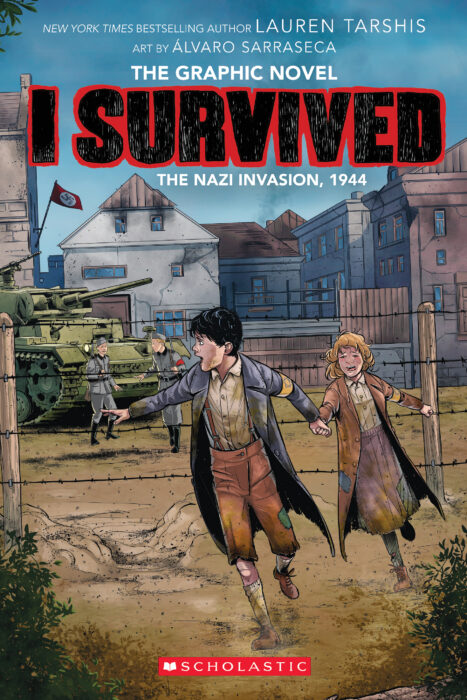

The ending is satisfactory as the children are reunited with their father, but the devastating effects of war are not minimized.
The graphic novel is adapted by Georgia Ball from the award-winning novel by Lauren Tarshis. The text and illustrations (by Alvaro Sarraseca and colored by Juanma Aguilera) move the story along quickly. I had read about the partisan effort in Germany, but particularly appreciated learning more about their work in Poland. The book includes back matter about the Holocaust.


