Showing posts with label adults. Show all posts

Friday, April 7, 2023

GAIJIN, BOMB, MAUS and I SURVIVED THE NAZI INVASION : Four WWII Graphic Novel Reviews

When a writer begins a work of historical fiction, she must start with research. For me, that means hours of reading Holocaust websites and books.  

As I mentioned in my first blog about Escape from Nuremberg, I decided to try my hand at writing a graphic novel. So, of course, that meant reading them to understand the genre. Here are the first few that I found at my library. 

GAIJIN by Matt Faulkner


Matt Faulkner's story of a Japanese-American boy is based on Faulkner's great-aunt's experiences. 13-year-old Koji Miyamoto faces prejudice and persecution after the attack on Pearl Harbor. He worries that his father might be fighting for the Japanese but doesn't receive word from him. 


Koji is put into an internment camp and his mother chooses to go with him. There he faces even greater pressure from the other boys who call him "Gaijin" (foreigner); he is a stranger and alien in his own country. He is pressured into committing petty crimes but eventually chooses to do the right thing. 

In the end, six years later, Koji is reunited with his father in Japan.

Since this was my first WWII graphic novel, I was interested to see how the passage of time is shown simply through small text boxes on the page and how much of the story is communicated through the illustrations.  It made me appreciate the art behind the graphic novel genre--a book told through vivid images and sparse text. 

In the Author's Note, Faulkner describes his great-aunt's trauma of being sent to an internment camp.

BOMB written by Steven Sheinkin and illustrated by Nick Bertozzi


This graphic novel adaptation of Steve Sheinkin's novel, BOMB: The Race to Build--and Steal--the World's Most Dangerous Weapon, was hard to put down. The recommended reading level is from 10-14, but it's a complicated story with flashbacks and multiple characters. I think it would be challenging for the average ten-year-old although it would show him the immense story behind the bomb's development, and probably demand a second read for true comprehension. Full of science such as physics and chemistry and history, I think it's suitable for older readers and adults as well.

BOMB is a story within a story. The "bookends" of the book are images of the FBI coming to arrest Harry Gold in May 1950 and then showing him put in prison. The story of the bomb's creation is set within the context of Harry telling the FBI agents how he leaked atomic secrets to the Soviets. 

A ton of information is included: world politics and politicians,  prestigious scientists who played different parts, places where the bomb was tested, the spies and unsung heroes, and the men who dropped the bomb are all mentioned. Although Sheinkin clearly shows why the bomb was developed and detonated, he and Bertozzi also show the devastation and destruction in Hiroshima and Nagasaki. 

In keeping with the serious nature of the book, the colors are dark and foreboding. 

BOMB_Excerpt_p62.jpg


MAUS by Art Spiegelman


Although MAUS: A Survivor's Tale, was not written to be a graphic novel, it has become a classic that tells the Holocaust story from the perspective of a survivor (William Spiegelman) as told to his son, Art Spiegelman. Notably, it is the first comic book to win the Pulitzer Prize in 1992 and is graphic in its portrayal of the Holocaust and its effects on victims and their children. 

Like BOMB, this story is also bookended by the narrator and there is the same story-within-a-story motif. The reader gets a brief glimpse into Art's childhood which foreshadows what William experienced in the war. The books moves quickly to Art's adulthood in which he is estranged from his father. The book shows Art's desperation in capturing his father's story. Was this so he can write and publish it? Or is it because he longs for reconciliation with his father. One can only wonder. 

The reader views William's trauma as the Polish Jews are terrorized and murdered, but we also see Art's trauma following his mother's suicide, his conflicts with his father, and his feelings of worthlessness and despair.  The multi-generational effects of the Holocaust are disturbing. 

Spiegleman's art is very different than Bertozzi's. His panels are in black and white as seen from a scene in the opening of the book. (I found it on this Pinterest board).


I SURVIVED: The Nazi Invasion, 1944 from the novel by Lauren Tarshis, adapted by Georgia Ball, illustrated by Alvaro Sarraseca, and colored by Juanma Aguilera.
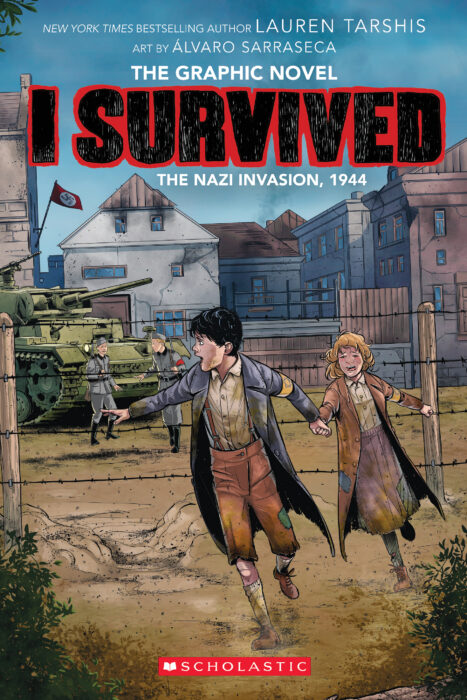


This book follows Max and his younger sister, Zena, who live in a ghetto in Esties, Poland. Their father was taken away by the Nazis and they're on their own. Finding a chance to escape, they hide in a hayfield where a sympathetic farmer gives them shelter. 

Much to their surprise, they find their aunt hiding in the same farm. She is a member of a partisan group that is resisting Hitler and conducting raids against Nazi factories and trains. 

Max and Zena are led to their hideout in a swamp, but their journey is filled with peril as the Nazis spot them. 

The ending is satisfactory as the children are reunited with their father, but the devastating effects of war are not minimized. 

The graphic novel is adapted by Georgia Ball from the award-winning novel by Lauren Tarshis. The text and illustrations (by Alvaro Sarraseca and colored by Juanma Aguilera) move the story along quickly. I had read about the partisan effort in Germany, but particularly appreciated learning more about their work in Poland. The book includes back matter about the Holocaust. 

All of these powerful books would be great curriculum resources in either middle school or high school. 


Monday, December 9, 2019

Voices: The Final Hours of Joan of Arc - An Audiobook Review and Giveaway

Congratulations to Jo Lynn Worden who won Sandra Warren's book, Obsessed By A Promise.

If you want to read a masterful portrayal of deep POV from multiple perspectives (as well as from the perspective of objects) then I recommend that you get hold of a copy of Voices: The Final Hours of Joan of Arc. Not only will you have a great mentor text for deep POV, but you'll also experience multiple types of poetic forms from the medieval period. Plus, you'll discover what life was like for Joan of Arc

Kudos to author, David Elliott. I can't imagine the research needed to write this short book in beautiful, classical poetry. 


REVIEW


Joan's story is told through herself, her mother, father, different witnesses at her Trial of Condemnation and testimony from the posthumous Trial of Nullification. But that is far from all. Charles VII also has a voice--one that is filled with his embarrassment over a young maid who said he needed her to rescue France from the English. 

Joan was a diligent, virtuous daughter, who could spin and mend better than any other woman in her village. But she was bored by these common, household tasks that bound her. In her fierce loyalty to her king, Charles VII, she believed that she could help him win the Hundred Year War. Around the age of thirteen she reported that she started receiving visions from saints and angels. They were her guides as she left home on her passionate journey to save her country. The archangel Michael has a voice of his own in the narrative. 

The author personifies both objects which Joan encountered as well as concepts. For example, here are parts of the poem from the voice of Joan's needle which she used as a young woman:


In the circle of women, is where I am found. Stitching and hemming and mending. I've been handled by many both maiden and crone...No one could touch her, the girl they called Joan. Ferocious, focus, strong-willed. She was a warrior,  the linen her foe. I was her weapon, her sword in her hand.

Other objects had voices. A pitchfork used by a farmer turned soldier, ("Why did he take me away from the farm?");  a 700-year-old sword she requested be brought to her ("How did she find me? Why did she take me from my rest?"); the alms she gave to the poor ("I felt precious in her hand"); the cattle she cared for ("Why did she see angels?"); her hair ("Cut off to her ears because it was too alluring to men"); the arrow that missed its target; the crossbow that found her thigh; her red dress she always wore and the tunic that replaced it; her virginity, and lust. Dramatically repeated was the somber voice of Fire: burning, soaring, and ready to devour. 

Because of the graphic and intimate portrayal of Joan's life and death, I recommend this for mature teens and adults. It would be a remarkable gift for someone who fits that category of readers.

Outside of Nikki Grimes' books, I rarely listen to a book and recommend that the audio version is the best way to "read" the novel. But in this case, I can't say enough about the dramatization that the three narrators, Saskia Maarleveld, Celeste Ciulla, and Luis Moreno provide. Their voices give a rich depth to the characters and objects that populated Joan of Arc's last years. Here is an audio snippet


GIVEAWAY

To enter, please leave a comment by December 12 with your email address if you are new to my blog. This is another giveaway courtesy of Recorded Books. Continental Unites States only. 


THE NIGHT WAR: A MG Historical Novel Review

  By now you should have received an email from my new website about my review of THE NIGHT WAR by Kimberly Brubaker Bradley. (It'll com...