Showing posts with label Japanese Americans. Show all posts

Friday, April 7, 2023

GAIJIN, BOMB, MAUS and I SURVIVED THE NAZI INVASION : Four WWII Graphic Novel Reviews

When a writer begins a work of historical fiction, she must start with research. For me, that means hours of reading Holocaust websites and books.  

As I mentioned in my first blog about Escape from Nuremberg, I decided to try my hand at writing a graphic novel. So, of course, that meant reading them to understand the genre. Here are the first few that I found at my library. 

GAIJIN by Matt Faulkner


Matt Faulkner's story of a Japanese-American boy is based on Faulkner's great-aunt's experiences. 13-year-old Koji Miyamoto faces prejudice and persecution after the attack on Pearl Harbor. He worries that his father might be fighting for the Japanese but doesn't receive word from him. 


Koji is put into an internment camp and his mother chooses to go with him. There he faces even greater pressure from the other boys who call him "Gaijin" (foreigner); he is a stranger and alien in his own country. He is pressured into committing petty crimes but eventually chooses to do the right thing. 

In the end, six years later, Koji is reunited with his father in Japan.

Since this was my first WWII graphic novel, I was interested to see how the passage of time is shown simply through small text boxes on the page and how much of the story is communicated through the illustrations.  It made me appreciate the art behind the graphic novel genre--a book told through vivid images and sparse text. 

In the Author's Note, Faulkner describes his great-aunt's trauma of being sent to an internment camp.

BOMB written by Steven Sheinkin and illustrated by Nick Bertozzi


This graphic novel adaptation of Steve Sheinkin's novel, BOMB: The Race to Build--and Steal--the World's Most Dangerous Weapon, was hard to put down. The recommended reading level is from 10-14, but it's a complicated story with flashbacks and multiple characters. I think it would be challenging for the average ten-year-old although it would show him the immense story behind the bomb's development, and probably demand a second read for true comprehension. Full of science such as physics and chemistry and history, I think it's suitable for older readers and adults as well.

BOMB is a story within a story. The "bookends" of the book are images of the FBI coming to arrest Harry Gold in May 1950 and then showing him put in prison. The story of the bomb's creation is set within the context of Harry telling the FBI agents how he leaked atomic secrets to the Soviets. 

A ton of information is included: world politics and politicians,  prestigious scientists who played different parts, places where the bomb was tested, the spies and unsung heroes, and the men who dropped the bomb are all mentioned. Although Sheinkin clearly shows why the bomb was developed and detonated, he and Bertozzi also show the devastation and destruction in Hiroshima and Nagasaki. 

In keeping with the serious nature of the book, the colors are dark and foreboding. 

BOMB_Excerpt_p62.jpg


MAUS by Art Spiegelman


Although MAUS: A Survivor's Tale, was not written to be a graphic novel, it has become a classic that tells the Holocaust story from the perspective of a survivor (William Spiegelman) as told to his son, Art Spiegelman. Notably, it is the first comic book to win the Pulitzer Prize in 1992 and is graphic in its portrayal of the Holocaust and its effects on victims and their children. 

Like BOMB, this story is also bookended by the narrator and there is the same story-within-a-story motif. The reader gets a brief glimpse into Art's childhood which foreshadows what William experienced in the war. The books moves quickly to Art's adulthood in which he is estranged from his father. The book shows Art's desperation in capturing his father's story. Was this so he can write and publish it? Or is it because he longs for reconciliation with his father. One can only wonder. 

The reader views William's trauma as the Polish Jews are terrorized and murdered, but we also see Art's trauma following his mother's suicide, his conflicts with his father, and his feelings of worthlessness and despair.  The multi-generational effects of the Holocaust are disturbing. 

Spiegleman's art is very different than Bertozzi's. His panels are in black and white as seen from a scene in the opening of the book. (I found it on this Pinterest board).


I SURVIVED: The Nazi Invasion, 1944 from the novel by Lauren Tarshis, adapted by Georgia Ball, illustrated by Alvaro Sarraseca, and colored by Juanma Aguilera.
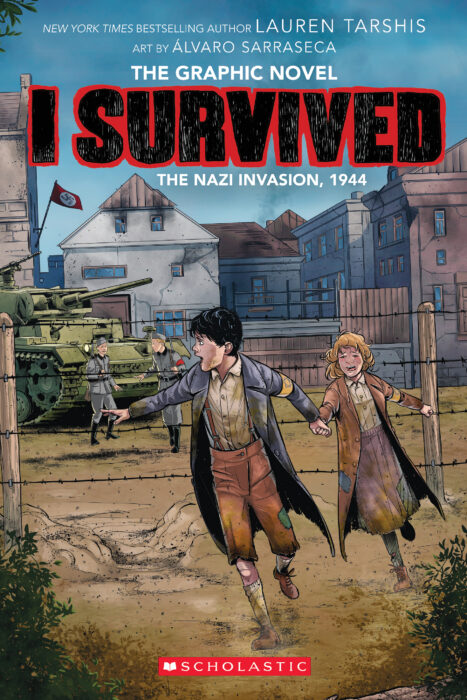


This book follows Max and his younger sister, Zena, who live in a ghetto in Esties, Poland. Their father was taken away by the Nazis and they're on their own. Finding a chance to escape, they hide in a hayfield where a sympathetic farmer gives them shelter. 

Much to their surprise, they find their aunt hiding in the same farm. She is a member of a partisan group that is resisting Hitler and conducting raids against Nazi factories and trains. 

Max and Zena are led to their hideout in a swamp, but their journey is filled with peril as the Nazis spot them. 

The ending is satisfactory as the children are reunited with their father, but the devastating effects of war are not minimized. 

The graphic novel is adapted by Georgia Ball from the award-winning novel by Lauren Tarshis. The text and illustrations (by Alvaro Sarraseca and colored by Juanma Aguilera) move the story along quickly. I had read about the partisan effort in Germany, but particularly appreciated learning more about their work in Poland. The book includes back matter about the Holocaust. 

All of these powerful books would be great curriculum resources in either middle school or high school. 


Monday, May 11, 2015

Red Berries, White Clouds, Blue Sky by Sandra Dallas: A Review and Giveaway

Congratulations to Sheri Levy who won an autographed copy of "Mr. Puffball: Stunt Cat to the Stars."

The year is 1942 and for 12-year-old Tomi Itano, a second-generation Japanese-American, life is about to change. Tomi loves everything about her home: the strawberries her father grows on their farm, her Girl Scout troop, her Japanese doll, which her grandparents sent her, and the American flag, which her father proudly salutes every day.

JapaneseAmericansChildrenPledgingAllegiance1942-2 by Photo attributed to Dorothea Lange(w). Via US Library of CongressFarm Security Administration and Office of War Information Collection
(Library of Congress). CALL NUMBER: LOT 1801
But amidst the paranoia of World War II, when Japanese newspapers and letters from home, are “proof” of being an enemy spy, the Itano’s become victims of fear, prejudice, and false accusations. Tomi’s father is arrested and taken to prison.  After President Roosevelt signs Executive Order 9066 ordering thousands of Japanese to be relocated, Mrs. Itano and her three children are taken to a series of interment camps. They finally are taken to Tall Grass, Colorado (a fictionalized camp based on Hamache) where they are forced to make a 16 x 20 square foot room their apartment.


Posted Japanese American Exclusion Order" by Department of the Interior. War Relocation Authority
This media is available in the holdings of the National Archives and Records Administration, cataloged under the ARC Identifier (National Archives Identifier) 536017.
Despite always worrying how Mr. Itano will find them, the family adjusts to camp life.  Although they don’t want to be there, the children gain friends and Mrs. Itano blossoms in her new role as a quilting teacher. Interactions with the local townspeople add more spice to the story. When Dennis, a boy Tomi meets, confronts her on being “un-American” because of how she looks, she retaliates in anger. Discovering he is the son of a German immigrant, she questions if everyone should be rounded up and shipped to a camp just because they all don’t look alike. His changed attitude towards the Japanese would be a great teaching point for teachers using this book in an upper elementary/middle school classroom.
Original caption: Hayward, California. Members of the Mochida family awaiting evacuation bus. Identification tags are used to aid in keeping the family unit intact during all phases of evacuation. Mochida operated a nursery and five greenhouses on a two-acre site in Eden Township. He raised snapdragons and sweet peas. 

When Mr. Itano is finally reunited with the family, he is a different man. Being unfairly imprisoned has left him bitter.  His love for the country he chose is replaced with anger and apathy. On top of that, his family has changed. His wife is no longer silent and submissive, his family doesn’t eat together, and his son wants to join the army. Unfortunately, his bitterness infects Tomi and her outlook changes also.  Not until Tomi writes a prize-winning essay on “Why I am an American” based on her father’s immigrant hopes and dreams, do her and her father’s attitudes change.

I was most captivated by Tomi’s mother. Faced with the challenges of being a mail-order bride, raising a family in a foreign country, being shuttled from one interment camp to another, and then a bumpy reunion with her husband who is unhappy with her Americanization—she showed the most endurance and strength.  Her authentic response to difficulties was the glue that kept her family together.

The book is recommended for reader ages 8 and up. I think that an 8-year-old would be too young to appreciate and learn from this story; I believe it is more suitable for boys and girls who are at least 10-year-old. Red Berries, White Clouds, Blue Sky is Sandra Dallas' second book about a terrible period in our nation’s history, and can be a valuable classroom supplement.  Jennifer Ikeda, the narrator of the audio book, did a good job creating the Japanese and American voices.


I took this picture on a recent trip to Bainbridge Island near Seattle Seattle. Then I found this on the same Wikipedia site where I found all of the black and white images.


Bainbridge Island (Wash.) evacuation -- Group of young evacuees wave from
special train as it leaves Seattle with Island evacuees, March 30, 1942
By the way, the 442nd Infantry Regiment which Tomi's brother joined, was composed of almost entirely of Japanese Americans whose families were in interment camps. It was the most decorated unit for its size and length of service in the history of American warfare. 

Thanks to the generosity of Recorded Books, I am able to offer this audiobook to a blog reader. Please leave me a comment by May 14 and I’ll enter your name in the giveaway. It will be a great addition to a school or homeschool library.  

THE NIGHT WAR: A MG Historical Novel Review

  By now you should have received an email from my new website about my review of THE NIGHT WAR by Kimberly Brubaker Bradley. (It'll com...