Showing posts with label Holocaust. Show all posts

Friday, May 24, 2024

THE NIGHT WAR: A MG Historical Novel Review

 By now you should have received an email from my new website about my review of THE NIGHT WAR by Kimberly Brubaker Bradley. (It'll come from WordPress). If you didn't, please check your spam box or if you have a Google account, it might have gone to your "Social" folder. 

Please drop me a note and let me know if you didn't receive the notification and I'll try to figure out the problem. I don't want to lose any of you!

Add this book to your TBR pile--it's terrific!


Friday, April 7, 2023

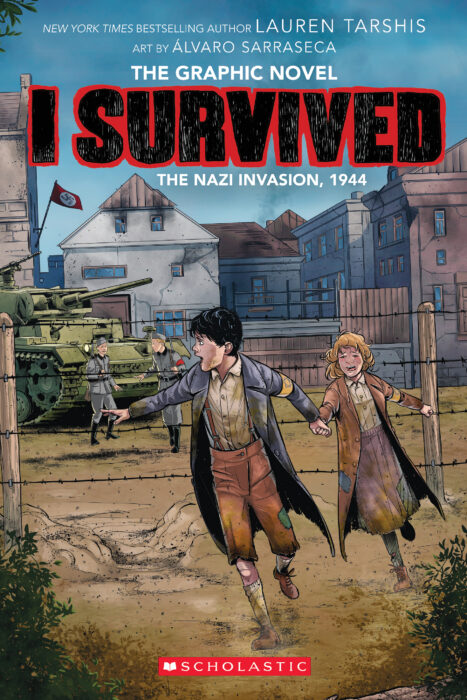
GAIJIN, BOMB, MAUS and I SURVIVED THE NAZI INVASION : Four WWII Graphic Novel Reviews

When a writer begins a work of historical fiction, she must start with research. For me, that means hours of reading Holocaust websites and books.  

As I mentioned in my first blog about Escape from Nuremberg, I decided to try my hand at writing a graphic novel. So, of course, that meant reading them to understand the genre. Here are the first few that I found at my library. 

GAIJIN by Matt Faulkner


Matt Faulkner's story of a Japanese-American boy is based on Faulkner's great-aunt's experiences. 13-year-old Koji Miyamoto faces prejudice and persecution after the attack on Pearl Harbor. He worries that his father might be fighting for the Japanese but doesn't receive word from him. 


Koji is put into an internment camp and his mother chooses to go with him. There he faces even greater pressure from the other boys who call him "Gaijin" (foreigner); he is a stranger and alien in his own country. He is pressured into committing petty crimes but eventually chooses to do the right thing. 

In the end, six years later, Koji is reunited with his father in Japan.

Since this was my first WWII graphic novel, I was interested to see how the passage of time is shown simply through small text boxes on the page and how much of the story is communicated through the illustrations.  It made me appreciate the art behind the graphic novel genre--a book told through vivid images and sparse text. 

In the Author's Note, Faulkner describes his great-aunt's trauma of being sent to an internment camp.

BOMB written by Steven Sheinkin and illustrated by Nick Bertozzi


This graphic novel adaptation of Steve Sheinkin's novel, BOMB: The Race to Build--and Steal--the World's Most Dangerous Weapon, was hard to put down. The recommended reading level is from 10-14, but it's a complicated story with flashbacks and multiple characters. I think it would be challenging for the average ten-year-old although it would show him the immense story behind the bomb's development, and probably demand a second read for true comprehension. Full of science such as physics and chemistry and history, I think it's suitable for older readers and adults as well.

BOMB is a story within a story. The "bookends" of the book are images of the FBI coming to arrest Harry Gold in May 1950 and then showing him put in prison. The story of the bomb's creation is set within the context of Harry telling the FBI agents how he leaked atomic secrets to the Soviets. 

A ton of information is included: world politics and politicians,  prestigious scientists who played different parts, places where the bomb was tested, the spies and unsung heroes, and the men who dropped the bomb are all mentioned. Although Sheinkin clearly shows why the bomb was developed and detonated, he and Bertozzi also show the devastation and destruction in Hiroshima and Nagasaki. 

In keeping with the serious nature of the book, the colors are dark and foreboding. 

BOMB_Excerpt_p62.jpg


MAUS by Art Spiegelman


Although MAUS: A Survivor's Tale, was not written to be a graphic novel, it has become a classic that tells the Holocaust story from the perspective of a survivor (William Spiegelman) as told to his son, Art Spiegelman. Notably, it is the first comic book to win the Pulitzer Prize in 1992 and is graphic in its portrayal of the Holocaust and its effects on victims and their children. 

Like BOMB, this story is also bookended by the narrator and there is the same story-within-a-story motif. The reader gets a brief glimpse into Art's childhood which foreshadows what William experienced in the war. The books moves quickly to Art's adulthood in which he is estranged from his father. The book shows Art's desperation in capturing his father's story. Was this so he can write and publish it? Or is it because he longs for reconciliation with his father. One can only wonder. 

The reader views William's trauma as the Polish Jews are terrorized and murdered, but we also see Art's trauma following his mother's suicide, his conflicts with his father, and his feelings of worthlessness and despair.  The multi-generational effects of the Holocaust are disturbing. 

Spiegleman's art is very different than Bertozzi's. His panels are in black and white as seen from a scene in the opening of the book. (I found it on this Pinterest board).


I SURVIVED: The Nazi Invasion, 1944 from the novel by Lauren Tarshis, adapted by Georgia Ball, illustrated by Alvaro Sarraseca, and colored by Juanma Aguilera.


This book follows Max and his younger sister, Zena, who live in a ghetto in Esties, Poland. Their father was taken away by the Nazis and they're on their own. Finding a chance to escape, they hide in a hayfield where a sympathetic farmer gives them shelter. 

Much to their surprise, they find their aunt hiding in the same farm. She is a member of a partisan group that is resisting Hitler and conducting raids against Nazi factories and trains. 

Max and Zena are led to their hideout in a swamp, but their journey is filled with peril as the Nazis spot them. 

The ending is satisfactory as the children are reunited with their father, but the devastating effects of war are not minimized. 

The graphic novel is adapted by Georgia Ball from the award-winning novel by Lauren Tarshis. The text and illustrations (by Alvaro Sarraseca and colored by Juanma Aguilera) move the story along quickly. I had read about the partisan effort in Germany, but particularly appreciated learning more about their work in Poland. The book includes back matter about the Holocaust. 

All of these powerful books would be great curriculum resources in either middle school or high school. 


Monday, August 10, 2015

Behind the Scenes of Prisoner B-3087

Last week I reviewed Alan Gratz's acclaimed Holocaust book, Prisoner B-3087. Today, Alan generously agreed to answer questions about what this book has meant to him both professional and personally.


CAROL: I understand Scholastic contacted you first, to see if you were interested in writing this book. Can you share what went into that decision making process for you?

ALAN: Yes, Scholastic approached me. Jack and his wife Ruth took his story to Scholastic, and they immediately saw that it would make a great book. But neither Jack nor Ruth are writers, so Scholastic asked me to write the book. Once I heard Jack’s account of his time in the camps, I couldn't resist—it was such an incredible story! In particular, I liked that he survived. So many stories of the Holocaust of course did not end so well. And I knew that for writing middle grade, that would be important.

CAROL: What was you process for writing the book? I assumed you interviewed Jack at least once.

ALAN: I worked on the book for a while before I ever met Jack in person, using what he and his wife had told Scholastic about his experiences in World War II and doing a lot of research on the concentration camps on my own. Then, about halfway through writing the first draft, I got to fly to New York and meet Jack. We spent the afternoon at the Holocaust Museum in Manhattan, where some artifacts of Ruth's time during the war are on display.

Jack's memory isn't what it once was, and he wasn't able to remember the answers to some of the questions I had for him. But later, when he read my first draft of the book, a lot of things came back to him. I think he needed the world of the book to help jog his memory. Writing this book became a real process of discovery as Jack and I uncovered some memories he didn't know he had. I'm pleased that I was able to write something that brought the past to life again for him, even if a great deal of that past was painful.

CAROL What did you do next? I assumed you consulted other books on the Holocaust. Or did you interview other survivors? What stands out as the most helpful "other" source of information? 


ALAN: I didn't interview other survivors, but I did read more accounts of the Holocaust--both academic and personal. I think the personal accounts were the most useful. It's the details I was looking for, not the general history. Specific things that happened to people. Events I could use to show real things that happened in the Holocaust. The reality was horrific enough without having to make things up.

CAROL: This is a novel and you make it clear in the back that it is a work of fiction. I don't know if you are able to distill how you wove together Jack's story with other information about the Holocaust, but your process interests me. How did you know when to take liberties with Jack's story? Perhaps an example or two might be helpful.

ALAN: Almost everything that happens to Jack in the book is real. But as I said before, Jack's memory isn't what it once was, and Scholastic really wanted us to see each of the ten camps Jack went to. And of course as a writer, I didn't want to just see them, I wanted something important to happen in each one. So while I had amazing stories from Jack's actual experience to put in--like hiding under the floorboards from Amon Goeth, or dealing with Moonface the kapo again and again, or watching the boy Fred die, or almost dying and then being tattooed at Birkenau--there were other times where I needed to fill in the blanks in Jack's memory. He remembered being at the salt mines, but not much more than the statues there. So I added, from reading another survivor's account, the scene where Jack sees the murdered body of a Jew who worked with the Nazis in the Krakow ghetto. Later, Jack remembered being at Bergen Belsen, but didn't have a specific story to tell about that experience. I had Jack see the "zoo" they kept at that the concentration camp, where the animals were fed better than the prisoners. Again, if something happens TO Jack, it's a good bet it really happened to him. It's the stuff he just sees and witnesses that I sometimes added, as I say in the back of the book, to give a fuller and more complete vision of the Holocaust. This was, after all, a book we expected to be used in Holocaust studies in schools.

CAROL: Do you consider this a collaborative work? Did Jack read any of your drafts and/or have input into them?

ALAN: As I said, Jack and his wife Ruth did read the drafts, and they gave me feedback on them. But I really did all the writing. Their input was more to get the details right. Part of the discovery was big things, but sometimes it was just small details. When I first interviewed him, Jack didn't remember the street he grew up on. When I chose one of the few streets in the Krakow ghetto then to be his home street for the story, he read that and immediately remembered that it wasn't right--and then DID remember the correct street. It was an odd book to write in that way--it was like the character I was writing would pop up every now and then and tell me, "No! Wait! That's not how it really happened!"

CAROL Have you done any public appearances with Jack?

ALAN: Jack and I filmed a video for Scholastic, which went on a DVD shown to students before releasing them into the Scholastic Book Fairs at their schools. But we haven't done any public appearances together. He's in New York, and I'm in North Carolina. Jack and Ruth both used to do a lot of school visits, telling their stories of survival, but they're both much older now and have a harder time traveling. I do a lot of school visits in Jack's stead now, carrying the torch for him and his story to a new generation.

CAROL: How has writing this book affected you both personally and professionally?

ALAN: Personally, spending time with Jack and his story and the world of the Holocaust has made me appreciate what I have--food on the table, a roof over my head, my family, my freedom--so much more. It's so easy to get wrapped up in day-to-day First World Problems and think the world is falling apart around you. All I have to do is think about how Jack's world really DID fall apart around him, how he lost EVERYTHING, even his name, his very identity, and it puts things into real perspective.

Professionally, PRISONER B-3087 has been a huge book for me. We've already sold more than a quarter of a million copies--most of those through the Scholastic Book Fairs--which makes it easily my best-selling and most widely-read book. It's been nominated for a dozen state awards, and its won three of them. I get two or three letters from student readers every week, and all of them clamor for me to write more books about World War II. Which is exactly what Scholastic wants too! I just turned in the first draft of a book about an Irish boy who is a spy in Nazi Germany in World War II as a part of the Hitler Youth, and I'm busy developing another book about the war. I will be very happy if my career becomes writing middle grade World War II historical fiction if kids keep begging to read more!

It's hard to keep up with all of Alan's books. His most recent novel, Code of Honor was just released. I'm currently reading The League of Seven, a steampunk/alternate history fantasy which won the 2015 SIBA Young Adult Book Award. Look for my review in a few weeks. And maybe a giveaway... although I think I have to save my autographed copy for my grandkids! 

Monday, August 3, 2015

Prisoner B-3087 by Alan Gratz

Congratulations to Tonya Goettl who won Wonder at the Edge of the World in last week's giveaway. Stay tuned for another great giveaway coming up soon. But first, two posts about Alan Gratz's middle grade Holocaust book.

I'm going to tell you from the start this review contains spoilers. It's a story driven by a young boy's desire and need to survive. But of course, the spoiler is implied by the very nature of this book. Prisoner B-3087 by North Carolina author Alan Gratz, is based on the true story of Jack Greuner, an Holocaust survivor.


The book opens in 1939 in Kraków, Poland. Yanek Gruener (much later he changes his name to Jack) is ten-years-old and his father doesn't believe that Hitler's invasion of Poland will last for more than six months. 

His family soon finds out how deadly wrong he is. 

In magnificent prose that combines accurate details from Yanek's life with historical research, Alan Gratz has woven together a painful-but-true portrayal of a young boy's determination to survive which carried him through ten concentration camps in six horrific years. 

Within three years the family goes from rationing; to losing jobs, their synagogue, and access to schools; to being sealed off within the walls of the ghetto. Life is horrible, but at least Yanek has his family around him. After his secret bar-mitzvah, he is terrified when the sick and elderly are killed. He thinks,
I was a man and I wanted to do something. Something to stop the Nazis. To save my family. I asked myself over and over again what I could do to help, but I had no answer. p.50
He argues that his family should not give in to the Nazi's demand to be "selected" and buys more time for them all. But one day he comes home and witnesses his parents being brutally herded away by the Nazi soldiers. 

Yankee is sent to the PÅ‚aszów concentration camp and is amazed to find his Uncle Moshe who gives him survival instructions: 
From now on, you have no name, no personality, no family, no friends. Do you understand? Nothing to identify you, nothing to care about. Not if you want to survive…We have only one purpose now: survive. Survive at all costs, Yanek. We cannot let these monsters tear us from the pages of the world. (pp. 68, 70)
As Yanek is packed into cattle cars and moved from one concentration camp to another he learns what he must do to survive:
  • Don't share your portion of bread with someone, even if that person might be kept alive by what you have.
  • Don't miss a roll call. You will be beaten.
  • Don't show fear. The Nazis' dogs will attack.
  • Don't befriend anyone.
  • Always obey orders. 
  • Don't think for yourself.
  • Don't question orders even if it means moving back-breaking rocks from one side of the yard and then back again. 
  • Don't fight back. If you do, you'll be killed.
  • Don't complain when you are forced to sing and entertain Nazi soldiers feasting on a dinner. Look away so your stomach won't grumble and you won't be shot. 
Yanek clings to the smallest "comforts" in his pursuit of survival:
I stood at the water pump, scrubbing my body. It was bitterly cold out, but I didn't care. I would scrub my body, I decided, each and every morning, no matter how cold it was, no matter how tired I was. I was alive, and I meant to stay that way.
…I paid careful attention to where I had been tattooed. Too many others had let their tattoos get infected, and that had taken them to the camp surgeon. You didn't want to go to the camp surgeon. Ever. I even rubbed my teeth with my wet fingers--we had not toothbrushes or toothpaste, of course, but it felt important to remember what it was like to be human. (p. 136)
As the war ends, Yanek's will to survive does not:
The war had come to Dachau, and any moment a shell or a bomb might fall on our building and kill us all. So many times I had wished for a bomb to fall on me, to end my suffering, but now I prayed that no bomb would hit me. Not now, when I was so close to the end! If only I could survive a little longer, I thought, just a little longer-- (p. 242)
As I said in the beginning of this review, it is obvious that Yanek Gruener does survive. So, it's not a spoiler to quote the last lines of this memorable book:
I stepped on board the train and didn't look back. For nine years I had done everything I could to survive. Not it was time to live. (p.256)
Next week Alan shares his process of writing Prisoner B-3087 and what it has meant to him both personally and professionally. To whet your appetite, here is a video of Alan with Jack and his wife Ruth, that Scholastic created. 

Next week Alan shares his process of writing Prisoner B-3087 and what it has meant to him both personally and professionally. To whet your appetite, here is a video of Alan with Jack and his wife Ruth, that Scholastic created. 


Monday, April 20, 2015

Teaching the Diary of Anne Frank: A Review and a Giveaway!

The first thing I noticed about Susan Moger’s book, Teaching the Diary of Anne Frank: An In-Depth Resource for Learning About the Holocaust Through the Writings of Anne Frank was her personal connection to Anne’s story. Here are the opening words to the preface:
I was born the day Anne Frank went into hiding-July 6, 1942. When I first read The Diary of a Young Girl, I was 13, the same age as Anne when she started her diary. That combination of events, and the fact that I, too, kept a diary, forged a connection between Anne and me. (p. 5)
The second thing I noticed was the book’s superb organization. Beginning with a lengthy note to teachers on how to use the book and  ending with “Resources and References” which is divided by grade level, the author has created a classroom resource which will make reading A Diary of a Young Girl not only memorable, but also a starting point for a learning unit with historical and sociological implications. 


Ms. Moger worked hard to show the historical context of Anne Frank’s life. But that broad worldview is balanced with personal snapshots showing how Anne was a “normal” teenager in an abnormal time. The book's timeline reflects this by showing what was going on in the Frank family in correspondence with world events.

Each of the five chapters incorporate resource pages amplifying the author's mission: to teach young people about the Holocaust so that Anne Frank's legacy will influence present and future generations.

You'll have to get the book to appreciate the depth of resources which Susan assembled in this curriculum resource. I can't begin to showcase her project suggestions, response journal topics, thought provoking discussion questions, and excerpts from Holocaust survivors. Here are just a few examples which spoke to me.

MAPS
http://www.theholocaustexplained.org/ks3/the-final-solution/german-expansionism/german-occupation-of-europe/#.VSbb0UvJ46I
This map is similar to the one reproduced in the book. If you click on this website you can see a succession of maps showing the progression of German occupation.

PHOTOGRAPHS
http://www.annefrank.ch/diary.html

This photograph captures Anne and her dream of one day becoming a journalist or a writer.

DOCUMENTS

National-Socialist German Workers' Party
Party Secretariat
Head of the Party Secretariat  Fuehrer Headquarters,                         July 11, 1943 
Circular No. 33/43 g.

Re: Treatment of the Jewish Question

On instructions from the Fuehrer I make known the following:
Where the Jewish Question is brought up in public, there may be no discussion of a future overall solution.

It may, however, be mentioned that the Jews are taken in groups for appropriate labor purposes.

signed M. Bormann

Distribution: Reichsleiter
Gauleiter
Group leaders
File Reference: Treatment/Jews

Source: Documents on the Holocaust, Selected Sources on the
Destruction of the Jews of Germany and Austria, Poland and the Soviet

Union, Yad Vashem, Jerusalem, 1981, Document no.160. p.342.

This is one of several documents used in the prosecution of Nazi war criminals during the Nuremberg trials. Ms. Moger also devotes several resource pages and discussion questions on the topic of doublespeak and euphemisms.

LITERATURE

            A Dead Child Speaks
                         by Nelly Sachs

My mother held me by my hand.
Then someone raised the knife of parting:
So that it should not strike me,
My mother loosed her hand from mine.
But she lightly touched my thighs once more
And her hand was bleeding –

After that the knife of parting
Cut in two each bite I swallowed –
It rose before me with the sun at dawn
And began to sharpen itself in my eyes –
Wind and water ground in my ear
And every voice of comfort pierced my heart –

As I was led to death
I still felt in the last moment
The unsheathing of the great knife of parting.


(Translated by Ruth &Matthew Mead)
Holocaust Poetry: Compiled and Introduced by Hilda Schiff.

PRIMARY RESOURCES
from http://www.annefrank.ch/diary.html
I read the Diary of Anne Frank over fifty years ago and I still remember some of the feelings it evoked in me. Photocopies of actual pages from the diary startled me. Of course I knew that her journal was a hand-written account and not a typed paperback. But seeing her handwriting and the photos she inserted with her comments, connected me to my younger self who kept a diary because that’s what Anne Frank did. It made me wonder: how many other young women and writers have been inspired by Anne’s example?

The Diary of a Young Girl is a classic book appreciated by readers young and old.  Hopefully this curriculum supplement will continue to facilitate Anne’s purpose: to document a piece of history that the world can’t afford to forget.  


Ms. Moger is giving away an autographed copy of this award-winning book. A perfect addition to any school or home school library, I hope my faithful blog readers will share this post with teachers and/or enter on behalf of a local school. To enter, please leave me a comment by April 23. Make sure you leave me your email address if you are new to this blog.
*******
If your class is studying the Holocaust, here are several other books on the topic which I have reviewed on this blog:

The Boy in the Striped Pajamas
Rose Under Fire
Liesl's Ocean Rescue
Prisoner of Night and Fog 

*******
MORE RESOURCES:
Visit Anne Frank Foundation for more pictures of Anne and her family.

Visit Biography.com for interviews about Anne's diary.

Read Annexed by Sharon Doger for a fictionalized story about Peter Van Pels.


Monday, February 16, 2015

Rose Under Fire: A Review and a Giveaway!

I wish this book didn't exist.

What I mean is that I wish Rose Under Fire, a brutally honest book about a young American pilot imprisoned in the Ravensbrück concentration camp, didn't demand to be written.


But unfortunately, it did.


Rose Moyer Justice is an 18-year-old American Air Transport Auxiliary pilot ferrying planes for the British government. Although World War II is drawing to a close, during a semi-secret flight she is captured by the Germans. For six long and painful months, Rose is incarcerated with thousands of other female political prisoners and seventy-four Polish victims of Nazi human experimentation who are nicknamed "The Rabbits."
Women working in Ravensbruck.
Photo courtesy YadVashem
Wein holds nothing back from showing Rose's physical, emotional, and mental struggles in the concentration camp. Her descriptions are full of such convincing detail that I felt guilty eating a granola bar while listening to it; the characters' starvation and deprivation had become so real to me. Similarly, when I listened to Rose's beautiful poetry sprinkled throughout the story I had to remind myself that Elizabeth Wein had penned these words. In the same way in which her fellow prisoners clung to her poetry, desperate for beauty in the midst of a world of despair, I felt as if the poems were gifts from Rose herself.

Six million Jews dying in concentration camps is a number difficult to comprehend  But like seeing thousands of shoes at the United States Holocaust Museum in Washington, D.C., I'll remember individual stories because Wein used amazing characterization and deep point of view to show each one.  

In the concentration camp Rose becomes a part of a "family;" a small group of prisoners bonded together by their desperate hope to survive. Lisette Romilly is nicknamed the "lagermutter" and acts as the mother to the group. A French musician, professor, and novelist, her character is based on Irène Némirovsky who was killed in Auschwitz. Lisette is arrested after her Jewish Polish husband is killed and she attempts to return to France. Rose realizes that Lisette deals with the loss of her sons and husband by mothering her small prison flock. Lisette moderates sibling-like squabbles in her family and fiercely protects and provides for them--by getting small scraps of bread, obtaining contraband medicine, and finding places for the rabbits to hide. 

Róża Czajkowska is fourteen when Lisette meets her. A fierce Polish member of the Gray Banks, an underground paramilitary association. she was arrested delivering explosives to the underground. Lisette begins mothering her when they are imprisoned together in the Lublin castle. When they reach Ravensbrück, Róża is one of the first to be operated on. This is from the mock interview with Lisette: 

"The theory was that the camp doctors would simulate battle wounds on their legs to find cures for German soldiers injured on the Eastern front. My companions had muscle, nerve and bone cut from their legs, or had gangrene cultured in purpose-made wounds in their healthy flesh. Several of our transport died after the first round of experiments in the autumn of 1942." 

Lisette's mission is to get Róża out of Germany so the world will see the atrocities performed there. Rose and Róża are joined by their shared name, Rose's poetry, and the challenge to "tell the world."


Scars on a woman's leg after medical experimentation.
Photo courtesy of Yad Vashem


Anna Engel, is one of the harsh women's S.S. guards assigned to Rose's unit. (Spoiler alert: She plays an important secondary role in Code Name Verity, a companion volume to this book). When she discovers that Rose is American, a unique relationship develops between the two women. Anna attended college in the United States and misses American food. In exchange for recipes and cigarettes, Rose procures calcium supplements for Róża. While listening to the book I kept wondering about Anna's (and the other guards) motivations to treat their prisoners with such unfeeling brutality. Wein does a good job of answering that question through glimpses into Anna's backstory.  Wein's portrayal of this sympathetic antagonist is very believable. In fact, Wein told me that she thought Anna was the best character she has ever created. 

I was worried that Rose Under Fire would end too soon; that I wouldn't know what happened to Rose or Róża. But their bravery against overwhelming odds built on a friendship in which they challenge each other to overcome their fears, provides a perfect ending to a powerful book. 
The audiobook was narrated by Sasha Pick who does an outstanding job of portraying a variety of foreign accents. Without question, her excellent narration drew me further into the story. 

I rarely give a five star rating to any book on Goodreads. But this winner of the 2014 Schenider Family Book Award is at least a six in my book. Wein's commitment to historical accuracy combined with a well-plotted story using beautiful language makes this a book I will remember for a long time. In my first email to Elizabeth I confessed I had a hard time saying I enjoyed her book because it was painfully wonderful. She wrote back, "Funny you should say 'enjoying' might not be the best word - when it first came out I'd say to people, "I hope you enjoy it - well, you won't enjoy it, but I hope you appreciate it!" THANK YOU for appreciating it. When I was writing Rose, my Jewish aunt and uncle (my father was Jewish) pointed out to me that if our grandparents hadn't left Europe in the early 20th century, we'd all be dead including my children. It's unbelievable how far-reaching that shadow is. We are the lucky ones."


Roza and her fellow prisoners urge Rose to "Tell the world!" In Rose Under Fire Wein has accomplished exactly that. 

Scroll through Elizabeth Wein's website and you'll find many materials which will facilitate classroom discussion. If you want to picture what life was like for Rose, view this You Tube video by chronoshistory:


To win an autographed hard copy of the Canadian edition of this book, please leave me your name (and email address if you are new to this blog) by Thursday, February 20th. Share this on your favorite social media or follow my blog, and I'll put your name in twice; just let me know what you did. 

This is a book you don't want to miss. 

THE NIGHT WAR: A MG Historical Novel Review

  By now you should have received an email from my new website about my review of THE NIGHT WAR by Kimberly Brubaker Bradley. (It'll com...