Friday, July 31, 2009

If Frank McCourt Taught It


Frank McCourt, who died on July 21, was not only a master storyteller, but also a high school English teacher. Following his death, the New York Times ran an article about him in which several of his former students were interviewed. Susan Jane Gilman, remembered that, "...he had us write courtroom defenses of inanimate objects and recite recipes as poetry." I thought those sounded like innovative writing exercises.

Vernon Silver recalled that a common exercise was asking students to describe what they had done when they got home the night before. "He would coax it out of us, showing us how to pay attention to mundane but telling details."

McCourt's memoir, Teacher Man was written in 2005 about his years as a school teacher. Since he once said, "The main thing I am interested in is my experience as a teacher," this book might be a great source of inspiration for teachers--particularly those who work in inner-city schools.

Another student, Kwana Jackson, who learned to love the written word under his tutelage said, "Only McCourt could make suffering desirable. Hell, you were going to suffer in this life anyway; you might as well do it doing something you love."

Or as McCourt himself said, "I had no accomplishments except surviving. But that isn't enough in the community where I came from, because everybody was doing it. So I wasn't prepared for America, where everybody is glowing with good teeth and good clothes and food."

Click on this link for an interview with McCourt about why he wrote about poverty.
Technorati Tags:
, , ,

Sunday, July 26, 2009

AnAuthor World Interview

I must be famous. Upon arriving at the Charlotte Douglas Airport when I was headed to Chautauqua,NY, I looked around for an empty outlet to plug in my laptop. I approached a man sitting next to the only available spot and asked him if I could use the outlet. He looked at me and said, "You must be Carol Baldwin!"

Actually, the man who recognized me was Tim Davis, co-founder with Pam Zollman of AnAuthor World in Greenville, SC. He had previously contacted me to see if I wanted to participate in a kick-off conference they are holding on August 15, to which I agreed. A few weeks later Tim saw my name on the list of Highlights Writers Workshop participants. We discovered we were on the same flight, and he suggested interviewing me in the airport. We had a lively conversation about books we've loved, writing and illustrating for children, flying, children, churches, and cousins.

True to his word, Tim's interview with me was just posted on AnAuthor World. If you are interested in writing and illustrating for children consider attending this reasonably priced one-day event. You can see the schedule and register here.

Technorati Tags:
, ,

Wednesday, July 22, 2009

Out of Austria - Part 2

Although it's been over a month since returning from Europe, thoughts about English language learners are still running around in my brain.

Packing to leave for that trip, I thought I'd catch up on my reading and threw in some journals for the plane and train rides. Appropriately, on the final train ride before returning home, I read "Why Travel? Reflections on Culturally Relevant Study Abroad." (Rhodes, J.A. & Milby, T.M. Spring, 2009, Reading in Virginia. 23-27)

Reporting on a trip in 2006 when several teachers attended the International Reading Association World Congress in Budapest, the authors concluded,

"Our two main research findings were that: (a) Study abroad program participation increased educators' cultural understanding; historical knowledge, literacy instructional strategies, and provided information from an international perspective, and (b) Participation in travel abroad placed educators in the role of language learners, thus providing an opportunity to develop empathy for ELL students within the United States."

Although I hadn't travelled to Europe as a part of language study, being immersed in other cultures among other language speakers made me self-conscious. I was the one who didn't fit in! Listening without understanding led my college-age daughter to observe, "Isn't it interesting that random sounds put together have meaning?"

Actually, these sounds are random to us, but have distinct meanings to the speaker and listener. And as Rhodes and Milby observed, "Educators who travel abroad return to American classrooms with additional instructional strengths. They have renewed interest in meeting students' needs, exhibit open and caring attitudes, and gain an expanded knowledge of history for the countries they visit."

If you travel in a foreign country, not only will you gain greater empathy for those for whom English is not their primary language, you will also encounter books and signs that have been translated into English--with more or less success.

Bookstore in Tabor, Czech Republic


Restaurant in Nuremberg, Germany


Technorati Tags:
, , ,

Friday, July 17, 2009

Words of Wisdom from Highlights Writers Workshop

This week has been an amazing opportunity to learn and grow as a writer. As I look back on the week, I want so share some of the highlights (pun intended) of this inspirational Highlights Writers Workshop.

I learned from Harold Underdown, my reviewer, that I needed to figure out what my character wants. Although I have taught that principle to other writers, I had missed finding that driving force for Kate Dinsmore, my 13-year-old protagonist in my historical novel, Half-Truths. After an hour of soul-searching, I finally got it! My novel now has the "arrow which will drive a book" as Patti Gauch shared in her talk on conflict and tension.


I also learned from Gauch that, "You have to be a little crazy to write a good and original book." Getting there has to do with discovering the truth in yourself. Gauch's advice fit as I wrestled to pin down the truths that Kate will discover about herself and her family. Gauch gave us all permission to think unimaginable things and to follow what we're passionate about.


Speaking of passions...Once upon a time I wrote a kids book about the art, history, and science of glass. Although I was under contract for Discover Glass, the publisher went bankrupt and the book has languished in a box in my laundry room closet. Caught up in writing and promoting Teaching the Story: Fiction Writing in Grades 4-8, the glass book has been untouched for several years. I'd lost hope of every publishing it, until I met Andrew Gutelle, who encouraged me to speak with Carolyn Yoder, the editor of Calkins Creek Books. She said she was willing to look at the outline and Andy Boyles, science editor for Boyds Mill Press said I could send him some sample chapters. Encouragement for all types of projects- fiction, nonfiction, magazine articles--abounds here.

Kim Griswell has been one of the people who has encouraged me in my writing career. She edited both articles which I sold to Highlights Magazine and it was fun to meet her and to take her workshop on "A Sense of Place." She said a lot about the importance of creating authentic settings including how a setting can introduce a threatening element and tell the reader to pay attention to what is going to happen next. A setting can shape characters, create a sense of mystery, demand the character's immediate action, and be a character in and of itself. (Think Oz in the Wizard of Oz.) In keeping with her class, here is a picture of Kim and I sitting at an antique desk in Alumni Hall here on the campus. I took dozens of picture of furniture to help me with my research for Half-Truths.


Finally, it is always a pleasure to be around Kent Brown, executive director of Highlights Foundation. His passion for educating and nurturing children was communicated throughout the conference. Here he is at last night's annual auction. The proceeds go to a scholarship fund which helps authors and illustrators participate in this writers workshop. His energy, enthusiasm, and love of life is contagious.

Joyce Hostetter, a friend with whom I lead writing workshops for teachers, told me that coming to Chautauqua would be life changing. I suspect that she is right.

Technorati Tags:
, , , , , , , , ,

Monday, July 13, 2009

"Fly Oh Thoughts on Golden Wings"


After playing a portion of Verdi’s opera from which these words are taken, today Peter Jacobi, professor emeritus of journalism at Indiana University, author, and writing consultant, inspired Chautauqua participants to “put fingers to the keys, give them wings, and set them flying.” To be honest, my fingers were flying as I tried to record everything he said. Here are some highlights that I captured for you.

To achieve the art of “literacy flight,” we must fulfill a set of artistic needs:
1. We must evince a willingness to soar. Imagine possibilities but then realize them. Tackle the imponderable and the unanswerable.
2. Let yourself go. Love the sense of freedom from releasing your imagination. This is non-settling for both reader and writer.
3. Acquire a yearning for adventure. He quoted Natalie Goldberg who said that “writers live twice.” They live everything a second time. Once to experience it, a second time to record it.
4. We must have courage. Annie Dillard said, “spend it all, shoot it all, give it all, give it now.” Be generous.
5. Know why you’re up there and where you’re going. Let the thing which is living in your imagination come to life.
6. Have vision to fly, write, and send forth your thoughts on golden winds.
7. Be acutely sensual.
8. Arrange words in a right logic.
9. Be passionate. Say what you have to say and say it “hot”. Have a wrestling match with your creative muse that lasts a life time.

Apparently Jacobi has been giving this advice for some time. Tonight in her speech, Candace Fleming remembered her first time at Chautauqua 16 years ago. She recalled Jacobi saying, "Write words that sing and soar." Some advice is timeless.

Technorati Tags:
, , , , ,

Sunday, July 12, 2009

“Writing is a way of life, live the life of a writer”

Last night, Donna Jo Napoli, mother of five children and author of 70 books, inspired me and 100 other participants with these words in her opening address of the 25th Highlights Writing Workshop in Chautauqua, New York. I feel blessed to be here this week and will do my best to share some of what I learn and experience.

Napoli's advice to us as writers is also applicable to those of you who are teachers and who want to encourage your students in the writing process. She had three main points to remember this week:

  1. "Grow big ears and thick skin." She encouraged us to listen not only to the workshop leaders who have learned from their own mistakes, but to also listen to our fellow students. In keeping with this she said,
  2. "Don't defend and don't argue back." The reader of our work is never wrong. She told us to write down whatever someone else has to say about our work and say, "thank you." Anyone who gives feedback is trying to be helpful.
  3. "Enjoy the process." More than getting published (or getting an "A" on an assignment or passing a test) we must enjoy the writing process. If we don't love what we're writing about, we will never get our readers to love what we have written.

Teachers in the elementary and middle school classrooms are generally not surrounded by as eager a group of students as the writers participating in this conference. Yet, Napoli's suggestions can help you in the classroom. Writers of every age can grasp the concept that they must, "Grow big ears and thick skin." Instruct them to listen quietly to feedback their peers give them about their written work. We often don't see what is missing from our own work and having someone else read it and say, "this just doesn't make sense" can be the best piece of help. As Napoli said, "If the reader doesn't get it, then we haven't included enough clues."

Finally, how many of your students truly enjoy the writing process or just see it as a means to an end. How many are engaged in their subject material? How many get to pick what they're writing about? As a fellow participant said, "We need to bring the "F" word into the classroom—FUN!

Kathryn Au writes in the June/July issue of Reading Today that to develop students' ownership of literacy, "The teacher must be a reader and writer, and share his or her life as a reader and writer, to help students take ownership of their literacy."

This summer, read and write just for FUN. In the fall, share these experiences with your students. Your example will teach your students to live their whole lives as readers and writers. Technorati Tags:
, , , ,


Wednesday, July 8, 2009

Raise Your Child's IQ!

I opened this morning's Charlotte Observer to the op-ed page and the headline, "Best children's books ever" caught my eye. Nicholas Kristof, a columnist for the New York Times, sang one of my favorite tunes.

In Kristof's words: "In educating myself this spring about education, I was aghast to learn that American children drop in IQ each summer vacation- because they aren't in school or exercising their brains.... A mountain of research points to a central lesson: Pry your kids away from the keyboard and the television this summer, and get them reading."

Kristof then went on to list his 13 all-time favorite books and invited readers to send in their own suggestions. From the looks of today's blog, he achieved his goal. He received over 2000 comments with other book recommendations. He is also looking for organizations that particularly encouraging reading for disadvantaged children. So if you know of one, leave a link in his comments page.

And while we're on the subject of not letting your kids "veg out" in front of the tube or computer this summer, how about linking that reading to a creative writing activity? Check out the International Reading Association's website for reading and writing activities. And what better time than the summer to get your daughter or son working on that "book" which they always say they're going to write? I just happen to know of a book which will help them along in the process. Ever hear of Teaching the Story: Fiction Writing in Grades 4-8?

Technorati Tags:
, , ,

Sunday, July 5, 2009

"In the Beginning was the Word"


One of the highlights of my recent trip to Europe was seeing the Bethlehem Chapel in Prague. First built in 1391 for the purpose of preaching the Word of God in Czech, it is most famous for being the place where Jan Hus preached from 1402-1412. The rectangular hall could hold up to 3,000 people and at times there was standing room only.

The original building was almost entirely destroyed in 1786. In the 1950's a major reconstruction was undertaken using drawings and paintings that were discovered. The flagstone floor, several windows, fragments of the walls, as well as the door which Hus used to enter the pulpit, are original to the 14th century building. Click here for a beautiful panoramic tour of the main hall.
I was awed to be in the place where the gospel was preached and proclaimed to a people who were ready to receive it.

Paintings on the walls are modern reproductions of medieval paintings complimented with texts of Hussite songs.


Visiting the Czech Republic without being able to speak a word of the language, I was aware of the importance of purposeful and productive oral and written communication. Without a shared language, a person is isolated and unable to "connect" to the people around him. As I thought about the Czech people who flocked to hear the gospel preached in their own language, I thought how I couldn't imagine not being able to understand my pastor preaching the Word of God. How incredibly frustrating that would have been to a people who was largely illiterate and dependent on others to bring them the Scriptures.

I am thankful for the work of Hus and other reformers before and after him, Wycliffe and Tyndale to name two, who worked at translating and getting the Bible into the hands of the common people. Without their work, we wouldn't be able to read and understand the Word of God.
Technorati Tags:
, , , ,

Friday, June 26, 2009

Wikis & Writing Across the Curriculum


What could be a more engaging way to reinforce science and social studies facts (and to simultaneously stretch under-used imaginations) then to teach students how to write short stories that incorporate either scientific, historic, or cultural data into fiction? Yesterday at NWRESA, I taught a group of North Carolina teachers how to create and use wikis as a tool to accomplish this goal.

These are the wikis which they collaborated on. As you look through them, realize that these are "works in progress" and that they were each created and assembled in under two hours. As we reviewed them at the end of the day, I was impressed with the way each group of teachers came up with unique historical characters and science-inspired settings. If a random assortment of teachers can generate these story starters, what could your students produce?

As you navigate through these wikis, click on the blue hyperlinks. These are links which the teachers embedded to websites or other pages within their wiki.

http://ashleytrivette.pbworks.com/

http://frazierscience.pbworks.com/

www.wikhump.pbworks.com

http://rountreeclass.pbworks.com/A-Trip-through-the-body

http://mv6eagles.pbworks.com/Social-Studies-Character

http://evasreadingclass.pbworks.com/A-Soldier's-Dream

http://birdlady11.pbworks.com/George-Cousins

http://mrsklutzmusic.pbworks.com/Rockin'-Rollin'-and-Readin'

Part of my pleasure in training teachers is to watch them get excited about new concepts to use in the classroom. These teachers used a feedback form in which they answered, "I came expecting...." and "I got....."

One teacher wrote, "I came expecting something that would not help me in the classroom;" and "I got a thoroughly developed higher order thinking activity that I will use extensively."

Another shared, "I came expecting nothing;" and "I got a useful way to encourage students to write."

A third said, "I came expecting to read stories and write about them in some way;" and I got a great tool that I can use in my self-contained EC room."

I was pleased that several teachers valued the hands-on experience of learning a new technology tool which they could use to develop writing skills across subject areas.

As you look through these wikis I hope you will find ideas for how to start a wiki of your own. Feel free to contact me at cbaldwin6@carolina.rr.com for information on a writing workshop using wikis in your school or district. Technorati Tags:
, ,

Tuesday, June 16, 2009

Out of Austria - Part I

Last week I returned home from Europe where I traveled with my husband, Creighton; daughter, Lisa; and her college friend, Courtney. With an extremely limited German vocabulary, I was hoping to either find people who spoke English or rely on others ways of communicating. The girls had just completed four months of language study in Granada, Spain and I was interested in their thoughts about using nonverbal communication to communicate across cultures. While hiking in Austria, walking in Salzburg, and riding the metro in Vienna, we talked off and on about nonverbal communication. I argued that smiles were fairly universal but Lisa told me a story which her Spanish professor shared with their class. When he visited New York City he was surprised how many women smiled at him. In Spain, smiles often communicate a sexual invitation.

With that information, and without the language skills necessary for conversation, I sat back and observed the Austrians around me. When a young toddler in a stroller smiled at me, I waved to him. His chubby hand opened and closed in imitation and his parents smiled at me.
A Viennese mother shooed her children away from a seat on a tram, wrinkling her nose in disgust and pantomimed putting her finger down her throat. Anyone watching could tell that without a word, she was telling her brood that there was vomit on the floor. I smiled and nodded at her--having already made the same discovery. Another mother squared her children's shoulders and ushered them to the place where she wanted them to stand to wait for the train. Without a word, she told them exactly what she expected.

In a small, crowded restaurant in Nuremberg, Germany, an elderly gentleman asked if he could join our table. He didn't say a word--his gesture and quizzical look communicated his question. Only later on in our meal when he saw my husband pouring over the city map did he ask, "Could I be of some help?" and we realized that he spoke English!

In Tabor, a small town in the Czech Republic, our family took a tour through underground tunnels that alternately served as storage for home-brewed beer and prisons. Our tour included a group of middle schools students who laughed and pointed at each other as we all donned white plastic helmets to protect our heads against the low ceilings. Although we couldn't understand a word they were saying, their message to one another was clear.

Spankings, kisses, hugs, raised eyebrows, a shrug that says "I don't know" --these are all part of universal non-verbal language.

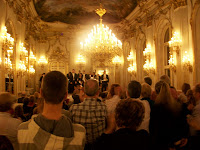
Other languages also spoke to me. One night in Vienna we heard opera in the Hall of Mirrors where, at the age of 6 in 1762, Mozart performed for Empress Maria Theresia (Marie Antionette's mother.) Although none of the performance was in English, the body language of the singers helped convey the stories they were singing. The music itself, composed by Strauss and Mozart, was its on language without words-- bringing me to tears as I remembered my father's love for classical music.
In a similar vein, the paintings and sculptures that bedeck roofs, churches, and doorways throughout Austria, Germany, and the Czech Republic each tell a story. This picture shows a medieval painting that had been stuccoed over in a cathedral in Salzburg.

This sculpture crowned the Gloriette, Maria Theresia's "summer home."

I never tired of the beautiful frescoes on the buildings' exteriors. These were both in the Czech Republic.

In Prague, before they begun to number the houses, they used pictures over the doorways like this, to identify the homes.

Sculptures were common in large cities or small towns.

Lisa loved this unicorn, near the steps where Maria and the Van Trapp children sang the "Do, Re, Mi" song in the Sound of Music.

Although my lack of German or Czech language skills did keep me in an "American bubble," I respectfully disagree with Lisa and Courtney--there are languages that speak across cultures. But, when I visit Spain next year when my other daughter Lori is studying there, I will take Lisa and Courtney's advice to heart. I'll be careful who I choose to smile at.
>Technorati Tags:
, , , , ,

Wednesday, May 13, 2009

The Outcasts of 19 Schuyler Place


What do two semi-retired Hungarian watchmakers, an unemployed billboard painter, a bald-headed art curator who wears a diamond stud in one ear, a high power attorney from a large New York communications firm, and a precocious 12-year-old girl all have in common?

Their passion to preserve three gigantic towers that are threatened to be torn down by city officials who consider them blights in the neighborhood.

These are not any ordinary towers, of course. But instead, they are outsider art built from pipes, scrap metal, pieces of porcelain, and a variety of glass shards (including such things as pieces of blue Noxema bottles) that took the two Hungarians 45 years to build.

In EL Konigsburg's 17th novel, a reader can hardly find a character that is more spunky, determined, and resourceful as Margaret Rose Kane. Full of humor, pathos, and suspense, readers from 5th grade and up will cheer along as Margaret Rose figures out a way to protect her uncles' beloved works of art from being destroyed.

I listened to this on CD and found Molly Ringwald's characterization of the Hungarian uncles particularly delightful. She captured their accents and my enjoyment of listening to their warm approval of their niece as well as their frequently funny arguments was enhanced by her performance. The uncles' astute observations of life add a rich depth to the story. "What you take away is as important as what you leave," Uncle Alex tells Margaret Rose as he "edits" (prunes) his roses. Through her characters, Konigusburg gives her readers—both young and old—a lot to think about.

This is a David vs. Goliath story that can be used in the classroom or home school setting to foster discussions about art, creativity, and the role of individual expression. (Atheneum, 2005)


Technorati Tags:
, , , ,

THE NIGHT WAR: A MG Historical Novel Review

  By now you should have received an email from my new website about my review of THE NIGHT WAR by Kimberly Brubaker Bradley. (It'll com...