Showing posts with label upper middle grade. Show all posts

Saturday, January 27, 2024

TEARS TO PRINCESS: A Review of "Tears of A Princess" by Guest Blogger, Mara Scudder

Tears of a Princess by Laura Thomas is the upper middle-grade sequel to the novel Tears to Dancing. It follows the main character’s best friend, Natasha, as she deals with the news of her parent's divorce and accompanies Bethany on a mission trip to Mexico that changes her perspective forever.


Although some elements of the novel were written better than the first book, there were still two persisting drawbacks. The first was the characters, all of which were one or two-dimensional. Even Natasha, who we were supposedly watching transform from a spoiled rich girl to a selfless and caring Christian, had most of her character development done throughout the year gap between the end of the first book and the start of the second. While the girl in the first book was careless, narcissistic, and vapid, in the second book Natasha has much more substance, dealing with a few emotional outbursts, which she quickly apologizes for. I was looking forward to watching the dramatic change, but instead it seemed as though she had already accomplished most of the change without God.

Another drawback was the dialogue. Rather than letting readers discover what a character was feeling and how they were changing, the author used exposition for the characters to communicate to each other. While their thoughts were more abstract and natural, their dialogue was blunt, no-nonsense, and to the point, even during very emotional scenes. This made it difficult to read, especially in scenes that were supposed to be the most powerful.

One thing that I appreciated about this work was the overarching themes that were missing from the first. Both tears, the sunrise, and the idea of Natasha being a “princess” were echoed throughout the work. Natasha’s transformation from being her father’s “princess” as a term of indulging endearment to thinking of herself as being a princess as the daughter of the King of kings had a special impact because of its intentionality. Tying in tears as her way of breaking her family’s picture-perfect facade and becoming more honest with people around her also enhanced the continuity of the work and made the resolution much more conclusive than it would have been otherwise.

Aside from this, the plot was also more coherent, allowing a more natural flow between events than the first book, and the overarching themes made the ending far more complete and satisfying. This ending made the ideas it had to offer much more impactful, creating a stronger lead-up to the trilogy’s finale, Tears, Fears, and Fame.


Hi! My name is Mara, and I’m a Christian artist, violinist, and blogger. I remember the day that I decided that I would learn something new about what makes a good story from every book I picked up — whether it was good, bad, or a mixture of both. I use my 
blog as a way of sharing some of the tips and tricks I’ve learned and highlighting which books, cartoons, and movies have taught me the most about writing an awesome story. I’m in eleventh grade and live in Philadelphia.  


Check out Greg Pattridge's Marvelous Middle-Grade Monday blog 
for more book recommendations.


Saturday, August 5, 2023

TWO JAPANESE INTERNMENT GRAPHIC NOVEL REVIEWS

 In my search for graphic novels to help me understand the genre, I came across these two books in my local library. Although totally different from each other, they both share the common element of Japanese internment camps during WWII.

DISPLACEMENT by kiku hughes


The first page of this YA time travel novel provides a backstory to equip the reader for the coming story. Written in first person, the character Kiku, explains that it is 2016 and she's been trapped in the past for over a year.

She's in San Francisco with her mother who is searching for the house where her mother grew up in. They didn't find the house.


Instead, Kiku found displacement.


She is taken back to the 1940s to the Japanese internment camp to which her grandmother, Earnestina and her parents, were taken. The story interweaves Earnestina's story with fictional elements of Kiku's time travel.

Through expressive images and dialogue, the author shows Kiku's loneliness, confusion, helplessness, and gratitude when she makes a few friends. She overhears Earnestina speaking Japanese in the rooms next to hers, but can't understand the language. Her roommate, Aiko, doesn't encourage her to learn Japanese. Kiku thinks,

But seeing how she and other Nisei (second generation) shied away from the Issei's (first generation) outdated traditions made me understand a little more just why there was almost no connection to Japan left by the time I was born. (p. 96)

Life is physically and emotionally difficult in the camp and Kiku vacillates between waiting to return home and making the best of the situation. When a neighbor gives her a small carving with her name on it, she recognizes a similar item that her mother had that belonged to Earnestina. I felt an intense connection to my grandmother in that moment. We were linked through this community, and I held the proof in my hand." (p. 128)

She moves to the Topaz relocation center in Utah and hears that a friend's father was taken to an army camp. They fear that they might not hear from him because they took his books and maps which made the government suspicious. Being from the future meant very little when my education on the past was so limited. (p. 154)

The illustrations are drawn with clean lines and the character's emotions are clearly portrayed. A palette of aqua and brown provide a calming effect for the turbulent story that unfolds.

I thought that the author depicted the conflicts of this time and place extremely well. Although the time travel aspects and resolution to the story were also well constructed,  I didn't like that the protagonist fell in love with another girl. As a conservative Christian, that aspect of the book detracted from the book's overall appeal. After googling kiku hughes, I realized that the protagonist reflects the author's orientation. 
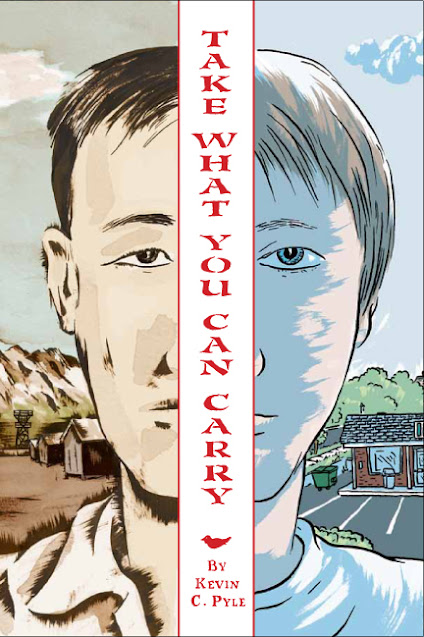
TAKE WHAT YOU CAN CARRY  by Kevin C. Pyle


Although this is also a graphic novel about the Japanese internment camps (with a surprisingly similar palette to Displacement), it is handled in a totally different manner. As you might assume from the cover, this is two stories in one book. The brown illustrations show the life of Mr. Himitsu as a young man in the Tanforan Assembly Center and then later in the internment camp in Manzanar, California in 1942. The blue illustrations depict six months in the life of Kyle, a young teen who recently moved into a Chicago suburb in 1978. Both stories progress through the book. Sometimes several pages are given to the Japanese internment camp, and sometimes several pages show Kyle choosing to go deeper and deeper into vandalism and shoplifting. 

At first, I didn't like that there was no dialogue in Mr. Himitsu's story, only illustrations. But the second time through I was able to "read" the illustrations better and saw how Kevin Pyle showed parallels between the two stories--thirty-five years apart. 
  • Each boy was in his own type of prison. 
  • Each boy faced teasing and ridicule.
  • Each boy faced unwelcome relocation.
  • Each boy experienced trauma that left them feeling powerless.
But, there are a lot of differences too.

In Mr. Himitsu's story, a mentor provides an opportunity for him to vent his anger--on a piece of wood. He carves and carves and by the time he leaves the camp, his suitcase is full of wooden birds. 

In Kyle's story, he has moved into a brand new neighborhood. He starts hanging out with some other boys they are a negative influence on each other. Kyle ends up destroying property and shoplifting--just for the thrill it gives him. The ending perfectly brings the two stories together.

Here are some pages that show you how the author juxtaposed the two stories.


I asked Kevin what his connection was to this story. Here is his answer:

"The most obvious is that I was caught for shoplifting when I was 11 or 12 and I worked for the storeowner as restitution. It really made me see the consequences of my actions. As an adult I did illustrations for the national law journal and once did one on alternatives to sentencing for youth and it made me think back on the experience. I realized I never knew if it was my father’s idea or the storeowner’s that I work off my debt and that sent my imagination rolling.

My other connection is that I had a painting teacher in college who was interned as a child. I wrote him while I was working on the book and he gave some good leads on research. He also read it before it was published and his comments were very inspiring and reassuring as to the accuracy. While the book was not intended as a straight history, I of course wanted to make sure it rang true."

Both authors drew from personal life events when writing and illustrating their graphic novels. As I plot Nightmare in Nuremberg, I'm aware that I'm doing the very same thing.

If you are interested, here is my review of Gaijin, another graphic novel about the Japanese internment camps. And my review of Red Berries, White Clouds, and Blue Sky

****

Congratulations to Sarah Johnson who won Southpaw Sully from last week's blog.

Don't forget to check out Greg Pattridge's MMGM blog with lots of other middle-grade book reviews!


Friday, June 2, 2023

BEHIND THESE HANDS: A Review and Giveaway

I am blessed with amazing writer friends whose stories inspire my writing. This week I am pleased to share BEHIND THESE HANDS by my writing buddy, Linda Phillips. Some of you may remember the cover reveal and when I blogged about Linda's unique path to publication for this book, which is her second novel in verse. Now you can glimpse inside this beautifully written upper-middle grade/young adult novel. 

But first, an update from Linda:

"Since the publication of BEHIND THESE HANDS in 2018, I have had the opportunity to share the keynote address at the National BDSRA (Batton Disease Support and Research Association) along with Laura King Edwards, whose younger sister, Taylor, partly inspired this story. Sadly, both Taylor and the other inspiring student whom I taught, Brandon Hawkins, have succumbed to this dreadful disease. Their legacy lives on through the work of the foundation, Taylor's Tale, and other foundations supported by BDSRA. Many thanks to my publisher, Light Messages, for keeping the fire going through this opportunity for my ebook to be selected as a Kindle Monthly deal through the month of June.  I hope you enjoy the read, and I always love hearing your feedback:  https://www.lindavigenphillips.com/contact/"


REVIEW

Fourteen-year-old music prodigy, Claire Fairchild, is headed toward a music competition. Her only worry is if she takes first place over her best friend Juan--who is actually proving to be more than "just a friend." The book opens with Claire's piano practice interrupted by her younger brother Davy who is visually impaired and recently diagnosed with a learning disorder. He smiles a lot and Claire thinks, 
It bothers me that he smiles so much, 
maybe because it doesn't seem normal; 
maybe because I know for sure  
if I were in his shoes 
my smile would be the first to go.  (p.6)

This is her first attempt to write down the music she has composed for the competition:
"The Kite" takes off 
in the dead silent stillness 
of this tiny room 
as if the breezes were driving  
through these walls, 
and I chase it with the melody 
that has gelled in my brain 
these weeks of practice, 
experimentation, 
frustration, 
doubts, 


and now 


certainty 
and  
exhilaration. 


I slide on the bench  
to the little table, 
and begin the task of setting down the notes 
that are strung across my brain, 
ready to pluck down 
like washing on a clothesline. (p. 15)
Into the middle of her preparation she is constantly interrupted by her parents' worries about Davy, his medical tests, her need to watch both brothers while her parents work, and her own self-doubts, comes devastating news: 
The suspense is over. 
Our house feels like 
those pictures you see 
after a tornado levels        
              everything 
but the victims are alive, 
shuffling around the debris 
in a daze. 
It's called Batten disease. 
.....
and  
it's going to get worse.  (pp. 31-32)


In heart-wrenching verse Linda leaves nothing to the imagination as Claire and her family reel from the news that truly does get worse: Davy will die from the disease, Claire is unable to concentrate on practice, she wants to give up music altogether because it feels meaningless, she is pummeled with guilt, her father won't talk about the diagnosis within the family, everyone acts like their family is normal when it is anything but, her mother is coming unraveled from lack of sleep and worry, and a cooling off with Juan that she can't explain--these are all more than Claire can bear.
Batten has rearranged our family 
like pieces of familiar furniture 
placed awkwardly in a new setting. (p.72)

When genetic testing reveals that her other brother, Trent, also has Batten, Claire finds out devastating news about herself:

What does that mean          
what she just said?                        
                      Carrier? 
What does that mean? 

I put my head in my hands 
seriously feeling faint now, 
nauseous, 
miles away as if I had just stepped          
                    out
of my own body. (pp 96-97)
Into the middle of this devastation steps Claire's best friend, Mia, who drags her along on a journalism assignment. Together, they befriend  Mrs. Shepherd, an elderly woman who shares her past sorrows as well as her wish that she had celebrated life more. This, along with attending the Batten Disease conference with her father, gives Claire the tools and drive to regain purpose and a plan to combat "the beast." 

I know I'll find a way to help my brothers. 
I know that wasting my time feeling sorry for myself                 
                       needs to be a feather      
                       not a rock.
I know that celebrating life needs to be a rock      
                       not a feather.
I know it might not be a bad day after all      
                       if I keep this up. (p.199)

BEHIND THESE HANDS doesn't cut corners or pretend something is pretty when it isn't. Batten Disease cuts short the life of young people and leaves families devastated by pain and loss. But it is the story of a brave young woman who faces it head-on and learns to celebrate the life of her two young brothers. In the end, she, Juan, and Mia meet with her parents to plan a fundraiser for Batten research. Other friends come to the house singing one of Mrs. Shepherd's favorite songs, "This Land is Your Land."
We all join in. 
Out of the corner of my eye 
I see Davy and Trent sitting at the top 
of the stairs, 
smiling and clapping. 
Mom brings them down and we finish the song.


"Are we having a party?" 
Davy says.


"Yeah," Trent says, rubbing his eyes, 
"How come you didn't invite us?"


All eyes fall on me.  
"This is just a preview, guys, 
the first of many

          and you will be invited

       to every single one of them.

I promise." (p. 288-9)


***********

GIVEAWAY


This book belongs in the classroom and will help readers gain empathy for those facing severe medical difficulties.  As Linda demonstrates in two scenes where bullies tease her brothers; it is often easy to pick on those who are weak. If you are a librarian or teacher let me know in the comments; I'll put your name in twice. I will pick a winner on June 7 and Linda will autograph a copy of the book. Please, U.S. addresses only.  

Make sure you check out Greg Pattridge's wonderful ALWAYS IN THE MIDDLE blog with other middle grade recommendations.


THE NIGHT WAR: A MG Historical Novel Review

  By now you should have received an email from my new website about my review of THE NIGHT WAR by Kimberly Brubaker Bradley. (It'll com...