Friday, January 22, 2010

Help for Haiti


Generally this blog is about literacy. But every now and then I blog about other important topics. This is one.

If you're like me, you might have wondered what you can possibly do to provide assistance in the wake of the disaster in Haiti. This week I found an answer in Donna Earnhardt's blog. She wrote about the health kits that UMCOR is assembling and distributing. Here are the instructions:

For individuals or groups that want to contribute basic necessities, UMCOR requests that the following NEW items be placed in a sealed one-gallon plastic bag.

1 hand towel (15” x 25” up to 17” x 27”. No kitchen towels.
1 washcloth
1 comb (large and sturdy, not pocket-sized)
1 nail file or fingernail clippers (no emery boards or toenail clippers)
1 bath-size bar of soap (3 oz. and up)
1 toothbrush (single brushes only in original wrapper, no child-size brushes)
6 adhesive plastic strip sterile bandages
$1.00 to purchase toothpaste
(NOTE: Toothpaste is purchased in bulk to be added to health kits to ensure that the product does not expire before they are sent.)

Because the emergency kits are carefully planned to make them usable in the greatest number of situations and strict rules govern product entry into international countries, UMCOR requires that the kits contain only the requested items – nothing more. In Charlotte, NC you can drop off assembled kits at: Mount Olivet UMC, 301 Mount Olivet Road, Concord, NC or at St. Stephen's United Methodist. Shipping instructions are also online here.

If my 85-year-old mother can assist in providing help to Haiti, what can you do?

Technorati Tags:
,

Thursday, January 21, 2010

Flygirl Makes the List!


I was delighted to find out that a book I recently reviewed, Flygirl was recognized as one of 2010's Best Books for Young Adults by the Young Adult Library Services Association.

I am planning on interviewing the author, Sherri Smith, in the next issue of Talking Story. I e-mailed my congratulations and said I knew she'd be dancing a jig in excitement. She wrote back, "Thank you, Carol! I only just found out about it myself. I’ll go put on my jig shoes and dance!"

Technorati Tags:
, , , ,

Tuesday, January 19, 2010

Multi-Racial Read #3


From the moment I read the title, When White is Black I knew that I would find stories within that would inform my research. Written by John Martin,
this is another book which causes the reader to consider how the color of a person's skin affects how he is perceived and treated by both the black and white community.

One aspect of this book which I find intriguing, is Martin's family tree that introduces the narrative. Tracing his mixed race heritage back four generations, Martin had African American, Native American, and Caucasian ancestors on his mother's side. I was familiar with the words Mulatto and Quadroon, but Martin introduced me to Octoroon. He labels his family further explaining that many were "Mulatto-W" (65% white). This forms an excellent backdrop to showing how the "one-drop rule" governed both his mother's and grandparents' lives.

Most of the book records his mother's (Mulatto-W) and grandmother's (Quadroon) experiences as multi-racial women--well before there was more than one box to check on a census form.(It was not until 2000 that individuals could check more than one race on the census form.) The time period spans almost a century (1876-1969) when passing afforded a better economic lifestyle but also included personal risks from both the white and black communities.

One of the stories that demonstrates the schizophrenia of the time period shows how in mid-life, Martin's great-grandfather (Mulatto-W) was recast from white to black after an incident when he saved a black man from being beaten by whites. The man he rescued later accused him of having a "brown" grandmother, whites began condemning him as a "white nigger," and his life dramatically changed. His daughter (Martin's grandmother) had always seen herself as white, "...in view of how colored folks were treated, there was no way she, or anyone else in their right mind, would voluntarily choose to be one of them." (p. 36). For many years afterwards she was plagued with "a mixture of confusion, anger, resentment, paranoia, and fear." (p. 37). Her questions about why her father has been mistreated were finally answered when she understood "how colored people experienced daily life, the humiliations they suffered, and the real barriers they had to overcome just to exist." (p. 37)

Are racial biases only about skin color, hair texture, or the shape of one's nose? In my next two blogs I'll reflect on that in greater depth.

Technorati Tags:
, , , , , , ,

Friday, January 8, 2010

Multi-Racial Read #2


Flygirl is a fictional account of a young light-skinned African American woman in Louisiana in 1941 who decides to pass in order to be accepted into the WASPs (Women Airforce Service Pilots). Her motivation is two-fold and powerful. She has a deep passion to fly, fueled by memories of flying with her deceased father who taught her how to fly his crop duster; and she desires to help bring her older brother home who enlisted as a medic.The core of this book, which is appropriate for 5th-9th grade readers, is the price that Ida Mae will have to pay to accomplish her dream.

I read this book looking for background information on Lillie Harris, my light-skinned African American character. I was not disappointed. Sherri Smith, the author of Flygirl, deftly depicts the conflicts which Ida Mae experiences because of her skin color. From the beginning when her best friend observes that she is “Little Miss Pretty Hair [with] Creamy White Skin” (p. 9) through the last pages when she is confronted by romantic attention from her white flight instructor—the book is full of the difficult decisions Ida Mae makes in pursuit of her goal.

As an author investigating the social and cultural context of the South before integration, the book’s key passages are those which show Ida Mae’s background and the tensions which she faces. Early in the book the reader discovers that Ida Mae’s maternal grandmother is a French-speaking Creole. Smith writes,

“My father’s people were town people, city folks who followed opportunity the way a compass follows north. Sometime back, one of them found herself with child by a white man. They steered that half-colored girl down a path that made each generation lighter than light, having children by white men and marrying those children to other mixed coloreds, lighter and whiter until my father was born.

“Daddy was destined to marry a white woman, to be a passé blanc and give his family a better lot in life. By daddy wasn’t an opportunist. He was a romantic, and his heart chose Mama. Grandmѐre Boudreaux never forgave daddy for his choice of a brown-skinned bride…” (p. 53)

Constantly fighting her fear that she will be discovered, Ida Mae passes into a world that is denied other African Americans. Although she is accepted into the WASP program and fulfills her dream to fly, there are heavy consequences. In a poignant scene her mother visits her at the training camp. Meeting her at the gate, Ida Mae pretends that her mother is her maid in order to have a simple conversation:

“Aware of the guard at our backs, we fall into the pattern of mistress and maid. Watching my mother play the role of servant, I feel a sour taste in my throat. I never meant for my own role-playing to bring her such humiliation.

“I don’t know this guard. He gives us a suspicious once-over, the look of someone trying to keep his status. “It’s all right,” I tell him. “She’s our housekeeper.” The word burns my throat…” p. 160-161.

Although more appealing to girls than boys, this account of one women’s struggle against both gender and racial prejudices would supplement classroom studies of African Americans and World War II. I learned a lot by reading it; Flygirl will provide thought-provoking lessons to students across many cultures. (G.P.Putnam’s Sons, 2008)
Technorati Tags:
, , , , , , ,

Saturday, January 2, 2010

Multi-Racial Read #1

"In Charlotte in 1950 family secrets unravel when a 13-year-old white girl (Kate) and a 14-year-old light-skinned black girl (Lillie) discover that they have the same great-grandfather."

That is the pitch of my Work In Progress (WIP). Although I'm a little younger than Kate and I wasn't raised in the South, it's not too much of a stretch for me to conjure up her character. But Lillie is another matter. The more I thought about her the more I realized that I had no idea what her life was like. My quest to discover how she would have felt about herself, her family, and her community, began in the research section of the Morrison branch of the Charlotte library. My next few blogs will be about the books that have informed my research.


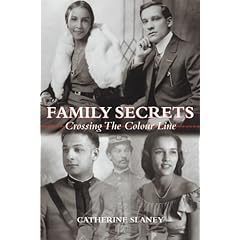
Family Secrets: Crossing the Colour Line by Catherine Slaney is an autobiographical account of how she discovered her black ancestors and relatives. Raised white, she began uncovering her genealogy in her forties. She uncovered the fact that her great-grandfather was Dr. Anderson Abbott, the first Canadian-born Black to graduate from medical school in Toronto in 1861. In the process of delving into her history, she investigated why (and how) several family members decided to "pass" as white, while their siblings did not.

One key theme I found in this book as well as in others, is that race is not just about the color of one's skin. As Slaney writes, "...this race business seemed to me not so much a matter about colour (sic), but rather one of racial identity and cultural representation." (p. 147)

When Slaney received photographs of her cousins she discovered great variations in appearances. "Some of the cousins were very 'black,' some were 'dark,' and others quite 'fair.' However, what really amazed me was that their skin colour did not necessarily reflect their choice of racial identity. In one case, I received a photo from a 'Black' cousin who strongly resembled my 'white' uncle they could pass as brothers." (p.147)

One of her light-skinned Black cousins wrote to her and said, "Americans tend very much to classify people by race. I think this probably goes back to the first segregation laws. Not that it was absent before but people were forcefully separated by their physical appearance. The Black's facilities, from schools to washrooms, were always inferior to the white's, during segregation, which perpetuated the notion that they were an inferior race." (p. 148)

This led Slaney to question, "If life could be so difficult as Black and one could pass as white, then why not do so? Moreover if one looked white, would it not prove awkward to claim a Black identity? Perhaps the purpose of identifying oneself with a particular race had more to do with the colour of one's state of mind rather than one's color of skin. Did identifying as Black then automatically imply that one could not identify as white? As one white cousin asked, 'When one is of mixed race, where does passing end and identity as white begin? Is it simply based on how you look?'" (p. 150)

These questions run through my mind as I wonder, how would Lillie have seen herself? How did others react to her? What experiences shaped and molded her? Stay tuned. With help from Slaney and others, Lillie is coming to life.

Technorati Tags:
, , , , ,

Thursday, December 24, 2009

Details Make a Difference

One of the instructional themes in Teaching the Story is that the details which an author includes make a difference in depicting a character, setting, or time period. I am repeatedly reminded of this fact in my own reading and writing.

Currently I am listening to Chains by Laurie Halse Anderson. This story of a young black female slave in New York City during the American Revolution is full of well-researched details. The foods the characters eat (eel pie, strawberry tarts, turtle soup); the clothes which the slaves wore (rags for gloves in the middle of winter); the fashion of the upper class women (mouse fur for fake eyebrows); the foods which the prisoners shared (buckets of moldy table scraps which friends or family brought)—all of these provide authenticity to Anderson’s thought-provoking story about the struggle for freedom. (By the way, this book would be a great supplement for upper elementary through high school students who are studying this time period. Make sure you download the reading guide and Anderson’s “Behind The Book” also.)

Recently I wrote a scene in my historical novel where my character puts her dog on a leash and walks him. Several days later, I interviewed George Snyder, a native Charlottean who lived in Myers Park in 1950—-the place and time period for my book. While showing me the house he grew up in and talking about his childhood George said, "We all had dogs. They weren't penned like they are nowadays. They would just run after us on our bikes. No one had leashes." I wouldn’t have guessed that in 1950 in Charlotte, NC dogs weren't on leashes. A minor detail, but one that is now correct.


Here is a picture of George pointing out the initials “LS” (for Luther Snyder) carved in the shutters of his grandfather’s eighty-year-old house. It’s an intriguing detail which would be tempting to work into my story. But as Karen Dionne warns in “Fact into Fiction” in the January 2010 issue of Writer’s Digest, “Facts are fun, but if a detail doesn’t move the story forward by establishing the setting, advancing the plot or shedding light on the characters, it doesn’t belong.”

In a few years when you read Half-Truths and you come across a savory detail—be sure that I have thought long and hard about including it. And if initials appear in a shutter somewhere you'll know there is a reason why.
Technorati Tags:
, , , , , ,

Sunday, December 20, 2009

Reading, Writing, & Gingerbread Houses

When my daughter Lori graduated from Covenant Day School three years ago, she challenged me by saying, "Mom, you've got a lot of time now. I think you should volunteer somewhere." I don't know about the "lots of time" -- but I did agree that I could be more involved on a volunteer basis in the community. Since my love is literacy, I approached Covenant Day High School and volunteered to coordinate a tutoring program. Together with volunteers from Christ Covenant Church, we are now in our third year. Last year we added a monthly trip to the school library as well as playing educational games when the students are done their work. Here is a slideshow including one of the library trips, tutoring, and our recent holiday party.


Technorati Tags:
, , ,

Tuesday, December 15, 2009

The Scholastic Art and Writing Awards for Grades 7-12

The Alliance for Young Artists & Writers invites students in grades seven to twelve to participate in the Scholastic Art & Writing Awards of 2010, the nation's longest-running, largest, most prestigious recognition program for creative teenagers in the literary arts. Scholarships are provided from a pool of $3.25 million in tuition support, the largest source of funding for teens in the arts. The top five writing portfolios submitted by graduating seniors are recognized with Portfolio Gold Awards of $10,000 each. Deadline is January 10, so you'll have something to do when you get back from winter break.
Technorati Tags:

Wednesday, December 9, 2009

My School in the Rain Forest


Back in November when I was a presenter at AASL, I got to play hostess to several authors who were also attending the event. I warned them ahead of time that the only "payment" I wished to receive was autographed copies of their books. They graciously complied and my library is richer. As I read them, I will share them with you.

My School in the Rain Forest by Margriet Ruurs (Boyds Mills Press, 2009) is a wonderful addition to her other book, My Librarian is a Camel. Through beautiful photographs and interesting text, Ruurs shows how children attend classes in such varied places as an outdoor school under a tree in Kenya, onboard the MV Anastasis hospital ship, and in a floating school on a lake in Cambodia. Children from kindergarten through middle school will learn from this eye-captivating book.


Technorati Tags:
, ,

Saturday, December 5, 2009

A Couch Story

I usually just blog about literacy. But when my daughter Lori (who is studying in Spain) posted this video on Facebook, I couldn't resist sharing it with you. Hope you enjoy it!


Besides...just think of all the literacy skills that were used to put this video together!
Technorati Tags:
, , ,

Thursday, December 3, 2009

Look Mom, I'm in Highlights!

Do you remember reading Highlights Magazine in a doctor's office as a kid? Remember the page where other children sent in poetry and drawings? Didn't you always want to see your own work displayed in those pages?

Children's writers and illustrators still aspire to be published in Highlights. For many of us, it's a milestone that once we reach it, we feel that we've finally "arrived."

Joyce Hostetter, and I can now proudly say we have reached that milestone and gone beyond. Yesterday, a staff member of the Highlights Foundation sent out an e-mail quoting articles which Joyce and I had written in Talking Story. For those of you who may not have read them, here is what was delivered to thousands of in-boxes throughout the world yesterday (with the addition of a few pictures):

What I Did on My Summer Vacation
By Joyce Hostetter and Carol Baldwin
Excerpted by permission from Talking Story, a newsletter by Joyce Hostetter and Carol Baldwin.

By Carol
When Joyce suggested this title for an article, we both laughed. How many of you remember writing that familiar essay?

I was fortunate to travel five times this summer. The most exotic destination was fourteen days in Austria, the Czech Republic, and Germany. The most writing-intensive destination was the Highlights Foundation Writers Workshop in Chautauqua, New York. For years I dreamed of attending; and when my writing buddy decided to go, we took the plunge, paid our deposits, and signed up.


Joyce said it would be life changing. I'm expecting she'll be right.
If you're serious about writing or illustrating for children, this is an event you want to attend. For five days, one hundred-plus participants are surrounded by a faculty of twenty-two authors, illustrators, and editors whose desire is to see you produce your best possible work and get it published. Workshops, speeches, networking times, and critique sessions with faculty stuff each day to the brim.

I was challenged by both Patti Gauch and Harold Underdown (my critiquer) to find out what the character in my historical novel truly wants. Patti said that this desire must be the "arrow that drives the book." I learned about dialogue from Donna Jo Napoli, a sense of place from Kim Griswell (pictured below), and about beginnings and endings from Peter Jacobi. There were forty-five workshops offered—more than enough to inform and saturate every participant.


One of the benefits of the intimate atmosphere was schmoozing with other aspiring writers, famous authors, and accessible editors. I think I'll never forget the image of Jerry Spinelli (pictured below), walking hand-in-hand with his granddaughters to the bus taking us to a picnic. With his flannel shirt and jeans, he is the most casual famous individual I've ever met. (His granddaughter, by the way, had an autograph book and was collecting autographs of other writers. I think she was sweetly oblivious to the fact that her grandfather was probably the most famous writer there.) I enjoyed meeting Carolyn Yoder, Joyce's editor, and Andy Boyles, the science editor at Boyds Mills Press, who expressed interest in my glass book.
Life changing? Stay tuned. I'll let you know as the year progresses and I practice what I learned in beautiful Chautauqua, New York.


________________________________________
By Joyce

I, for one, would love to go to Chautauqua every summer. But Chautauqua is more like a once-in-a-lifetime experience. So I didn't let my mind dwell on that idea.
Instead I planned to mostly stay at home. I was tired of traveling during the school year and wanted to save my away time for a writing retreat in late summer.
So during the last full week of August, I indulged in a week in northeastern Pennsylvania at one of the Highlights Founders Workshops. These events, no matter the workshop title, are writer's heaven. At each one I've attended, I've grown as a writer and made new friends.
This event was a writing retreat with my Calkins Creek editor, Carolyn Yoder, and ten alumni retreaters.
I enjoyed
my own cabin with coffeepot and drinks in the fridge;
one-on-one critiques with Carolyn;
writing all week!;
writer friendships;
phenomenal food; and
Sunning weather.
It was the perfect summer vacation!

For more information about the Highlights Foundation Writers Workshop at Chautauqua or our Founders Workshops near Honesdale, Pennsylvania, visit www.highlightsfoundation.org or contact Jo Lloyd at contact@highlightsfoundation.org.
Please feel free to share this e-mail with others who may be interested.
Talking Story is a newsletter produced by authors Joyce Hostetter and Carol Baldwin
Highlights Magazine, HIghlights Founders Workshop, Calkins Creek, Highlights Writers Workshop, Joyce Hostetter, Talking Story

THE NIGHT WAR: A MG Historical Novel Review

  By now you should have received an email from my new website about my review of THE NIGHT WAR by Kimberly Brubaker Bradley. (It'll com...