Friday, January 25, 2008

From the Mountains to the Sea


Two weeks ago I was in Cullowhee, NC for the NCCAT seminar; today I'm in Kiawah, SC presenting at the South Carolina Council of the Teachers of English. Believe it or not, it is colder along the coast of South Carolina than it was in the mountains! Such is the unpredictability of Carolina weather. Highlights of this conference have been:

  • The genuine warmth and hospitality of the SC teachers. They are an enthusaistic group of educators.
  • Meeting Art Young, the keynote speaker and one of the leaders in the field of Writing across the Curriculum. This morning he addressed the links between reading, writing, technology, and conversational learning. I was fascinated by the interaction of SC high school students; Clemson University students; and Sweden's Chalmers University of Technology students as they read T.S. Elliot's "The Love Song of J. Alfred Prufrock" and discussed it through a blog. What a remarkable way for students to think critically and be challenged by students from other peer groups and cultures!
  • Meeting a friend of Julie Graddy, Maupin House's publisher, from 30 years ago when they were friends in Gainesville, Florida. I sat next to her at lunch and within 3 minutes we'd found a connection. Small world.
  • Signing Teaching the Story—always fun!
  • Learning more about wikis and blogs. Technology in the classroom, as many of you know, is staring us in the face. The second edition of Teaching the Story will have several mini-lessons on using technology to teach students how to write fiction. Stay tuned for more details!
  • Walking by the ocean at sunset, where waves combed the beach leaving tendrils of sand to be washed away in tomorrow's tide.
  • Finding a perfect miniature conch shell which I will save for my granddaughter, Ebby.

Thursday, January 24, 2008

Crispin: The Cross of Lead by Avi


This is a magnificently written story of two individuals whose lives intersect in medieval England. The first is Crispin, an orphaned peasant boy who is pursued by nobles suddenly seeking to kill him. The second is Bear, an itinerant juggler and a member of an underground movement pursuing freedom from the same nobility who are trying to capture Crispin. Written with authentic language and dialogue, Avi keeps young readers on edge as Crispin faces one conflict after another against the background of peasant life complete with the ever-present hostile soldiers, the slop in the streets and the lice in Crispin's bedding.

History teachers who are teaching medieval history can use this book for supplementary reading, but for those of you who are teaching writing, this mentor text is also a great example of how a main character solves his problems. From climbing walls that separate him and Bear, to outwitting his chief antagonist (the village steward) with clever words and a dagger, Crispin matures. As a result of his difficulties, he is transformed from an ignorant village boy who fears that a 3-story building will fall down, to a young man who rescues his hero and surrogate father, Bear.

Great character lessons also pervade this book. Better than a 21st century psychiatrist, Bear teaches Crispin that he isn't a "nobody without a soul." By listening to instructions to look people in the eye, the young boy hesitatingly moves from a servile position into the freedom of being able to make his own decisions. Bear's words are worth quoting. At one point he remarks, "In a ruthless world I find innocence more a puzzle than evil." Coming from the lips of a fictional character that lived over 600 years ago—it is still applicable today.

Girls and boys from 4-8th grades will enjoy this 2003 Newberry Medal book. It is the precursor to Crispin at the Edge of the World which I also enjoyed.

Hyperion, 2002.

Tuesday, January 22, 2008

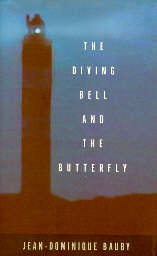
The Diving Bell and the Butterfly


Poignant and powerful, Jean-Dominique Bauby's memoir of the last months of his life make The Diving Bell and The Butterfly a recommended read for mature young adults. In his mid-40's, Bauby suffered a severe stroke to his brain stem leaving him a paraplegic able only to communicate his thoughts, fantasies, desires, or memories by blinking his left eyelid. Written by this former editor of Elle, Bauby's book is a testimony to the power of the written word. In 130 short pages, the reader is invited into a world that we would choose not to experience: a world defined by a respirator (the diving bell), a wheel chair, and helplessness. But from within this powerless condition, Bauby records fond memories of his children, his loves, and even his favorite foods.

Bauby spent a summer working with a young woman who painstakingly read his eyelid blinks by going through the frequency order of the French alphabet. At the end of the summer he dictated the following closing paragraph: "Does the cosmos contain keys for opening up my diving bell? A subway line with no terminus? A currency strong enough to buy my freedom back? We must keep looking. I'll be off now."

He died two days after the French publication of this book.

(Alfred A. Knopf, 1997)


Technorati Tags:

Wednesday, January 16, 2008

Put Pizzazz into your Students’ Writing: Using Fiction Techniques to Write Grab-You-by-the-Collar Expository Essays


Lured by my title, twenty-seven elementary and middle school teachers joined me yesterday at NWRESA in Wilkesboro, NC. With the common goal of improving students' test scores (the specter which haunts many language arts teachers), we looked at how students can improve their essays by adding voice, using "show don't tell writing", and utilizing effective syntax. Along the way we detoured into "the land of critical thinking" as we analyzed low-scoring narrative and expository essays (from Jane Kiester's book, Blowing Away the State Writing Assessment Test) and re-wrote them in a student's voice. Collaboration ruled the day as teachers enjoyed the interaction with their peers, were further validated in their teaching skills, and learned a few more tricks of the writing trade to bring back to their classrooms.

Technorati Tags:
, , , ,

Saturday, January 12, 2008

Is there a Children’s Book in You?


On Monday, Joyce Hostetter and I were welcomed to NCCAT, the North Carolina Center for the Advancement of Teaching. This retreat center, which snuggles into the Appalachian Mountains across from Western Carolina University, is a teacher's dream come true. For one week out of the year, North Carolina public school teachers are given the opportunity to study, relax, and rejuvenate tired minds. This particular week, Joyce and I had the privilege of leading twenty-three K-12 teachers through the process of writing for the children's market.

As we listened to the teacher's goals when we assembled together on Monday afternoon, many repeated the same theme: "I'm coming here to see if I have what it takes to be a writer." Joyce and I were expecting them to state that they wanted to write a picture book or a young adult novel. As we found out, their goals were far more personal: they needed permission to "open a vein" and write which was bubbling just beneath the surface. After that initial session, I advised the group that beyond the ability to write (which they all demonstrated beautifully), they each needed two greater skills: the ability to receive rejection and the ability to persevere.

As I anticipated, Joyce and I complemented each other. It is as if we have each been developing our skills in anticipation of crossing paths at the MidSouth Reading and Writing Institute last June. Joyce, as the middle grade author of BLUE, brought her knowledge of writing dialogue, historical fiction, and personality types (both of the authors and characters!). I brought Teaching the Story: Fiction Writing in Middle School, 15 years critiquing manuscripts for the SCBWI Charlotte group, and my experiences teaching teachers. We were delighted to discover that not only our laptops full of powerpoints dovetailed, but our personalities worked well together also. Joyce gently chided me that I was the one who made sure we stayed on our schedule and was ready to improvise in front of the group; I envied Joyce's well-designed powerpoints that had cars and characters careening on and off the screen.

On Thursday afternoon the group gathered to share how NCCAT had refreshed and challenged us both personally and professionally. That evening, as we met to hear everyone's work, I felt like a midwife as I listened to poems, picture books, magazine articles, and the beginnings of several young adult novels. It was a privilege to be a part of the birthing process of so many stories for children–and of the writers themselves.

Sunday, January 6, 2008

Getting Ready for NCCAT

Yesterday, Joyce Hostetter and I had a flurry of e-mails between us as we prepared for our seminar this week at NCCAT on "Is there a Children's Book in You?" We are excited about this opportunity to work together. Although were both brain dead by the time we called it a night, she one-upped me with a great blog about the event. Go to her live journal and see her take on how she got ready for the week. (Don't you just love the color coordinated crates of books? My collection is not nearly as organized as hers!)Technorati Tags:
, ,

Thursday, January 3, 2008

Writers & Teachers-- Take a Break!

Joyce Hostetter, my fellow author and presenter next week at NCCAT, forwarded this movie clip on writers. We'll be using it as an ice breaker; you can use it for a writing break or to show your students. Either way, it's guaranteed to bring a smile to everyone's face!

Technorati Tags:
, ,

Saturday, December 29, 2007

A blog about blogging

Looking for more information about teaching, blogging, & technology? Check out,
Cool Cat Teacher Blog. I stumbled upon Vicki Davis' blog; she has lots to offer and her site is well organized and easy to navigate. Technorati Tags:
,

Tuesday, December 25, 2007

Up the Down Staircase


Why don't you use one of those Barnes & Noble or Borders' gift certificates you just received and treat yourself to a picture of a NY public school circa 1960. I first read Up the Down Staircase by Bel Kaufman (Prentice-Hall, Inc, 1964) as a teenager. Recently, my teenage daughter Lydia, brought the familiar pink and orange book home from the library after reading about it in Now, all we need is a Title. Kaufman's insights into the labyrinth of rules which teachers daily negotiate as well as the voices of the adolescents (who are the reason that teachers keep teaching) are timeless.

Written as an epistolary novel, the office memos, intraschool communications, and students' comments from the class "Suggestion Box," etc., show a novice English teacher's struggles between her desire to reach her students or the pull to accept a more comfortable university position. Here are some snippets to entice you into reading the entire book:

From the Suggestion Box (spelling & grammar are as they appear in the book). These are in answer to the question, "What did you get out of English so far?"

"What I got out of it is Litterature and Books. Also some Potery. And just before a test—a doze of English. Having Boys in class dis-tracks me from my English. Better luck next time." (p.74)

"I hate to think back on all my English years except one teacher I will never forget because when my note book wasn't so good (it was mostly in pencil) instead of telling me to do it over in ink she just told me to put renforcements on the holes and that will be enough. The next day she asked me did I put renforcements in. When I said I did she didn't even look she just said she'd take my word for it. That gave me a warm feeling inside because it was the first time a teacher took a pupil's word without asking to see if it was true. Most the of the time they don't even know your name." (pp 74-75)

"Dribs and Drabs. McBeth one week Moby Dick next, a quotation mark, oral debates on Should Parents be Strict? Should Girls Wear Jeans? The mistakes I made in elementery school I still make. I hope to achieve correction." (p. 80)

"I want to thank you for giving me your time after school, for encouraging me to write, for trying. But with 40 others in the class, whose problems are so different, I realize how little you can do, and I feel we are both wasted."(p. 114)

And on integration (p.212):

1. How stupid can you get?

  1. Bussing kids to school miles away.
    1. Just to juggle it around.
    2. Then got back to the filthy slums.

      (After school)

    3. Can't be juggle like different color marbles.
    4. It takes time.
      1. Lincoln (Slaves)
      2. Rome (Wasn't build in a day)

You'll laugh, you might cry, and if you're a teacher you'll nod your head and wonder along with the author of Ecclesiastes, "Is there nothing new under the sun?"


Technorati Tags:

Monday, December 24, 2007

Snow Flower and the Secret Fan


I love it when my 16-year-old daughter Lydia, recommends a book to me. As she predicted, Snow Flower and the Secret Fan by Lisa See (Random House Inc., 2005) is a compelling, and at times disturbing, story about Chinese women in the 19th century. Unlike other popular young adult novels, this book is written as a personal narrative as the main character, Lily, tells her story directly to the reader. In this way the reader accompanies Lily on her journey as she is paired to another seven-year-old girl who becomes her laotong, her soul mate; undergoes the painful rite of footbinding; learns nushu the secret written language of women; is betrothed, married, and raises children---all within the strict rules of Chinese society.

In the course of the book, the reader learns about the shame, fears, superstitions, and traditions that ruled Chinese families as tightly as a seven-year-olds' bound foot. But it is also a book about love, asking the reader: what is true, unconditional love between friends that accepts without question a beloved's barbs and attacks? At the end, Lily confesses that her pride prevented her from loving rightly and gives the reader much to think about.
Technorati Tags:
,


Tuesday, December 18, 2007

Readinking

"Real reading is reading and thinking at the same time," Ian Carle, fourth grade elementary teacher, Kansas City, Mo.

In a recent letter to the editor in Reading Today, Mr. Carle argued that it is time to invent a new word for reading which engages the reader. "...reading is more than just saying the words correctly. With that in mind, I combined elements of the words reading and thinking and readinking was born…Readinking is the act of specifically thinking while we are reading."

Quoting David Pears, Laura Roehler, Janice Dole, and Gerald Duffy in their chapter "Developing Expertise in Reading Comprehension," which appeared in What Research Has to Say About Reading Instruction (2nd edition) in 1992, Carle lists five activities vital to reading comprehension:

  • Questioning: What readers are asking before during or while they read.
  • Synthesizing: How readers continually change their mind as they read.
  • Schema: How a reader uses background knowledge to understand the text.
  • Visualizing: The pictures that are formed in a reader's head while reading.
  • Determining importance: How the reader is able to identify what is important.

This list compliments the presuppositions and themes of How to Read a Book, a book which I have blogged about and am still working through. (Some books require a lot of readinking!)


I like Carle's thoughts and new word for another reason. Say readinking aloud and another image comes to mind:

READING IS KING!

THE NIGHT WAR: A MG Historical Novel Review

  By now you should have received an email from my new website about my review of THE NIGHT WAR by Kimberly Brubaker Bradley. (It'll com...