Saturday, May 22, 2010

Beach Hands

I rarely write poetry. Every once in awhile, particularly when I'm relaxed on vacation, I play with words and out pops a poem. Here is one I wrote tonight:


ocean hands curl
white, foam grabbing land, layering
sticky, salty, sand, icing
ankles and toes.
Children are crabs,
playing tag
daring waves
to catch them
if they can.


Technorati Tags:


Friday, May 21, 2010

101 Tips for Homeschoolers

If you homeschool your children, you might want to check out this blog for a variety of helpful tips. Although the website appears to be dedicated to helping students find the appropriate online college, there are also numerous resources for students of all ages. The 101 suggestions (or "lifehacks") include links for math, planning, time management, history, and socialization.

Technorati Tags:
, ,


Wednesday, May 19, 2010

Bragging On My Buddies

In our last issue of Talking Story for this academic year, Joyce Hostetter and I offer some fun family and classroom activities, four cool giveaways, and several book reviews.  If you haven’t already subscribed, you can still do so by clicking here.

In addition, we announce two book developments. Joyce’s book Blue has just been released in paperback which is a huge step for an author. “Blue in paperback is more affordable for the reader who doesn’t have deep pockets.” Joyce explained. “And paperback also travels better on vacations!  Also, certain reading lists or programs like ‘Battle of the Books’ favor titles that are available in paper.” You can find a brief review of Blue on my blog here, or more lengthy reviews here. 


Secondly, Clay Carmichael, whose book Wild Things I reviewed this spring, is excited that her book was just released in audio format. "I'm thrilled and grateful to see that Wild Things continues to enjoy such success and to see the audio format expand readership.” Clay wrote in an e-mail. “Last week the book was named a 2010 Bank Street College Best Children's Book and nominated for the 2010-11 North Carolina Children's Book Award--nominated by NC, which please me no end."


I’m proud of both of these North Carolina authors. Both books are great reads for upper elementary school students and if you’re looking for good summer reading for your students or children, I heartily recommend both.


Technorati Tags:
, , , ,


Wednesday, May 12, 2010

Teachable Moments

As educators and parents we’re always thrilled when we connect with a student or child.  That was my experience while working with a student who is a part of the tutoring group I coordinate. A joint ministry of Christ Covenant Church and Covenant Day School, the group has met once a week for three years.

This year I initiated a “teaching time” at the beginning of the hour in which the adult and teen tutors took turns teaching about any subject that interested them and which the boys might enjoy. Presentations included talks on nutrition, choosing a college, playing the guitar, being an airplane pilot, and (I must admit) I slipped in a few writing mini-lessons.

Since I just returned from Spain, a mini-lesson on the country was in order. I spread out country maps on the floor as well as the Madrid map which was published by McDonald’s. They had fun locating the restaurants and then checking out the coins I had brought home. The boys devoured the chocolate candy, but weren’t fans of the anise cookies (not too many people are) that I had bought for one Euro.

Several students drifted away to do their homework, but Patrick who is just finishing fifth grade, stayed to look at pictures on my laptop. For three years Patrick has preferred to work alone and rarely met my gaze. Suddenly, animated conversation flowed between us.

First he asked me if I had met any British people. This led to a conversation about the Revolutionary War Then he asked me if I had met Sir Isaac Newton. A quick math mini-lesson later, we were looking at my pictures from Spain.

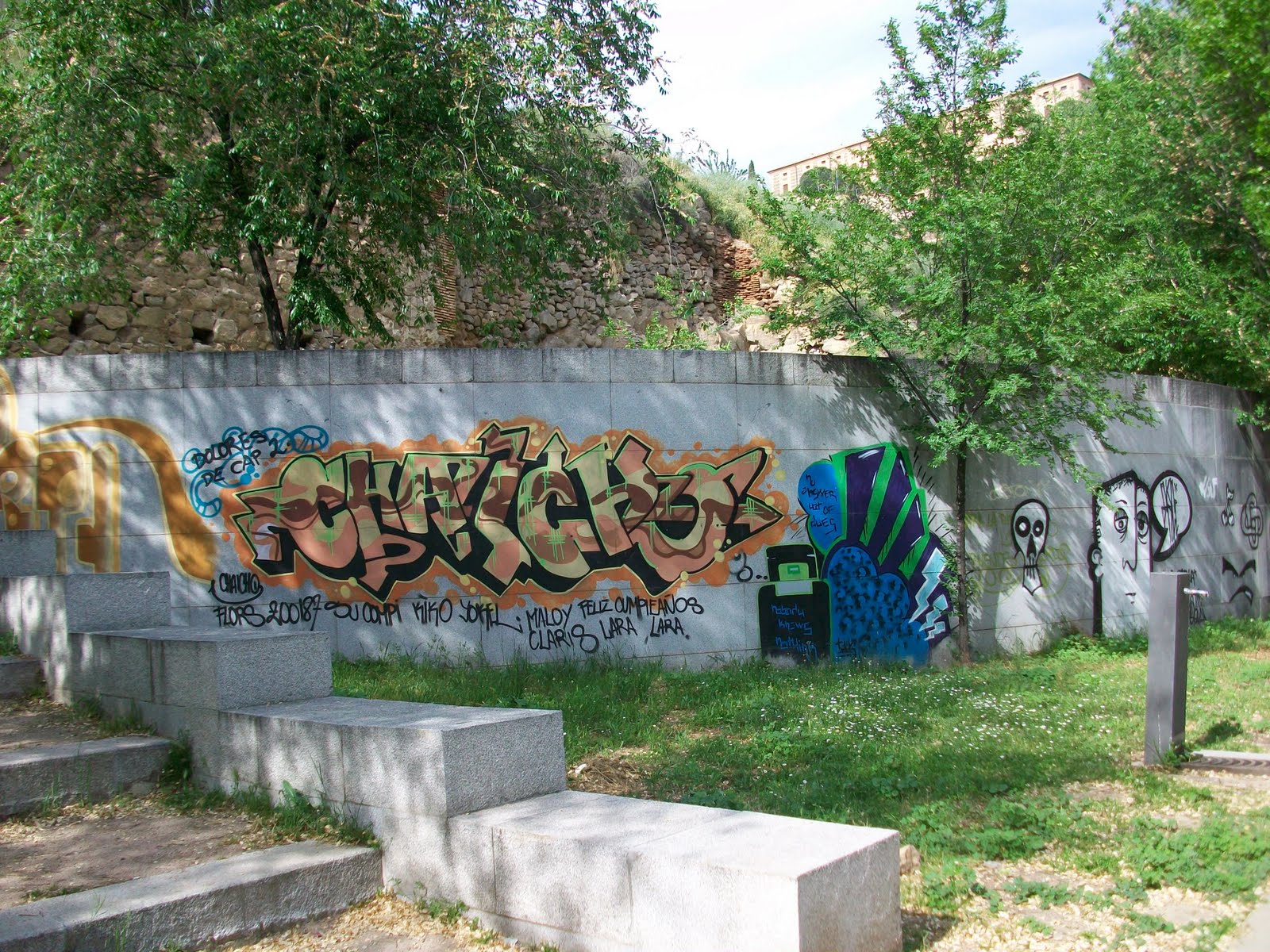
Even though he couldn’t read the writing, this graffiti intrigued him,


And he was visibly impressed with,


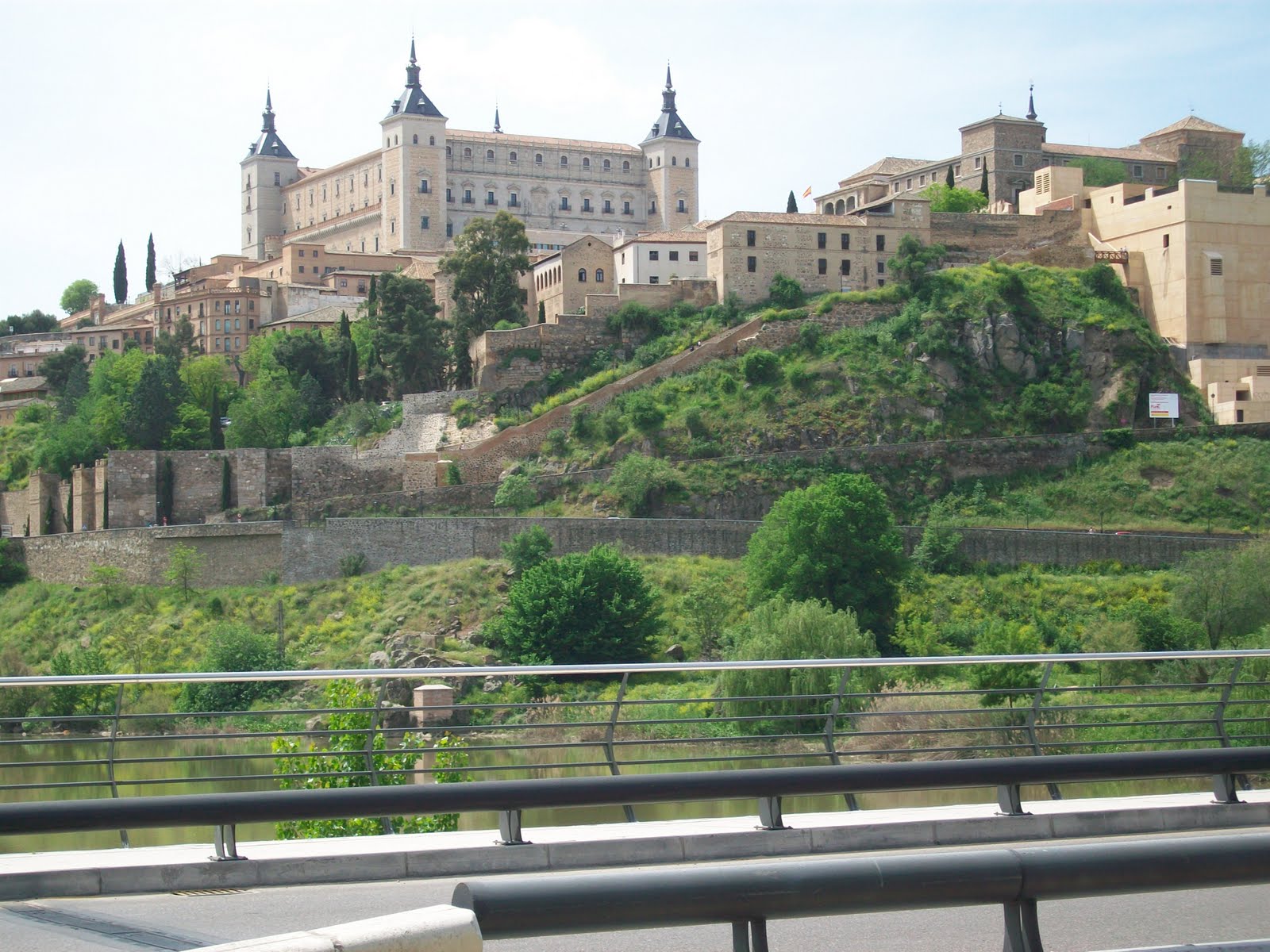
When I showed him pictures of Toledo, a medieval city, we talked about why ancient cities were surrounded by walls.  I pointed out that just as these city’s inhabitants were protected by the walls, God is our protector. “For thou hast been a shelter for me, [and] a strong tower from the enemy.” (Psalm 61:3) He nodded.


We talked about the reason that the city streets were so narrow,


And how every town had it's own church.

We figured out why this modern building was built around this ancient wall:


Patrick was interested in the stores that sold armor


And knives.


I told him how the swords from The Lord of the Ring were made in Toledo.

We looked at buildings, statues, plazas, and an old Roman well surrounded by the city of Oviedo,  where my daughter is studying.


We didn’t finish going through my pictures and I was surprised when I looked at my watch and there were only five minutes left before it was time to go.

Teachable moments. I had about forty of them that day and they were each precious.

Technorati Tags:
, , , ,


Monday, May 10, 2010

When the Writing is on the Wall

Last year when I traveled with my husband through Austria, Germany, and the Czech Republic, I was interested in the tags and graffiti which I saw. I found this tag in Nuremberg, Germany:

And this graffiti in another part of that city:


Looking at them, I remembered an article that I had read a few years previous in the Journal of Adolescent and Adult Literacy. According to Laurie MacGillivray and Margaret Sauceda Curwen, authors of "Tagging as a Social Literary Practice" (Journal of Adolescent and Adult Literacy (pp. 354–369) doi:10.1598/JAAL.50.5.3), tagging is "not simply an act of vandalism or violence; it is a social practice with its own rules and codes—a literacy practice imbued with intent and meaning."

Although the authors acknowledged the vast amount of money spent on cleaning up street writing, they believe that this is a meaningful form of literacy. According to them, "Tags can be a youth’s signature moniker, a slogan, a protest, a message, and occasionally a lengthy tribute. They differ from graffiti in that they always consist of letters in which alphabetic style, use of colors, and crafted script is highly valued. Inventiveness, flexibility, and playfulness with textual spellings and meanings are integral to the tagging community. Rarely recognized by outsiders, highly stylized script, one of the main characteristics of tagging, is often only readable by tagging insiders. (p. 358.)

A tag in Toledo, Spain:
 

And from a park in Oviedo, Spain: 

The authors found that tagging accomplished several purposes. It sustained social relationships, was a form of dialogue and conversation, was a means to declare membership in a particular tagging crew (which was safer than a gang), provided commentary on larger societal issues, and a way to display talent.


Street art in Oviedo, Spain


The authors recommended that, "When educators open up the curriculum using students’ everyday literacy interests as starting points, they can also attend to issues of power, authenticity, and culture embedded in the social practices (p. 368).


Something to think about next time you see graffiti, tags, or street art.


Technorati Tags:
, , , ,


Monday, May 3, 2010

"Whatever?" Never!

As a writer, I believe that words matter. Each one a writer chooses to use reflects an heart attitude and should convey a specific meaning. The same is true for the spoken language.

I´ve been hearing ¨"whatever" more and more and it bugs me. It´s a word of defeat, apathy, and surrender. It does not equal peaceful acceptance nor is it learning to embrace trials and the concomitant growth they produce.

I agree that we all must choose our battle grounds and we´d be perennially exhausted if we fought over every issue in our lives.

Many years ago, when I was a new, overwhelmed mother, a friend counseled me to "pick my battles." I  followed that advice. That didn´t mean hiding my head in the sand or avoiding all confrontations. It meant (to switch metaphors) knowing what it was worth going to the plate about.

Parents don´t tell their toddlers "whatever" when they´re having a tempter tantrum or permit their teenagers to drink and drive. Friends don´t look away from friends who are flirting with breaking their marriage vows, a community doesn´t ignore a judge who takes bribes, and a nation doesn´t turn its back on a lying president.

Pick your battles and go to bat for them. One for me is this:

No more "whatevers." Ever.

Thursday, April 29, 2010

Why Boys Lag Girls in Reading

From IRA: Reading Radio
Listen and Learn
Why do boys lag girls in reading and what can we do about it? Listen as literacy expert William G. Brozo discusses the overwhelming evidence of a gender gap between boys and girls in reading that is an accelerating international phenomenon. Brozo explores how current notions of masculinity may be contributing factors and shares field-tested strategies for closing the gap.

Brozo is Professor of Literacy in the Graduate School of Education at George Mason University in Fairfax, Virginia, and is author of To Be a Boy, To Be a Reader: Engaging Teen and Preteen Boys in Active Literacy (International Reading Association). 

Get the Word Out
IRA Reading Radio segments are meant to be shared! We encourage you to share this important information with your school community, professional circles, and social networks. Act today to get the word out!
  • Forward this blog to your professional colleagues and ask them to listen to the program and forward it to a friend
  • Post the program link on your Facebook, Twitter, or any social media site
  • Share the program with staff, teachers, and parents in your school and district.
About IRA Reading Radio
IRA Reading Radio airs monthly on the BAM! Radio Network, a radio website for the education community. In each installment, IRA Executive Director William Harvey interviews an expert on a key topic relating to reading education.

Technorati Tags:
, , , ,


Monday, April 26, 2010

You Tube in the Classroom


Have you ever thought of you how you might be able to use "You Tube" in the classroom? View this video by OK Go and let me know how many ways you might be able to use this in your science or English classroom.
 Technorati Tags:
,


Thursday, April 22, 2010

Reading a Museum

For those of you who are planning an end-of-the-year class trip to a museum, I’d like to share some insights from an article in a recent International Reading Association journal.

“Museum Literacies and Adolescents Using Multiple Forms of Texts ‘On their Own,’“ (Journal of Adolescent and Adult Literacy, 53 (3), 204-14. doi:10.1598/JAAL.53.3.2) evaluated the way in which eight teenagers interacted with exhibits in the Bedford Museum, a collection of archeological artifacts from the Americas, Greece, and Africa. Although none of the teens spent time reading the printed texts accompanying the displays, each of the participants made several “text to self” and “text to text” connections based upon the exhibits.

After analyzing the students’ responses, the author, A. Jonathan Eakle, concluded that “what was seen in the museum took precedence over what was written.”   Although some might disparage how the teenagers ignored the printed museum texts, Eakle argued otherwise:

“…the greatest value of the museum experience may well be how visitors, such as the adolescents in the present study, use museums freely, that is, on their own and for their own purposes. And to be free was an attractive part of adolescent museum excursions as shown through the investigation, whether it was, for example, escape through fantasy play, as was the case with Frank and Tom [two teens] darting among museum labyrinths, or by turning a corner to go beyond adult purview, as did Flo aka Mic and Bishop [three other teens] to discuss an interesting object in their own terms. These movements through, and readings of, space are an important aspect of museum literacies and suggest degrees of freedom perhaps not available in many education settings. In times when liberties and choices are often considered precious and rare commodities in education, as well as in wider communities, museums may offer important possibilities for engaging in most valuable aspects of literacies.

Furthermore, Eakle recommends that teachers conceptualize museums as text, thinking about the exhibits as if they were chapters of a book. In this way, activities like treasure hunts are in fact search-and-find activities familiar to literacy educators (p. 213). 

Eakle ended the article with questions which can guide museum learning.
·      Who is represented in the exhibition?
·      Who do we not hear from through the exhibition?
·      What language does the museum curator use to create a visual image?
·      What images, other objects, and spaces does the curator use to craft a language?
·      If we were to take away the printed text labels, do our notions of the museum object or exhibition change?
·      Whose interests are served by the museum text? Whose interests are not served?
·      What view of the world is put forth by ideas in the museum texts? What views are not?
·      What are other possible worldviews seen through the museum texts?
Note. Questions are adapted from Franzak, J., & Noll, E. (2006). Monstrous acts: Problematizing violence in young adult literature.Journal of Adolescent & Adult Literacy, 49(8), 662–672. doi:10.1598/JAAL.49.8.3

Technorati Tags:

Tuesday, April 20, 2010

SOS for PLCMC

If you live in or near Charlotte, NC then you know that public libraries are in huge financial trouble. I recently received this email:

What is to become of libraries
if funding is cut by 50%?

Get the facts. Show your support.
Join the conversation.

Last week, Director of Libraries Charles Brown presented three scenarios to the Library Board of Trustees that outlined ways Charlotte Mecklenburg Library could potentially deal with an expected $17 million (50%) budget cut from Mecklenburg County. Learn more and find out how you can help at one of these community meetings:
  • Wed., April 21 at 6:30 p.m.
    CPCC North campus: 11930 Verhoeff Drive, Huntersville
  • Mon., April 26 at 7 p.m.
    CPCC Levine campus: 2800 Campus Ridge Road, Matthews
  • Wed., April 28 at 11:30 a.m.
    Main Library: 310 North Tryon Street, Charlotte
  • Thurs., April 29 at 6:30 p.m.
    Myers Park Baptist Church: 1900 Queens Road, Charlotte
  • Mon., May 3 at 6:30 p.m.
    CPCC Cato campus: 8120 Grier Road Charlotte
Additional community information sessions will be scheduled soon so that citizens from across the County who are interested in the future of the Charlotte Mecklenburg Library can learn more at www.plcmc.org. 


The county has already fired over 100 staff and cut hours at many branches.I can't imagine a community without libraries. Can you?


If you value the many services which public libraries provide and you live in the area, come out and show your support. 

Technorati Tags:
, ,


Thursday, April 15, 2010

Hormone Jungle

After quoting one of Brod Bagert’s poems in a previous blog, I decided Hormone Jungle was worthy of its own post. This collection of 50+ poems is “written” by 11 fictional characters, the self-proclaimed “Digital Poets.” The book is presented in the form of a scrapbook compiled by the girl whose poem, “Middle School Payback,” began a middle school poetry war. Bagert did such an excellent job of writing the poems from different point-of-views that several times I had to remind myself that he is the behind-the-scenes real author of the entire collection.

Middle school voices are authentic and compelling. Consider this final verse from “Middle School Payback” by Christina Curtis:

This ain’t elementary anymore,
You’re in a brave new world,
You’re a boy in middle school
And buster, I’m a girl!
So down on your knees and crawl, slime,
Middle school is payback time.

The poetry matures as the pre-teens develop into teenagers. No adolescent anxiety is left untouched. Body odor, self-image, fear of love, fear of rejection, sports trauma, school … Bagert’s “Digital Poets” uncover them all. What middle schooler won’t relate to:

“Bored” by Steven Gilley

Forty-three stations on the radio,
Ninety-seven channels on cable TV,
Thirty-nine thousand books in the library,
And the whole world on the Internet.
So why am I totally bored?

I’m lying in bed, I smell like cheese,
And half the day is through.
I think I get so bored because
There’s too much stuff to do.

Or, how about “Underarm Charm” by Ryan Spalding:

Last night at the drugstore,
My mother smiled discreetly and said:
“Look, Ryan, deodorant.
Would you like the roll-on or the spray?”

I may not have big muscles,
And I may not have a tan,
But I’m growing hairy armpits,
And I’m smelling like a man.
Although many of the poems are humorous, some are serious such as “The Door Unopened,” by Emma Mackey:

In our house there are doors—
    A front door.
    A back door.
    A door to the patio.
Doors that open to the light.

But there’s another door—
    A door that moves on rusty hinges
    To steps that sink through silence,
    Past the whisper of broken promises,
    Into the dust of forbidden memory.
In my house there are lots of doors,
And among them
There is one door
I can never open again.

Christina Curtis opens the book with a flippant narrative about the Digital Poets, and ends with a somber reflection about Steven Gilley that brought me to tears. Bagert has woven together poetry and fiction into an award-winning book that will be appreciated by students and teachers alike. Art work by “real” middle school students at  PK Younge Laboratory School in Gainesville, Florida, complements the book. (Maupin House, 2006) 


Technorati Tags:
, , , ,


THE NIGHT WAR: A MG Historical Novel Review

  By now you should have received an email from my new website about my review of THE NIGHT WAR by Kimberly Brubaker Bradley. (It'll com...