Showing posts with label Maupin House. Show all posts

Monday, August 1, 2016

The Power of Social Media: Summer Camp at Highlights Part I

Congratulations to Rosi Hollinbeck, who won The Last Cherry Blossom. I think of Rosi as my west coast counterpart. She reviews and gives away books on her blog, as well as provides great links to other writing sites.
*****
I was fortunate to attend Summer Camp at Highlights Foundation and in upcoming posts will share many of the writing tips I learned. But first, I have to tell you a story about the power of social media. 

One afternoon we took a tour of the Highlights and Boyds Mills Press offices. We all rushed to get our pictures taken under the Highlights banner. Here I am with my new friend, Kesha Grant, who I plan to exchange manuscripts with.

We met different editors, heard about the submission process, and were introduced to the new Hello magazine for 0-2 years. (A great shower present for new moms!)

Who doesn't remember Highlights from their dentist's or doctor's office as a kid? 

Now they publish Bilingue, which is in Spanish! 


After the tour of the editorial offices, we were ushered into Boyds Mills Press and saw the table around which editorial decisions are made. 


Assistant editor, Cherie Matthews, showed us several new releases including the award winning fun book, One Day, The End by Rebecca Kai Doltish and illustrated by Fred Koehler. 
I expect to see Jan Davis-Castro,
my fellow writer from the Carolinas,
at our next SCBWI Carolinas conference.

At the end of her presentation, one of my fellow conferees asked, "What happens after the book is published? How do you get reviews?" Cherie explained how the book is sent out to hundreds of reviewers including Publisher's Weekly, the School Library Journal, as well as to bloggers who review books. 

Then she said, "Carol Baldwin has a wonderful blog that I follow." 

Everyone looked at me. "I'm Carol Baldwin," I said.  

Cherie said, "No. You can't be the Carol Baldwin. She lives in Charlotte, NC."

"Really, I am Carol Baldwin." Then I explained when I moved from Charlotte to Greenville, SC I forgot to update my blog. 

I was thrilled that an editor from Boyds Mills Press followed me! Everyone laughed, I changed my personal information on my blog as soon as possible, and we all saw first hand the power of social media. 
Cherie Matthews and I.
I asked Cherie how she came across my blog and why she read it. She said, "We met through Joyce Hostetter. I was at the Barn during one of Carolyn Yoder's retreats and Joyce was telling about the Talking Story newsletter, which the two of you publish. This led me to sending Calkins Creek titles for you and Joyce to give away. I follow your blog and others to keep informed and find out what the community of bloggers are chatting about. I learn what bloggers are reading, who they admire and want to emulate, what causes you angst, and how you encourage and support one another. It's a good way to be with like-minded people who I may otherwise have never met."

Earlier in our week at camp, Mitali Perkins had given a keynote on the importance of using social media. "It's a great opportunity for you to showcase your writing! Make your voice pop!" she said. Writing 140 character tweets (nouns! verbs!) helped her write picture books.

In addition Mitali highly recommended that we:

  • Register a domain name ASAP. GoDaddy was one site that was mentioned.
  • Create a Facebook author page, even if you're unpublished. Populate it with posts from other pages such as publishers, libraries, and professional organizations related to the content of your book. "You'll be branding yourself by finding organizations with similar interests. Recommend free content for your followers." 
  • Organize your Facebook friends into lists. You can then target this list when you are creating an event.
  • "Gather your courage. Be passionate. This must come from your personal vocational mission, or else it won't work."
  • Create Twitter lists for "tuning in, research, and promotion."

I met with Mitali and she gave me
 terrific ideas for Half-Truths.

After the interchange with Cherie Matthews, Sid Reischer, one of my fellow campers who is new to social media, asked me why I blogged and what I hoped to accomplish. Although some people think blogging is dead, I told him it has helped me create an online presence. 

I've been blogging since May, 2007 when my editor at Maupin House, Emily Gorovsky Raj, suggested it might be a good idea. I had no idea what I was getting into, but I learned. 

As my fellow campers and I laughed about Cherie's comments, I realized that I blog because I enjoy it. It's not for everyone and it certainly takes time, but I like recommending books and giving them away. I like sharing what I'm learning as I write Half-Truths or from other websites and writing conferences. Plain and simple: blogging fits who I am. A good lesson for me to remember on my writing journey. 

I named my blog in an impulsive moment of "let's get this done and move forward." Since then I've envied my friends who have come up with much more creative names for their blogs. But guess what? Now I'm glad I kept it simple. 

It seems to have worked for Cherie!

Monday, June 4, 2012

And the winners are....

Thank you to those of you who entered last week's giveaway. Here are the winners: 
Sally Spieckermann won Katie Monnin's ebook: Teaching Graphic Novels: Practical Strategies.


Brynn Speer won Katie Monnin's ebook: Teaching Early Reader Comics and Graphic Novels.

And last, but certainly not least (I think she may be my number one winner of books off my blog and the Talking Story newsletter)--

Linda Andersen won a personally autographed copy of Snow Wildsmith's book, 


Thanks to everyone who participated. If you didn't win, hold on tight. At the end of this week I'll interview Snow about the set of FIVE other books she just published. Of course, there will be another giveaway!


Monday, June 20, 2011

Digital Tools for Teaching

I’ve often compared writing and publishing a book to pregnancy, labor, and birth. Within the context of that simile, if I help a friend or student write or publish a book I either feel like a midwife or grandmother.

When I received my copy of Steven Johnson’s book, Digital Tools for Teaching, I definitely felt like a proud grandma. I hadn't contributed one iota to the content. Instead, I introduced him to Julia Graddy, my publisher at Maupin House.

I met Steve three years ago when he participated in the “Is There a Children’s Book Inside of You?” NCCAT  seminar  which Joyce Hostetter and I co-led. At first he successfully hid his expertise as a technology facilitator and focused on writing a funny picture book. But when he leafed through Teaching the Story and we began brainstorming the digital tools which could enhance the process of writing short stories, the second edition of my book was born. 

Steve and & I brainstorming at NCCAT


After Steve wrote twelve technology mini-lessons for my book, he began work on his own project with Maupin House. He wanted to create a book that would make technology accessible to every teacher--even those who were techno-phobic.  His dream was to provide an overview of e-tools which can be used in the classroom,  show how they could be used in a variety of subject areas, and meet the needs of a variety of techno-savvy elementary and middle school students.

No small task. But with the able help of my editor, Emily Raaj, Steve accomplished exactly that.

The first thing that will reassure teachers overwhelmed with digital technology is Steve’s division of thirty e-tools into three groups:  those for newbies, developing users, and advanced users. From there he encourages teachers to rethink their role as educators:

Going forward, our jobs must be about giving our students personalized, relevant instruction that develops their ability to make meaningful sense of the information-rich world they live in. Sure, they can find anything and everything under the sun on the Internet-but do they know what to do with it?  Can they evaluate the accuracy of what they read? Can they analyze and organize the glut of information? How does it improve their lives? They might have the world at their fingertips, but we have the power to guide them towards molding it into something worth creating. p. 4.

Steve next presents the eight characteristics of the “Net Generation.” Reading this will help you understand the different ways in which your students approach the Internet. And, it will help you feel OK about asking your students for help troubleshooting when something goes wrong. In fact, figuring out what went wrong is part of the learning process for everyone.

The meat of this encyclopedia of digital classroom technology, is the 30 alphabetized tools. Each double-page spread explains  what you need to do prior to utilizing the tool in your classroom, tells you how to get started, lists other issues to consider, and provides examples of how to use it in language arts, science, math, and social studies. It would be easy to feel overwhelmed except that the book is very readable and Steve walks you through the process of classroom implementation. If that wasn't enough, Steve offers his website as an on-line "living, breathing resource for all teachers."

Steve's enthusiasum for the power of using digital tools in your classroom is contagious.


Steve in the computer lab at Washington St. School
Rockingham, NC

And I'm not saying that just because I'm the proud grandma.

It's the honest truth. 

****
Joyce and I are giving away a copy of Steve's book in our next issue of Talking Story. If you haven't subscribed yet, click on the link which will bring you to our last issue. On the top, click on "Subscribe" and then send us an email when you receive your copy in a few weeks.  

Wednesday, March 9, 2011

This Book is Really Gross!


If the subtitle of this book won’t grab your students’ attention, then the blurb from the back of the book will: “Featuring facts about stuff that’s slimy, mushy, oozy, crusty, scaly, and smelly!”


Open the book and you’ll find scientific, historic, and gross facts about everybody’s secretions, smells, and scabs. Barf, burps, dandruff, farts, and poop. If it’s gross and relates to your body, it’s in the book. The highly descriptive prose is a great example of what Maupin House author, Melissa Forney, calls “Razzle Dazzle Writing.” 


Consider this description of skin. “A huge number of living creatures survive on your skin... These creatures, called bacteria, sway, roll, bounce, swim, eat and reproduce on your skin. They are so small that a dozen could line up across one pore. On your legs about 8,000 bacteria live in each square inch….Under the grease layer on your forehead are about 8,000,0000 critters for each square inch. That’s a larger population of bacteria in one square inch under your forehead than the entire number of people in Kentucky and Tennessee combined!”


After a detailed description of how zits are formed, the reader discovers, “All form of acne start out the same way. Dead skin cells shed inside pores. The dead skin cells then clump together with sebum, bacteria, and bacterial waste in the pore and form a comedo. The word “comedo” actually means “fat maggot” in Latin, because early doctors thought that these bumps were really maggots under the skin…” Gross. (p. 39-41).


This book is a great resource for both science and language arts classrooms. Yesterday, I read snippets of it to students in grades 3-8.  A second grader couldn't wait to get his hands on it.

Science written in a highly engaging manner. I love it!


Tuesday, October 19, 2010

Reading & Writing Resources

Along the way I have discovered a variety of resources that can help you in your classroom or in your own writing.  Here are a few. Let me know if they help you as instructors and writers.

For teachers and homeschool educators:
  • If you look above this blog heading, you'll see that I just created a new page, "Teaching the Story." If you click on it you'll not only find book reviews, but also several reproducibles from the CD that are now available on-line.
  • The Maupin House blog is full of useful information and resources for teachers and homeschool parents. Several Maupin House authors and editors blog about subjects that interest them and you will receive input from a variety of professionals.
  • Not sure about what book to recommend to your child? You can search my blog under "books for boys," "books for girls," "books for boys and girls," or "historical fiction." Or you can check out GoodReads and read other people's  book reviews.
  • I blogged about Literacyhead before. It's worth repeating--this is a tremendous resource.
  • National Novel Writing Month has a program geared specifically towards young writers. I'll be one of the featured "pep talkers" in November.
For writers:


Thursday, August 19, 2010

Love to Learn

The title of this homeschool conference says it all. Don't all educators-- both home and public-- wish that their students would "love to learn?"

The student and adult participants who came to my two workshops last Saturday demonstrated this desire. I was pleased that several attendees learned how to use muscle words (click on this link and select "download now" for the handout) at my first session, "Jazz Up Your Writing," and then applied these skills when they wrote descriptive paragraphs in the second session, "Learn from the Masters." Time was short but participants wrote FAST and imaginative characters and sensory settings bloomed as a result of quick collaboration.

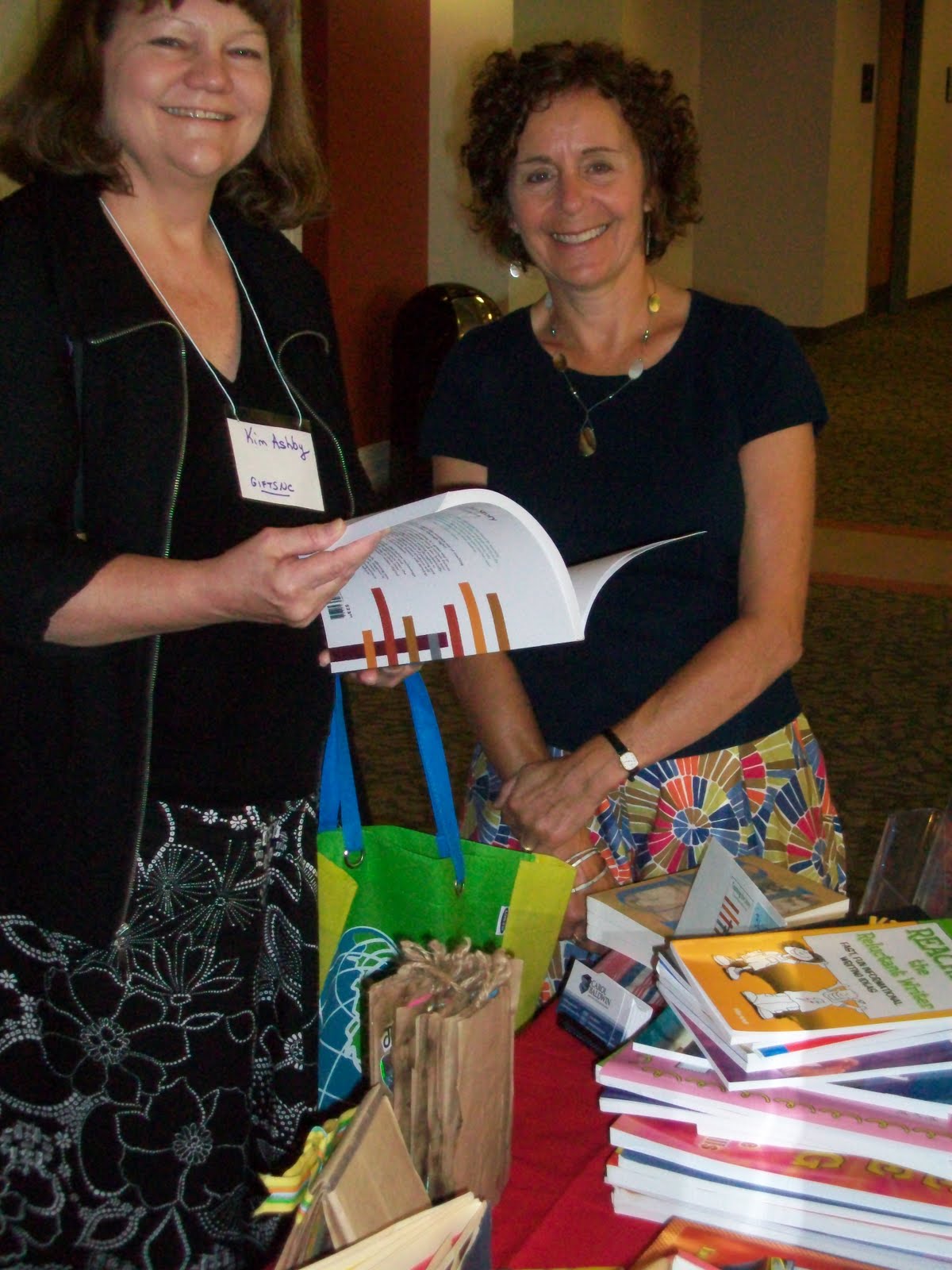
When I wasn't teaching, I spoke with parents about Maupin House books,
and shared table space with Triangle Education Assessments.
Debbie Thompson, founder


If you are a home educator in need of testing materials, I would encourage you to check out their resources.

Carolyn Justice, tester

One of their books is A Concise Guide for Homeschool Families Planning For High School, which Carolyn wrote.

By the end of the day young entrepreneurs had set up space next to us and demonstrated innovative uses of duct tape. With colorful and designed tape they made and sold wallets purses, tiaras, and flip-flops. Now, here are two creative kids showing their love for learning--on the spot!


Monday, June 21, 2010

Teaching the Story: A Middle School Teacher's Testimonial

Last November when I taught at NCCAT, I met Rebecca Quick who had taken a workshop from me at the North Carolina Middle School Conference. I was delighted to find out that she had been using my book and asked if I could interview her.  Now, seven months later, here is the interview. (Scroll down for the video.)


Carol: You have taught language arts for thirteen years. How is Teaching the Story different than other materials you have used?

Rebecca: I have many other writing materials which I never know quite when to use.  Teaching the Story is very well organized and allows me to stay focused on teaching each story element.  The CD provides worksheets that I use as overheads thus simplifying the process of developing a story.

I want to allow my students to write freely, but they get very overwhelmed with the process. Before I used your book I found myself teaching all over the place without a lot of structure. As a result, my students’ writing was all over the place.  Now, using Teaching the Story, at the end of each semester my students have a well written short story of which they are proud.

Carol: What was the most significant way that Teaching the Story helped you as a teacher?

Rebecca: It gave me an outline and direction to teach each element of a story.  For example, the fact that there was a separate chapter on developing the character and then several mini-lessons to help students develop their character was very helpful. 

Teaching the Story is very specific and detailed with lessons that explain and show exactly how to create a setting, develop a character, and create a "real" problem with a "real" solution. 

Carol: Was there a particular lesson that was most helpful?

Rebecca: I found that planning the plot helped the students organize their stories. The “Build-a-Plot” handout was one of the most useful instruments.  As a teacher, I was able to give the students a visual representation of their story in a very simple format.  It allowed me to conference with them and they could adjust their stories as needed. 

Carol: How did the book help you to be a more organized teacher?

Rebecca: By taking time to teach each element in a very simple manner my students did not get overwhelmed and could really focus on the key elements of their story.  It also helped to have a focus when conferencing.  I knew what I had just covered in class and I was able to discuss and give very specific feedback when trying to help them revise. 

Carol:  What would you say to other language arts teachers?

Rebecca: I believe that Teaching the Story will give direction when teaching the fictional narrative. There are many ways to teach students how to write stories, but you will find that Teaching the Story is very helpful in staying focused and keeping the process simple.  At the same time, the book still allows room for your personal style and additional lessons.


Technorati Tags:
, ,


Thursday, April 15, 2010

Hormone Jungle

After quoting one of Brod Bagert’s poems in a previous blog, I decided Hormone Jungle was worthy of its own post. This collection of 50+ poems is “written” by 11 fictional characters, the self-proclaimed “Digital Poets.” The book is presented in the form of a scrapbook compiled by the girl whose poem, “Middle School Payback,” began a middle school poetry war. Bagert did such an excellent job of writing the poems from different point-of-views that several times I had to remind myself that he is the behind-the-scenes real author of the entire collection.

Middle school voices are authentic and compelling. Consider this final verse from “Middle School Payback” by Christina Curtis:

This ain’t elementary anymore,
You’re in a brave new world,
You’re a boy in middle school
And buster, I’m a girl!
So down on your knees and crawl, slime,
Middle school is payback time.

The poetry matures as the pre-teens develop into teenagers. No adolescent anxiety is left untouched. Body odor, self-image, fear of love, fear of rejection, sports trauma, school … Bagert’s “Digital Poets” uncover them all. What middle schooler won’t relate to:

“Bored” by Steven Gilley

Forty-three stations on the radio,
Ninety-seven channels on cable TV,
Thirty-nine thousand books in the library,
And the whole world on the Internet.
So why am I totally bored?

I’m lying in bed, I smell like cheese,
And half the day is through.
I think I get so bored because
There’s too much stuff to do.

Or, how about “Underarm Charm” by Ryan Spalding:

Last night at the drugstore,
My mother smiled discreetly and said:
“Look, Ryan, deodorant.
Would you like the roll-on or the spray?”

I may not have big muscles,
And I may not have a tan,
But I’m growing hairy armpits,
And I’m smelling like a man.
Although many of the poems are humorous, some are serious such as “The Door Unopened,” by Emma Mackey:

In our house there are doors—
    A front door.
    A back door.
    A door to the patio.
Doors that open to the light.

But there’s another door—
    A door that moves on rusty hinges
    To steps that sink through silence,
    Past the whisper of broken promises,
    Into the dust of forbidden memory.
In my house there are lots of doors,
And among them
There is one door
I can never open again.

Christina Curtis opens the book with a flippant narrative about the Digital Poets, and ends with a somber reflection about Steven Gilley that brought me to tears. Bagert has woven together poetry and fiction into an award-winning book that will be appreciated by students and teachers alike. Art work by “real” middle school students at  PK Younge Laboratory School in Gainesville, Florida, complements the book. (Maupin House, 2006) 


Technorati Tags:
, , , ,


Monday, October 26, 2009

Monday Morning Mini-Blog


After my last blog post on Incognegro, my editor informed me that Maupin House has started a new blog for teachers for the forthcoming book, Teaching Graphic Novels by Katie Monnin. If this is a genre you use in your classroom, be sure to check out the blog and the book.


Last night I was moseying around on the internet and checked out my friend Joyce Hostetter's blog to see her latest post. She is my co-author for the newsletter Talking Story, and I was delighted to find a terrific summary of our latest issue. I hope you'll take a minute to visit her blog and then decide to subscribe to our newsletter. Our goal is to provide information about books as well as writing resources for teachers, media specialists, homeschool parents, and writers. Let us know how we're doing!


Thursday, September 10, 2009

Talking Story is Live!


For days my fellow author, Joyce Hostetter, has been tweaking our newsletter, Talking Story. Writing the articles was the easy part. Putting it all together was another story. Although I moaned and groaned about the hours I spent editing and uploading addresses, to be honest, Joyce conceived the project and is responsible for how professional it looks. If you didn't receive a copy in your in-box today, click here, and you'll go right to it.

It feels good to have published this issue. As icing on the cake, I was delighted that my former editor at Maupin House, Emily Raij, chose to blog about us today.

My husband and I are in Crossville, Tn. for a few days of R & R. For him, that means golf and tennis. For me, it means 3 R's-Reading (Joyce's "Work in Progress" about a WWII conscientous objector); 'riting (time to get back to my historical novel. Hmmm...last I worked on it was in July. Where in the world was I?); and Recreating (have bikes, will travel.)

Sounds like a winning combination to me!
Technorati Tags:
, , , , ,

Friday, April 10, 2009

Hot News from the Association of Educational Publishers


Today I received word from my publisher, Maupin House, that Teaching the Story: Fiction Writing in Grades 4-8
was named as a finalist in this year's Distinguished Achievement Awards given by the Association of Educational Publishers. What was the first thing I did after hearing this exciting news? I went digging to find out who the folks are who granted me this award. Here is what I found:

According to their website, they are a "national, nonprofit professional organization for educational publishers and content developers." The organization started in 1895 as a university-supported institution, most recently on the campus of Rowan University in Glassboro, NJ. In the "it's a small world department," as a teenager I attended a fine arts camp (I focused on creative writing--what else?) at Rowan University—which at that time was named Glassboro State Teachers College.

AEP is a group of approximately 400 publishers who submit their books to judges who are "selected from a pool of educational publishing professionals (writers, editors, designers, educators, product developers, and marketing directors)." I looked at the judge's evaluation form and was pretty impressed with the rigorous assessment used to evaluate the educational books. Each year the Distinguished Achievement Award identifies superior educational products in four categories: Curriculum, Periodicals, Professional Development, and Technology Innovations. Teaching the Story is under "Professional Development" and one of four finalists in the subcategory of Differentiated Instruction.

For those of you who aren't in the educational field, you may wonder what the term "Differentiated Instruction" means. Here is AEP's definition from their website: "Products that are designed to take into account students' varying background knowledge, readiness, language, preferences in learning, and interests. They provide a model or process to aid in teaching and learning for students of differing abilities in the same class."

I can't honestly say that when I conceived the ideas behind Teaching the Story, I thought it would be a book used by students at many different levels. All I thought about was that writing a story is something that many students are naturally drawn to and that the task stretches students' imaginations. As I tell teachers who attend my writing workshops, when students write a story they practice all of the skills necessary for expository writing—it's just a lot more fun. But, since narrative writing is taught in upper elementary through middle school, my editors and I decided that the book needed to be flexible. It had to be designed in such a way that a teacher in any of these grades could pick it up and use it in her particular classroom and address the needs of students with divergent interests and abilities. Many hair-pulling hours went into figuring out how we might successfully pull this off—apparently the judges at AEP thought we did.

I am pleased and honored at this recognition, but am also fully aware that it would not have been possible without diligent coaching and editing by my editors at Maupin House. Kudos goes to them for having two other titles honored in this year's AEP line-up: Writing Intervention Kit for High School by Nancy Dean, and Learning Through Writing Series: Authentic Writing Activities for the Content Areas: Grades 3, 4, and 5 by Kathleen Kopp.

Technorati Tags:, , , ,


THE NIGHT WAR: A MG Historical Novel Review

  By now you should have received an email from my new website about my review of THE NIGHT WAR by Kimberly Brubaker Bradley. (It'll com...