Monday, July 11, 2016

Carver: A Life in Poems

Every once awhile I come across a book that I can't bear to give away. I'm sorry friends, but Carver by Marilyn Nelson, (Boyds Mills Press, 2001) is a book that is staying on my shelf. 

Like me, many of you probably know some of the basics about George Washington Carver's life. You may know he was born a slave in Missouri about 1864, started the agricultural department at Tuskegee Institute, and developed new uses for peanuts, cowpeas, and sweet potatoes in his desire to help poor farmers combat poverty.
Tuskegee Institute, 1916
 https://commons.wikimedia.org/w/index.php?curid=685224
But what you probably don't know is that besides being a scientist, inventor, and botanist; he loved to sew, paint, play piano, and read his Bible. Although he never married or had children, for 47 years at Tuskegee he taught multitudes of students, personally corresponded with countless farmers who sought his help, and left a legacy of information and inspiration.  
http://www.icr.org/article/science-man-god-george-washington-carver/
Award winning author Marilyn Nelson, tells Carver's story through beautiful poetry. Sometimes the poems are from Carver's point of view and his emotions and thoughts are so well portrayed that you feel as if you are inside his skin. Other poems are written from the point of view of people who interacted with him. All of them weave together well-researched details and build a narrative of Carver's life. 


Here are a few of my favorites, but please note that I had difficulty formatting the second, third and fourth poems and had to skip lines. There are no line spaces in the original. 
The Last Rose of Summer
The paper shakes so
the words are hard to read,
but what good is a singing range
from high D to three octaves below,
what good the bold step to a larger canvas
for the yucca on the easel now,
what good piano lessons paid for
with paintings, what good
a rosebud boutonniere if Jim
 
        your brother  
            smallpox    (p. 24)
***************
Four a.m. in the Woods
Darkness softens, a thin
tissue of mist between trees. 
One by one the day's 
uncountable voices come out 
like twilight fireflies, like stars. 
The perceiving self sits 
with his back against bought bark, 
casting ten thousand questions into the future. 
As shadows take shape, the curtains part 
for the length of time it takes to grasp, 
and behold, the purpose of his 
life dawns on him. (p.25)

***********
Ruellia Noctiflora 

A colored man came running at me out of the woods 
last Sunday morning. 
The junior choir was going to be singing 
at Primitive Baptist over in Notasulga, 
and we were meeting early to practice. 
I remember wishing I was barefoot 
in the heavy, cool-looking dew. 
And suddenly this tall, rawbone wild man 
come puffing out of the woods, shouting 
Come see! Come see! 
Seemed like my mary janes just stuck 
to the gravel. Girl, my heart 
like to abandon ship! 

Then I saw by the long tin cylinder 
slung over his shoulder on a leather strap 
and his hoboish tweed jacket 
and the flower in his lapel 
that it was the Professor. 
He said, gesturing, 
his tan eyes a blazing, 
that last night, 
walking in the full moon light, 
he'd stumbled on  
a very rare specimen:
Ruellia noctiflora, 
the night-blooming wild petunia. 
Said he suddenly sensed a fragrance 
and a small white glistening. 

It was clearly a petunia: 
The yellow future beckoned 
from the lip of each tubular flower, 
a blaring star of frilly, tongue-like petals. 
He'd never seen this species before. 
As he tried to place it, 
its flowers gaped wider, 
catching the moonlight, 
suffusing the night with its scent. 
All night he watched it 
promise silent ecstasy to moths. 

If we hurried, I could see it 
before it closed to contemplate 
becoming seed. 
Hand in hand, we entered 
the light-spattered morning-dark woods. 
Where he pointed was only a white flower 
until I saw him seeing it. (p. 73-4)
********* 
My Beloved Friend 
Letter to Jim Hardwick, April 1924 

Your letter touched me deeply. How I wish 
I was more worthy of the things you say 
about me. I love you more dearly because 
you are of another race. God is using you 
to teach the world the brotherhood of man, 
the fatherhood of God. How sweet it is 
to let God purge our souls of ego and 
bitterness, and to have a little taste 
of heaven here on earth. I trust you will pray 
for me, that I get rid of my littleness. 
I did not have to learn to love you: You 
were chosen for me. I knew that the first 
time I saw you. It was the Christ in you, 
of course. (p. 86)

I read this book because I thought Carver could be an inspiration for Lillie, my African American character in Half-Truths. What I didn't expect, is how much Nelson's poetry and Carver's life would inspire me. 


Monday, July 4, 2016

The Art of Growing Artists- Part III

It's been a pleasure to share images from my week volunteering with Explore the Arts camp at the Fine Arts Center in Greenville, SC. If you missed it, here are the first and second posts. Thanks to all who have left comments and vicariously enjoyed my week.

Apart from talented instructors, one of the things that amazed me was the venue for this camp: the Fine Arts Center itself. It was like attending camp in a museum with one major difference: instead of entering gallery rooms off the halls filled with glass, pottery, exotic quilts, and lithographs, students walked into fully equipped art classrooms and studios. 

Here is a peak into more of the classes:

The creative writing instructor, Laura Gerhiser Hensel, is my new friend who suggested I volunteer at the camp. During her class, upper elementary and middle school students focused on the basics of figurative language and incorporating the five senses into various writing exercises. Writing both poetry and prose, students invented new words, played with phrases, and explored synesthesia. 

Laura leads a story telling exercise:


Here is a poem Ari Carroll, a rising seventh grader at Hillcrest Middle, wrote:   


Show Stopper
I remember pancakes and doughnuts
And marathons of Saturday morning cartoons.
I remember wondering if I could ever draw that well.

Syrup, thick and slow, sliding off the counter and perfectly into the bag on the floor.
pages and pages vanquished by sugary goodness. A true killer.

I remember yellow humanoid bunnies and tuxedo-wearing demons and alien cats named Fifi.

Being excited for my first commission.
Waiting all day,
I ran upstairs after dinner.
And drew and redrew every painful frame.

I decided enough was enough, and I pressed into the paper a little too hard.
I remember the explosion, the ink everywhere, and the fun I had, letting the crazy take over.
I remember waking up on the floor too early, only to edit the frames together.
Triumphantly, I released  the animation.
Ari Carroll is an aspiring artist and writer who enjoys writing sci-fi, drawing humanoid cats, and role-playing with friends. 

***********

Upstairs, artist Yoshiko Moon taught her young students Japanese art including print making, origami, and several different ink techniques. 


Downstairs, Candice Bryant led kindergarten through third graders in musical theater. 

And while Katy Cassell, the metals instructor at the Fine Arts Center, led a teen and adult class on Printing Techniques in Enamel,

Katy demonstrates an enameling technique.
A VERY hot enameling kiln.


a few doors down, Ted Mickens showed students how to make a plaster bank, create spin art, sculpt figures from wire, and sculpt foam blocks,
Ted Mickens at work.


and Amanda Griffith taught animal portrait painting.


Coordinating 20 teachers, over 200 students, and 16 high school volunteers, is like juggling balls, rings, clubs, and a few fire sticks. To do that takes someone with a passion for arts education and a love for children. It takes a person like Donna Shank-Major.

During the academic year Donna teaches design at the Fine Arts Center. But for over 15 years, she has been the juggler making sure that each Explore the Arts student receives a quality experience.  
Donna is flanked by volunteer Georgia Stickler (left) and
student intern, Bonnie Campbell (right).
In 2007 Donna added classes for high school students and the following year opened them to adults. Now teachers can take a class and receive professional development points/hours toward recertification.  

Donna, along with her staff of highly qualified instructors, created an atmosphere of exploration, engagement, and collaboration which stretches and grows each participant. The result is a week of diverse art instruction which parallels Greenville itself: a city with more art, music, and drama than I have time to appreciate. 

But Explore the Arts was a good beginning.

Monday, June 27, 2016

The Art of Growing Artists- Part II

Last week I showcased some of the young artists I met at the Explore the Arts camp at the Fine Arts Center in Greenville, SC. In this post you're going to meet more artists and also hear about how art inspires writing. The pictures, videos, and poetry are mine. The italicized portions are excerpts from an essay by Donna Baier Stein, "Art for Contemporary Writers" that appeared in the July/August issue of Writer's Digest.

Ekphrasis and....Collage?

The literary term for describing in words what you see in a picture is ekphrasis. The practice can be traced back to Plato and Aristotle, through the Renaissance and the works of the Romantic poets, all the way into literature of the 19th century. Typically, the word ekphrastic is applied to poetry. 


Creating collage with Judy Verhoeven

But fiction writers, too, can derive inspiration from physical works of art. Herman Melville uses ekphrasis in Moby-Dick...Taking the practice a step further, visual images can become actual prompts for an entire story or novel.

Ekphrasis and....Dragons?

Eric Benjamin demonstrates the art of dragon drawing


 Whatever medium you choose— from painting to sculpture, pottery to pencil illustrations—art can trigger a story inside of you. Here are some ideas for finding your own ekphrastic story starter: 
*Wander through a museum *Browse an art collection online*Visit a local gallery *Check out a book of art history from the library*View a collection of poster prints online or in a store. 
          (Carol's addition: Visit your local arts camp or school!)

The old aphorism “a picture is worth a thousand words” is most often attributed to Arthur Brisbane, a famous newspaperman. In 1911, Brisbane urged members of the Syracuse Advertising Men’s Club, “Use a picture. It’s worth a thousand words.” He believed in catching a reader’s attention fast and forcefully. Don’t waste your time fumbling for words, he was saying, when an image can get the job done better. Inadvertently, perhaps, Brisbane was setting up pictures and words as opposing forces. Ekphrastic fiction reunites the two, as a picture can actually produce a thousand words. 

Ekphrasis and...Music?

If Brisbane is correct, how many words do these videos inspire?


Jeff Holland led Drums and Shakers

Drum Set and Snare Drum

Beginning Guitar with 

Ekphrasis and....Improvisation?


Instructor Mia Hartley Phillips said second and third graders created this dance following a discussion of music evoking emotions. 


Ekphrasis and....Me?


Oh, Dragon!
With tail unfurled
claws paw the air.
Dance, prance
in vestments of turquoise, purple,
red and orange.
Royalty.
You dwelled in a canvas cave
until life breathed in you through
imagination.

Imagination
molds
chunks of clay
into a fierce monster
or a bird sitting on her nest.

Imagination turns paper
scraps into sunflowers,
blue and pink fragments
into hydrangea,
paint droplets
into
masterpieces.

Imagination
swirls swathes of filmy cloth
and suddenly, 
a young girl is a fantastical creature
hatched from an egg
in search of her sister. 

Imagination
unfurled
unfettered
unashamed.
Art begets art.
Ekphrasis.  


Thank you, Donna Baier Stein for introducing me to the concept of ekphrasis. And thank you, Explore the Arts students, for giving me the opportunity to practice it. 


Monday, June 20, 2016

The Art of Growing Artists - Part I


As some of you know, my husband and I recently relocated to Greenville, SC. I am finding an explosion of art and cultural events as well as arts education in the schools--including creative writing! Looking for an opportunity to teach, an acquaintance recommended I first volunteer with the Explore the Arts camp that meets in the Fine Arts Center. Over the next few weeks I'll share some photos and videos. These posts will be heavy on images and light on text as I try to share with you the excitement and energy of these young-artists-in-training. And hopefully, next year I'll be sharing my experiences teaching fiction and journalism!
When I stopped in the Drama and Improv class led by Andrew Bryant, they immediately improvised a jazz pose for me.


These rising kindergarteners and first graders learned about famous artists in Painting and Collage taught by Carol Ann Good, and then dripped, splattered, and painted away!


Jan Woodward taught Ballet and Modern Dance to sixth through eighth graders. The dancers had just learned this routine. 

Each instructor was passionate about communicating his or her love for art to their students.  It was a pleasure to watch kindergartners through adults unabashedly throw themselves into the act of creation. 
Opera star,  Kimilee Bryant, showing her class
her Phantom of the Opera scrapbook


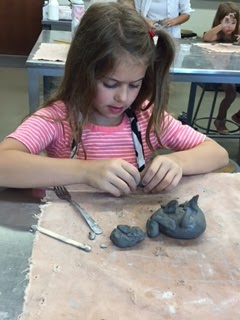
The following pictures are from Katie Jones' class of second and third graders enjoying Clay Exploration.


I tried to take a picture of Dr. Roy Fluhrer, Director of the Fine Arts Center, in front of one of the many sculptures which adorn the school. He declined. Over his shoulder as walked away he said, "It's not about me. It's about the kids."

Monday, June 13, 2016

The Setting Thesaurus Books Are Here: Help Becca And Angela Celebrate!


Readers of this blog are no strangers to one of my favorite online writing resources, One Stop for Writers.  Now, the co-creators of that marvelous website, Becca Puglisi and Angela Ackerman, have added two more thesauri (yes, that really is an acceptable form of the plural!) to their awesome collection of self-published books. (Here is Becca's post on Setting through Personification. It'll give you an idea of the expertise these ladies offer the writing community.)

Now, in their own words, this is what you can look forward to in these thesauri:

"As we storytellers sit before the keyboard to craft our magic, we're usually laser-focused on the two titans of fiction: plot and character. Yet, there's a third element that impacts almost every aspect of the tale, one we really need to home in on as well: the setting.

"The setting is so much more than a painted backdrop, more than a stage for our characters to tromp across during the scene. Used to its full advantage, the setting can characterize the story's cast, supply mood, steer the plot, provide challenges and conflict, trigger emotions, help us deliver those necessary snippets of backstory...and that's just scratching the surface. So the question is this: how do we unleash the full power of the setting within our stories?


"Well, there's some good news on that front. Two new books have released this week that may change the description game for writers. The Urban Setting Thesaurus: A Writer's Guide to City Spaces and The Rural Setting Thesaurus: A Writer's Guide to Personal and Natural Spaces look at the sights, smells, tastes, textures, and sounds a character might experience within 225 different contemporary settings. And this is only the start of what these books offer writers.

 "In fact, swing by and check out this hidden entry from the Rural Setting Thesaurus: Ancient Ruins.
 
"And there's one more thing you might want to know more about....


"We are celebrating our double release with a fun event going on from June 13-20th called ROCK THE VAULT.


"At the heart of the Writers Helping Writers site is a tremendous vault, and we have been hoarding prizes of epic writerly proportions.


A safe full of prizes, ripe for the taking...if the writing community can work together to unlock it, of course.

"Ready to do your part? Stop by Writers Helping Writers to find out more!"

Angela and Becca are encouraging their readers to post fanciful pictures of their favorite thesaurus. Here's my first attempt:

What are you cooking up
with your thesaurus?

These two awesome ladies plan to encourage people to share their love of all books thesaurus in nature. Take a picture of your favorite thesaurus and post it online with the #myfavoritethesaurus hashtag.  If they get to 500 original pictures they'll give away all the prizes locked in the vault. It's free to enter, but the more people who post pictures, the more prizes can be won. 
Here is one of the many resources you'll find on their Pinterest board: 

If you are a One Stop subscriber, don't panic. All the material found in these two new thesauri is right at your fingertips. Just used it myself last week!


Monday, June 6, 2016

Aaron Moments: A Tribute to Friendship

Congratulations to Joyce Hostetter who won the autographed copy of "The Great Call of China" on last week's post. Trust me, her winning was independent of this post!


A Bible Lesson

The ancient Israelites had a problem. In a battle with their enemies the Amalekites, Moses and Aaron noticed that whenever Moses held up his hand, Israel prevailed. But his hands got heavy and when he let them down, Amalek prevailed. 

Exodus 17:12 says, "But Moses' hands were heavy; and they took a stone, and put it under him, and he sat on it; and Aaron (his brother) and Hur (his companion) held up his hands, the one on the one side, and the other on the other side; and his hands were steady until the going down of the sun." 

Apparently this intervention worked because the next verse records how the Israelites were victorious. This is a superb example of two friends coming alongside a great leader and giving him the help he needed.

Since this blog deals more with writing than Biblical history, you might be wondering where I'm going with this post.  


Half-Truths and Aaron Moments


I'm close to the end of my fifth write-it-from-the-beginning draft of Half-Truths. Last week I was writing a scene in which Lillie really wants to be mad at Kate. But, according to my outline, this is Act IV when the two girls are now friends. Why would Lillie choose not to nurse her anger?

Light bulb moment. By remembering a time when Kate believed in her when other people didn't.

In my mind, I dubbed this previous incident in the story an "Aaron moment." A time when Lillie was ready to give up and give in. But Kate's encouragement kept her going--despite her fears and doubts. 


Meet my "Aaron's"


Like Moses and Lillie, I've had my moments when I was ready to quit. Thankfully, I've had three friends who have believed in me and helped me fight my panic and doubts. You've met these friends in blog posts, but here's a little more backstory about how each one has helped me with my story. 

In chronological order, here are my three "Aarons:"

April, 2016

Seventeen years ago, Fran Davis, the Regional Advisor for SCBW (there was no "I" back then) called me, and then called Linda Phillips. She had decided the two of us should co-chair the 1999 regional conference in Charlotte. We each agreed although there was one problem--we had never met. After much email correspondence, phone calls, and meetings, Linda and I pulled it off. 

In the process, we became critique partners, praying friends, and walking buddies. We continue to lift each other up when the other person is overwhelmed by doubts and fears. We give each other marketing advice, pep talks, and a different perspective on ourselves and our writing. Most of all, we're always there for each other as the voice of encouragement when the other person wants to abandon her work.  


In 2007, I met Joyce Hostetter at the Mid-South Reading and Writing Institute in Birmingham, Alabama. I went to her workshop on writing historical fiction and had her autograph a copy of BLUE. Thus started a friendship which led to us co-teaching writing workshops at NCCAT and publishing our online newsletter, Talking Story. 

In 2008 Joyce challenged me to stop talking about writing a novel and to plunge into NaNoWriMo. She encouraged me to spend a week at a Highlights Foundation Workshop for which I'll always be grateful. She's read and critiqued numerous synopsis and first pages. She's now (finally!) reading this draft and giving feedback on everything from sentence order to killing my darling similes. When I bewail how long it's taken to write my first novel she offers understanding but no excuses.  

2013

I attended the 2011 SCBWI-Carolinas conference with a revised first draft and great confidence that I was on my way to publication. Mary Kate Castellani,  my critiquer, changed all that.  She rocked my world and changed my novel by calmly suggesting that my book would reach a wider audience if I wrote it from both Kate's and Lillie's POV. 

My mind whirled as I walked through the revolving doors at the conference hotel. I had just finished writing the entire book from Kate's POV. How could I possibly write a story from a black girl's POV? How could I start all over again? (little did I know...)

The first person I saw on the other side of the door was Rebecca Petruck. 

She not only told me I could and should write Half-Truths from both POV's, she has helped me with the humongous task of plotting a book from two points of view. I've appreciated Rebecca's ability to see what Half-Truths was trying to be and to bring me back from the many bunny trails which my imagination led me on.

******
These friends have believed in me as a writer and in Half-Truths as a story. They have been my "Aarons" figuratively holding up my arms when my battles were rough. Thank you, Linda, Joyce, Rebecca, Kate, and Lillie. You each have showed me how powerful friendship can be. 

How about you? Who are your "Aarons"? 

THE NIGHT WAR: A MG Historical Novel Review

  By now you should have received an email from my new website about my review of THE NIGHT WAR by Kimberly Brubaker Bradley. (It'll com...