Monday, September 27, 2010

First Pages

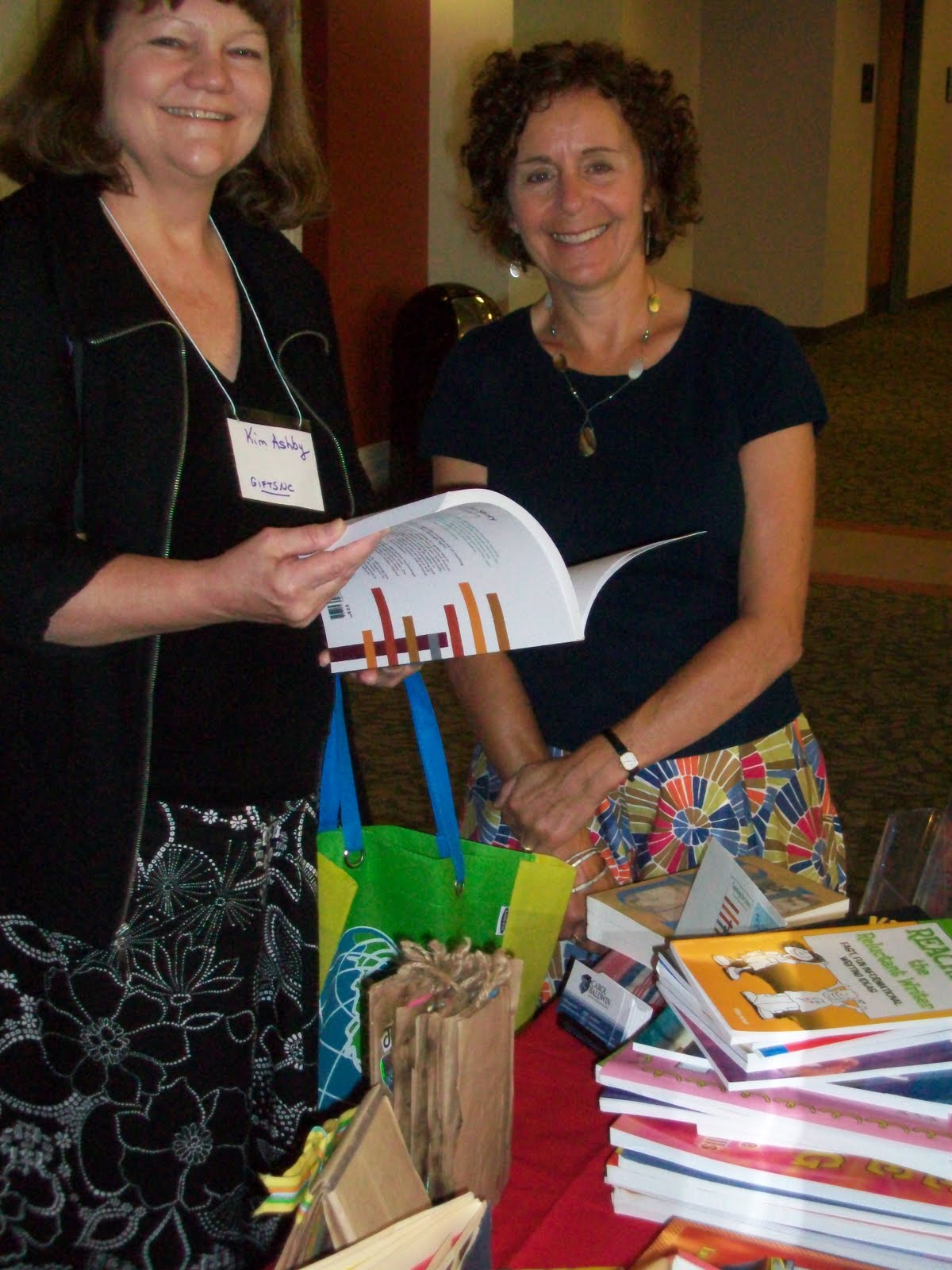
This past weekend I attended the SCBWI-Carolinas annual regional conference. I learned about plot, pacing, and novel outlines and connected with old and new friends. Workshops and general sessions with editors and agents packed the schedule.


Liz Waniewski, Senior Editor at Dial Books for Young Readers

On Saturday we gathered for an hour titled, "First Pages." Conference attendees were invited to submit the first 200 words of their work-in-progress.Thirty annonymous submissions were randomly chosen and read by a panel that included two editors and one agent. After each page was read the experts gave their on-the-spot-opinions on whether or not they would continue to read and their reasons why. This process mimics what they do everyday. Receiving piles of submissions, they are trained to quickly assess if a manuscript conveys conflict, grabs the reader, has voice, and is well-written.

Chris Richman, agent with Upstart Crow Literary Agency


Having participated in "First Pages" before, I have come to appreciate their collective wisdom and often reach the same conclusions these professionals do while I am listening to the submissions. Pictured here were the three experts on Saturday.
Alvina Ling, Senior Editor at Little, Brown Books

Since there were close to 200 attendees, I thought that the chance of mine being read was pretty slim. Without my full attention, I suddenly heard the opening line, "I am a scrubby old corn stalk stuck in the middle of Grandmother's rose garden." I sat up, grabbed the arm of my friend sitting next to me, whispered "that's mine!" and heard the speaker continue:


"If I hadn’t promised Daddy that I’d try and stick it out, I’d be on the first bus back to South Carolina. Wish I could hide under the linen tablecloth hanging to the floor like I used to. But I’m not a kid anymore.


"Ginny scolded me before dinner. 'Katie, you should wash your hair and put on a clean blouse before going downstairs.' But like always, I didn’t mind her advice. Just because she’s three years older than me she thinks she knows everything. Miss Smarty Pants. Almost as bad as Grandmother herself.

"So here I sit in my grandparent’s house in fancy Myers Park, grubby as a cotton picker. It doesn’t matter I’ve been unpacking boxes and trunks all day. Ginny has been too, but somehow she looks fresh and pretty. I notice my broken, dirty fingernails and I shove my hands into my skirt pockets. At least I changed out of my dungarees.

"'Anna Katherine!' Grandmother’s voice is sharp. 'Would you please fold your hands so that Granddaddy can say grace?'"

                                              * * * * * * * * * * *
Two hundred words that I spent hours on. What would the panel say? Would this be enough to grab their interest and make them want to read more? Would my manuscript make it through this first critical reading?
 
I wanted to hear their comments but was scared. The last time my first page was read -- from a previous version and prior to developing this plot line  -- was dismissed as uninteresting. My heart pounded.  Here are some of their comments that I scribbled as they talked:
 
"Strong characterization. Strong sense of main character. Good example of voice. Liked the first line. Liked the information conveyed."
 
Best yet, each member of the panel said they would continue reading.
 
I was ecstatic.
 
It took ten minutes for my heart to stop racing.
 
Now, back to work. I have a book waiting to be written. And three recognized literary professionals who said they'd read more.
 
How about you? Are you hooked?

Thursday, September 16, 2010

Oh the Places You'll Go!

You may associate the title of this blog with the popular Dr. Seuss book of that name. But in this case, I’m referring to the places that an author such as myself goes to in order to research historical fiction. On Tuesday, that meant going to the celebration of the United House of Prayer’s 84th convocation in Charlotte, NC. It also meant eating delicious food and listening to trombone bands, vocal choirs, and brass choirs as they played for 200 appreciative fans.


What is my connection to a gospel shout?


For those who are new to this blog, I am writing an historical middle grade novel which takes place in Charlotte in 1950. The main plot is about how a 13-year-old-white girl and a 14-year-old-light-skinned African American girl discover that they are second cousins. In the process of researching the story I have read books, interviewed scores of people, and tried to capture life in Myers Park and Cherry—the neighborhoods in which my main characters lived.


One of the stories I heard was about the annual Daddy Grace parade that wound itself through Brooklyn, a neighborhood torn down in urban renewal during the 1960’s. Thinking that could be an intersecting point for my characters, I’ve researched Daddy Grace and his influence in the African American community. Although the original House of Prayer for all People which he founded in the 1930’s was razed, a new building now draws hundreds of people to its location in North Charlotte. When I found out that the Levine Museum was hosting a concert there, I suspected I would find a detail or two that would find its way into my book.


I was not disappointed.


Since pictures are worth a thousand words, videos must be worth several thousand each. Here is a sampling of what I saw and heard.


Here is Felton Weather, first lead trombonist:


And the rest of the Clouds of Heaven band:


The youngest musicians:


Jaydon Caldwell, age 6, plays along with his Daddy, a trombonist
I listened to the music and wished the trombonists would parade through the auditorium in the same way that 60 years ago, musicians wound their way through Brooklyn. (Click here and then click on Brooklyn for a video from 1959.) I understood how crowds gathered and how people were drawn to Daddy Grace.


 Members of the United House of Prayer Bailey String Praise band and choir.
Photo by T.ORTEGA GAINES, Charlotte Observer
How will attending this event inform my story? I gained three words: pulse, rhythm, and throb. I am richer as a novelist, for having heard, and felt, this Charlotte musical tradition.

Tuesday, September 7, 2010

Science in a 17-Syllable Setting

Science, poetry, and short stories. You might not ordinarily put those three together in the same sentence, let alone in the same curriculum. Here is a suggestion that could be used in your language arts or science classroom.


On a recent drive at dusk from North Carolina into Tennessee, I saw beautiful gray clouds that resembled feathers. They reminded me of arrows and as night descended, I began playing with the image, wondering how I could use it in a poem. Since I couldn’t get beyond the clouds themselves, I thought it might make a good haiku. Here is the first result:

Gray feathered clouds

shot from hidden bow. Puncture

blood-red dying sun.

In Teaching the Story I discuss how setting should help create a story’s mood. The same can be applied to poetry. Since I used a metaphor and compared the clouds to an arrow, the verb “puncture” followed which led to the creation of a dramatic, violent setting with an ominous mood.

Could I change that mood? Here is the second haiku:

Gray feathered clouds

line rose-kissed skyscape. Blue

hills embrace twilight.

I started with the same prompt but instead of a setting which reflected war and destruction; I created a soft, romantic mood by using the image “rose-kissed skyscape,” and using personification by suggesting that the hills “embrace” the twilight. The haiku format forced me to choose verbs and adjectives which enhanced each specific mood.

Since I didn’t take a picture of the clouds, when I decided to write this blog I googled “gray clouds + feathers” to search for an illustration. Although I didn’t find a picture of the clouds that streamed over the Smokey Mountains, I discovered that these clouds are called cirrus virtebratus—and were an identifiable subspecies of Cirrus clouds.
Photo by Michael Grossman, taken in Germany

Suddenly, my interest in clouds sky-rocketed (forgive the pun!) and I began wondering about other clouds outside the car window. Science exploration had begun.

You can do the same. Use a visual prompt in your classroom, either from pictures your students bring in or from a website like Google images. Exercise muscle words, play with verbs, and brainstorm moods.

Science, poetry, and short stories. Why not?

technorati tags: writing across the curriculum, haiku, clouds, cirrus virtebratus, Exercise Muscle Words, Teaching the Story: Fiction Writing in Grades 4-8


del.icio.us tags: writing across the curriculum, haiku, clouds, cirrus virtebratus, Exercise Muscle Words, Teaching the Story: Fiction Writing in Grades 4-8


icerocket tags: writing across the curriculum, haiku, clouds, cirrus virtebratus, Exercise Muscle Words, Teaching the Story: Fiction Writing in Grades 4-8


keotag tags: writing across the curriculum, haiku, clouds, cirrus virtebratus, Exercise Muscle Words, Teaching the Story: Fiction Writing in Grades 4-8

Wednesday, September 1, 2010

Reading & Writing Celebrations that You Don't Want to Miss

Mark your calendars for the following events. This list was culled from the August/September issue of Reading Today, an International Reading Association publication.

National Book Festival- September 25
If you live in the Washington, DC area, this year's festival will be an explosion of authors and books. Visit the website to see the large array of activities planned for the day.


Read for the Record - October 7. This year students from around the world will read The Snowy Day as they raise awareness of the importance of early literacy. Last year over two million readers read The Very Hungry Caterpillar. Help break the record!


Teen Read Week- October 17-23
This annual celebration sponsored by the Young Adult Library Services Association, targets teens, their parents, librarians, educators, booksellers, and other interested adults. The goal is to encourage youth to read for pleasure and to visit their libraries.


National Day on Writing- October 20
For the second year, the National Council of Teachers of English are encouraging writers of all ages to submit stories, poems, recipes, emails, videos, and artwork to this online gallery.


Thursday, August 26, 2010

The Vanishing Point

I read Louise Hawes' account of the 16th century Renaissance painter, Lavinia ("Vini") Fontana, and my mind was full of adjectives: colorful, rich, luscious, dramatic, hungry, passionate, and romantic--in every sense of the word. Hawes uses historical facts-- Vini's father (Prospero) being a prestigious portrait artist and her marriage to one of his students--to name two, as the scaffolds upon which she constructs this novel. With imagination, Hawes shows Fontana overcoming emotional, societal, and familial obstacles in order to realize her passion: to study and practice art.

This is not only a story of how a young girl finds her place in the male-dominated art world, but Hawes' attention to historical detail makes this a great book for classroom study of the Renaissance period. The relationship between her parents which shows her father's despair over not having produced a male heir, tarrot cards and superstitious beliefs, the role of the church--each one of these are seamlessly woven into this rich tapestry. And through it all, there are wonderful threads of images about art, music, puppets, appetite, approval, love, secrets, dreams, and the vanishing point itself.

In this section, Vini analyzes her first drawing and thinks,
"Father would have hated the lack of perspective. 'Remember the vanishing point,' he is always telling his students. 'Objects become smaller as they move toward the horizon.'....

"The vanishing point, Vini thinks as her father drones on. The place where things get so small they disappear. Perhaps she and Mama seem that small to Prospero....” (p. 21)

Hawes' expertise in art history and as a young adult author shines in this book that female readers of all ages will enjoy. Notice how she draws from both skills in these descriptions of Vini painting her father and his apprentice, Paolo:

"She has transferred her drawing to one of the canvases Paolo has brought. She needs only to lay in the colors in a few more places. It is almost alive.

She likes the shadow, the tongue of purple she has added behind the pair of walking men, and the mist from the fountain in the foreground, each drop of water like a pearl....

"But something is wrong with the way she has shown Paolo ...
...

"She tries a layer of chalk under Paolo's face and hands, hoping to nurse him to life, to find the gift he can bring to the painting. She adds more linseed oil, as Paolo has taught her to, managing to keep the paint moist, moving. It is like a language she has always known, the play of light and dark." (p.51-52)

I closed the book with chills and tears in my eyes. I felt not unlike Vini when she left her beloved puppet shows, "She turns from the stage, brimming with a sweet, not unpleasant sadness, which she nurses all the way home." (p. 7)

Read this book and savor the words, the textures, and the symbolism. For further information, read an interview with Hawes, or download a study guide, or see some of Fontana's paintings. (Houghton Mifflin, 2004)

Self-Portrait at the Spinet

Saturday, August 21, 2010

Upcoming Writing Workshops

Writing workshop in San Antonio, Tx

In case you or your children are interested in further developing your writing skills, my schedule this fall includes the following workshops:

Teen Writer's Workshop

Who? 6-10th graders

What? This workshop is for students who have imaginary characters and plots swimming inside their heads just waiting to come out. Students will discover how to bring their stories to life by brainstorming an original character, setting, and plot. They will begin the process of weaving them together into a short story.

 Where? AnAuthor World, Greenville, SC.


When? Oct 2 & 9    9AM-12PM

***********************************************
Stories That Are Out of This World

Who? Tweens and teens - from 11-16 years old

What? Find out how to create a story with an imaginary science fiction or fantasy character and put him/her/it into an extraordinary-yet-believable-setting.

Where? Cornelius Arts Center, Cornelius, NC

When? October 23  9 AM-12 PM


***********************************************

Everyone Has a Story

Who?  Ages 16 and up

What? Discover how to create and weave together the three elements of a story: character, setting and plot. This introductory workshop will get your creative juices going and you will go home itching to write the story that is inside you!

Where? Cornelius Arts Center, Cornelius, NC

When? November 13  9 AM- 12 PM

Thursday, August 19, 2010

Love to Learn

The title of this homeschool conference says it all. Don't all educators-- both home and public-- wish that their students would "love to learn?"

The student and adult participants who came to my two workshops last Saturday demonstrated this desire. I was pleased that several attendees learned how to use muscle words (click on this link and select "download now" for the handout) at my first session, "Jazz Up Your Writing," and then applied these skills when they wrote descriptive paragraphs in the second session, "Learn from the Masters." Time was short but participants wrote FAST and imaginative characters and sensory settings bloomed as a result of quick collaboration.

When I wasn't teaching, I spoke with parents about Maupin House books,
and shared table space with Triangle Education Assessments.
Debbie Thompson, founder


If you are a home educator in need of testing materials, I would encourage you to check out their resources.

Carolyn Justice, tester

One of their books is A Concise Guide for Homeschool Families Planning For High School, which Carolyn wrote.

By the end of the day young entrepreneurs had set up space next to us and demonstrated innovative uses of duct tape. With colorful and designed tape they made and sold wallets purses, tiaras, and flip-flops. Now, here are two creative kids showing their love for learning--on the spot!


Tuesday, August 10, 2010

Island Sting

What better way to hook your readers than have your main character almost drown as she rescues an endangered Key deer and is fished out by a cute guy--all in the first 10 pages of your book? Those are the ingredients that author Bonnie Doerr uses to keep 5th-8th grade readers from putting down this illustrated eco-mystery.


Kenzie Ryan and her newly-divorced mother (Maggie) have just arrived in the Florida Keys. While Maggie is starting her job as a nurse, Kenzie is supposed to be unpacking boxes and setting up housekeeping in their grandmother’s cottage. Instead, she is quickly consumed by an obsession to discover the poacher who is killing the miniature Key deer who make the Big Pine Key their home. Kenzie’s anger towards the unknown poacher is joined with a desire to clean up the litter-strewn island. These two themes intertwine and constitute the backbone of this entertaining and informative book—and become the focal point for the Keys Teens Care group which Kenzie helps form.

Science and language arts teachers will be excited to find a contemporary mystery that can be used across the curriculum. Teachers and students will both be happy with the end notes which provide more history and information about the Key deer and their fragile island environment.

Bonnie Doerr lives in North Carolina but her intimate knowledge of the picturesque Florida Keys comes through on every page. When I wrote to her and complimented her on how well she described this extraordinarily unique setting she said: “I actually consider the setting to be a character in my work. Since I have an environmental theme, I need readers to care about the environment before they will care about any wrong or crime associated with it. I often say I hope readers feel like they're on vacation in the Florida Keys when they read my work. A free vacation with no bugs, no sun burn, and no crowds!”

In my book, Teaching the Story, I discuss how setting should answer the question, "What can happen here?" This example of a well-honed description, prompts the reader to ask that question:

 “Cars poured out of the shopping center under an ever-threatening sky. Clouds darkened and billowed
 upward. Armies of great mushrooms, brewing thunderous time bombs.” (p. 192.)

Whether you read this as an adult or recommend it to your students, I have a challenge for you. How many ways can you find that Ms. Doerr uses the word “sting?” I found two. She told me of a third. Is there a fourth hidden in these pages? Read the book to find out! (Leap Books, 2010)

THE NIGHT WAR: A MG Historical Novel Review

  By now you should have received an email from my new website about my review of THE NIGHT WAR by Kimberly Brubaker Bradley. (It'll com...