Wednesday, July 2, 2014

Introducing Jenn Bower, "Authorstrator": Part I

Being a member of a SCBWI critique group has lots of advantages: I receive feedback about my manuscript and have the opportunity to learn more about writing by critiquing others. I also meet wonderful writers who are serious about honing their craft and getting published. And every once in awhile, skilled illustrators wander into our group and I'm astonished at their work. Since I can barely draw a stick figure, I'm always in awe of their abilities to tell stories through art and to deepen a story's impact through images.

Jenn Bower is new to the Charlotte SCBWI critique group, but not new to the creative arts. When she started talking about how she illustrates digitally, I begged her to educate me--and my readers--on how this is done. She agreed to fit me into her busy schedule and answer several questions.

Jenn also introduced me to the idea of "Authorstrator"--writers who are also illustrators. I think you will agree that the next four blog posts demonstrate her skills as both. Take it away, Jenn!
**********

CAROL: Tell us a little about yourself and why you consider yourself to be an "authorstrator”.

From "Bo Peep Gets a Makeover"

JENN: As a kid, I dreamed of being a model, actor, and architect.  I loved telling stories with laughable characters and regaled my relatives with ‘Myrtle the Turtle’ and ‘Chubby’ imitations.  I always made things: Barbie clothes, Barbie homes out of wood blocks, sewing and knitting projects, homemade cards.  I also wrote, produced, directed, costumed, set designed, and stared in some form of homespun Holiday two-man pageant, with my younger sister, or performed in all the school plays.  I knew, since the First Grade when I won the Great Pumpkin Decorating Contest, I was born to create.  

A bit of a late bloomer with a horrible sense of direction, I attended UNC-Chapel Hill for Journalism & Advertising and then earned my BFA-Interior Design degree from Winthrop University.  Too clumsy to be a model, too camera shy to be an actress and lacking any affinity for load bearing wall calculations
, I then promptly went to work in the insurance, luxury retail, and investment holding industries.  I hated my life and was insanely jealous of my younger sister who was pursuing her second degree in Children’s Illustration.

The birth of my daughter made me examine the shape of my own life as I was molding hers.  What examples did I want to set?  I always dreamed as a child but fear addled the pursuit.  In 2001 I enrolled in writing for children literature course but found my writing to
be acerbic and serious.  I needed to peel back layers of adulthood so from 2008-2010 I wrote and published poems and short stories under a pseudonym.  There was a fantastic online community at the time called URBIS.  I connected with a talented group of writers who really challenged my writing.

In 2010 while cleaning out a closet I unearthed my old college art bin.  As I tested decades old markers and pens for life, I doodled a character and then posted a picture on Facebook.  It was the most commented on and ‘liked’ post of the year.  The match was struck and I couldn’t stop drawing again.  I tend to work in extremes so when the drawing rocketed the writing abruptly halted.
From "Kidlitart Process Post"
In 2011 I joined SCBWI, primarily as an illustrator.  At the 2012 Regional Carolinas conference an editor said something that stuck with me: “You illustrators need to step up your game and learn to write as well.”  Frankly, it pissed me off.  I wondered why this individual didn’t toss down the same white glove to writers.  It nagged at me for a year.  

I participated in PiBoIdMo that November and generated a month’s worth of picture book ideas.  They hibernated in a Moleskein pocket sketchbook. Here is a short video showing me paging through a similar notebook:


At the 2013 conference I participated in the Illustrator’s Intensive led by Dan Yaccarino and his Art Director, Patty Ann Harris from Little Brown Books for Young Readers.  They gave us an actual working manuscript and tasked us to develop characters based on the story.  Something clicked during the process and I knew I was a storyteller that had to write and illustrate my own stories.  The remainder of the conference I sat in on every breakout session related to the craft of picture book writing. 
*******
Join us next week when Jenn shares her creative process!

Until then, here is Jenn's Facebook profile picture. You can see this lady is someone special!
Jenn getting kisses from Trinity,
her 18 month old, 82lb Doberman rescue.
Really. 


Tuesday, June 24, 2014

Meet My Experts--Part I

As promised, today you're going to meet four women I have interviewed in the process of writing Half-Truths. I hope you'll enjoy a glimpse at their lives--"back in the day"-- and a few of their insights which have contributed to my book.

Thereasea Elder

T.D.'s Truths by Stanley and Janice Frazier
In 1962, Thereasea was one of the first black public health nurses to 
integrate the white nursing community in Charlotte.


Thereasea as an Army Cadet
in WWII

At JCU's exhibit honoring the African Americans who 
integrated the medical profession in Charlotte. 
June, 2014

Thereasea has given me hours of her time answering innumerable questions about her community growing up, what it was like going into a KKK community as a black nurse, and the challenges which Lillie and Kate (my characters in Half-Truths) could conceivably face. One day when we were talking about race she said, "None of us were the same color. 'If you’re black get back, if you're brown stick around, if you’re light and bright you’re damn near white.' This wasn't said in our home, but it was said the streets. Even though everyone was brown and knew in general what that meant – that white blood was there—the specifics wouldn’t have been shared."


Vermelle Diamond Ely


Vermelle Diamond as Miss Queen City Classic
1948

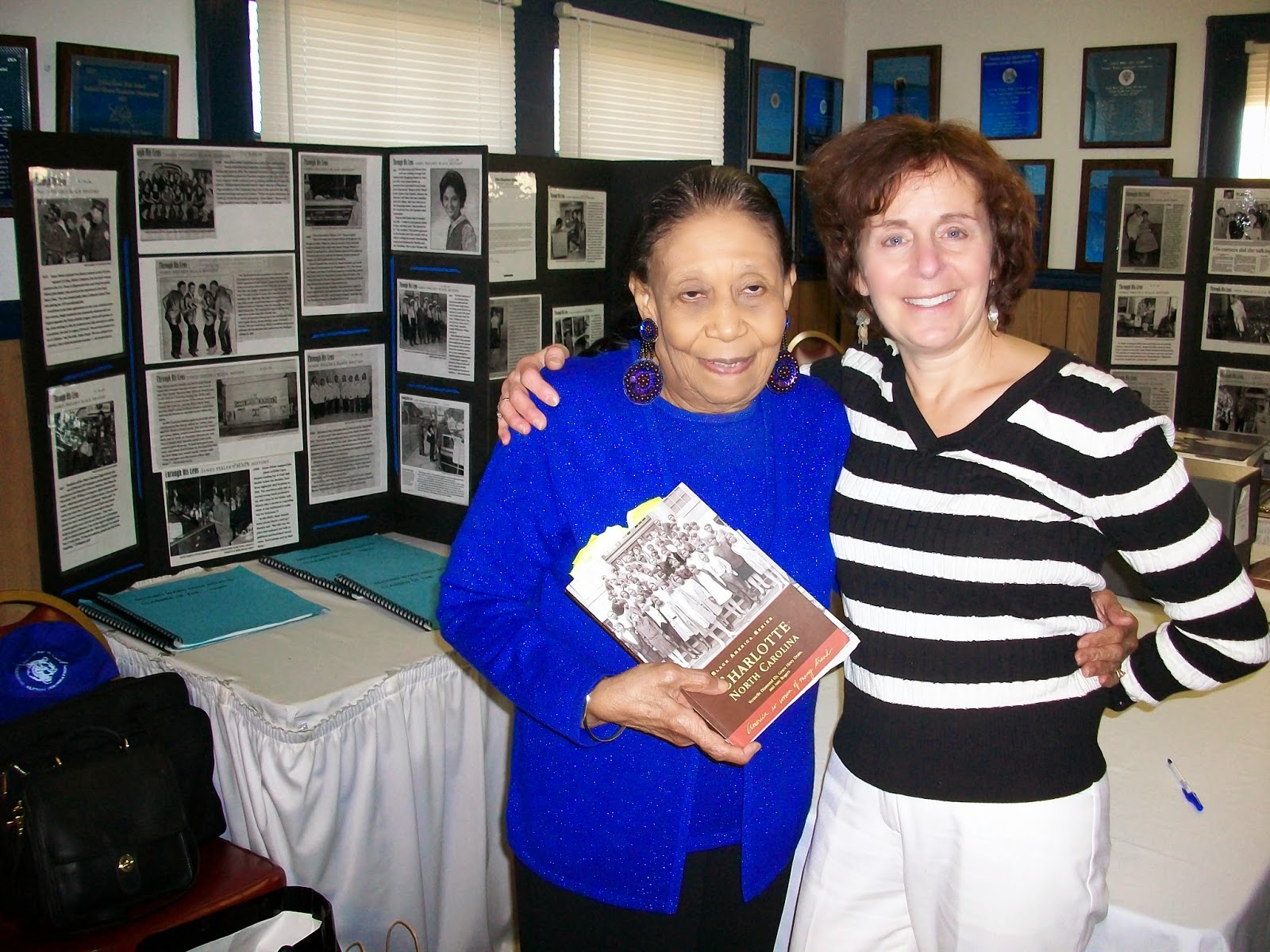
Vermelle and I at the Second Ward High School
Alumni House, 2010

Although she has been legally blind for all her life, Vermelle is co-author of the book, Charlotte, NC which is part of the Black America Series. When we talked about passing she told me, "Black girls who passed did it for their convenience. To get their hair done, go to the front of the line, get waited on, or go to eat in a certain restaurant. Their parents wouldn't have encouraged them." Speaking of my characters she said, "Lillie and Kate might have tried to see if Lillie could pass--just for fun and to see if she could get away from it." And for the record, "Lillie could have gone wherever she wanted with Kate because she was so light she could pass. Kate would have stuck out in the black community-but she would have been accepted there."


Daisy Stroud
Daisy and Gerson Stroud wedding
Circa 1948 


Outside their home
Circa late 1950's-mid 1960's


Daisy Stroud
December 2010

Daisy talked about the Cherry neighborhood (where Lillie lives): "There was a lot of pride there. They were the strivers who made sure their children had the opportunity to go to college." She remembered Bishop Daddy Grace: "He had beautiful light-skinned girls fanning him when he sat on his throne. It was an honor to be one of his girls; they were attractive and had good hair. They looked more like they were a different race." Similarly, "Young women who represented Second Ward High School were light-skinned….They were the privileged ones…We accepted in our race that some were like this. Then we would try to be like them because their beauty brought them privileges."
 
Dorothy Counts-Scoggins

In 1957, Dorothy Counts was one of the first black
students admitted to Harding High School in Charlotte.

She was met with jeers

and harassment. Her parents withdrew her
after four days. 


Photo taken at Johnson C. Smith University
where Dorothy grew up. 

June 2014
"I wanted to make sure that what happened to me at age 15 growing up in this community wouldn't happen to someone else." Dorothy has spent her life advocating for better education for all children passing along her father's legacy. "We knew separation was wrong but my parents taught me acceptance and tolerance. My father, a professor at Johnson C. Smith and a minister, wasn't able to do anything about the separation. But when Kelly Alexander, Sr. asked him if he would be willing to test the new civil rights legislation, (Brown v. Board of Education in 1954 outlawing segregation in schools), our family agreed."  
***********
I am indebted to these women--and the other experts who have shared their life stories with me. My work is a richer tapestry as a result of their honesty and forthrightness. 

Tuesday, June 17, 2014

Picture This: A Behind The Scenes Look at Researching Historical Fiction

Congratulations to Linda Andersen who won an autographed copy of Linda Phillips' ARC, CRAZY.

My last few blogs have been heavy on text, so I thought I would do something different for the next two weeks. Today I'm going to share some of the photographs I consult while writing Half-Truths. Next week, you'll meet a few of my experts--from "back in the day," and now. 

*******
With the help of Pinterest and The Public Library of Charlotte and Mecklenburg County, these images help me create the story of Lillie Harris, my light-skinned African American protagonist who lives in Charlotte, NC in 1950. 

MRS ANNIE TURNBO MALONE A chemist and entrepreneur, Annie Turnbo Malone became a millionaire by successfully developing and marketing hair products for black women in St. Louis. She used her wealth to promote the advancement of African Americans and gave away most of her money to charity. Born on August 9, 1869, in Metropolis, Illinois. http://en.wikipedia.org/wiki/Annie_Malone


Johnson C Smith University
1947 Homecoming 
African American Album 
http://www.cmstory.org/african/album/volume1/079.htm

Rose Morgan - Founder of Rose Meta House of Beauty, one of the largest and most visible African American beauty salons in the U.S. in the 1950s and 1960s. From Ideas to Independence: A Century of Entrepreneurial Women | NWHM. entrepreuners.nwhm.org 

Pinned from Etsy, this is my model for Lillie's little sister, Gloria.

The Tate Family, 1910
A prominent Charlotte African American Family
Several of Thaddeus' Tate daughters
passed for white. 
http://www.cmstory.org/african/album/volume1/009.htm


"The Tate family lived in this elegant home at 504 East 7th Street. Thaddeus Tate opened a barber shop in 1882 which prospered for over sixty years. He co-founded several of Charlotte's leading black businesses, including the Afro-American Mutual Insurance Company and the Mecklenburg Investment Company." http://www.cmstory.org/african/album/volume1/010.jpg 


Second Ward High School
served black students from 1923-1969.
It was torn down when busing began. 
http://www.cmhpf.org/S&Rs%20Alphabetical%20Order/SurveyS&Rjeffers.htm 

Second Ward cheerleaders, 1940
http://www.cmstory.org/african/album/volume1/educat10.htm

A view of homes along East 8th Street in Brooklyn. Area was demolished during urban renewal in the 1960's-1970's. Photo courtesy of Second Ward Alumni Association. 

http://www.cmstory.org/aaa2/places/content_brooklyn.htm


Bertha Pinckenpack in front of her house on Alexander Street
 with her great-granddaughters, 
Geraldine and Beverly, c. 1950.
 http://www.cmstory.org/african/album/volume1/013.htm


Bishop Daddy Grace
was the leader of the United House Of Prayer For All People, 
a Pentecostal denomination that met in the Brooklyn neighborhood.
http://www.cmstory.org/aaa2/places/main_menu.htm

I study pictures like these for all types of information: people Lillie might have heard about or met; hair, clothing, and shoe styles; neighborhoods she would have walked through; what her school looked like. I never know which image might provide an interesting detail that will inform my work.

How about you? What resources do you use when researching a book?


THE NIGHT WAR: A MG Historical Novel Review

  By now you should have received an email from my new website about my review of THE NIGHT WAR by Kimberly Brubaker Bradley. (It'll com...