Wednesday, August 25, 2021

SILLY BOOKS FOR KIDS (with not-so-silly messages): 2 REVIEWS AND 2 GIVEAWAYS

I'm slowly making it through my to-be-reviewed shelf (which keeps getting replenished by publishers and publicists sending me books!). Last spring I received these two books from Sleeping Bear Press and I'm now getting around to sharing them with you.


A CAPE!


Author-Illustrator Marty Kelley's book begins and ends without words. In fact, I bet the entire book has less than 150 words. But his line art tells a story that every preschooler will be able to read.

The story begins as soon as the reader opens the book to see the main character jumping, leaping, and giving a thumbs up as he tries out his cape. The initial textless pages are in black and white...except for a red towel that the little boy discovers in a linen closet.

The towel, of course, becomes his cape. 


Study this spread. Do you see how the boy begins in black and white and the character gradually gets colored in? Do you see the expressions on his face? The story's action is communicated through the illustrations.

He announces to his father (who is almost always shown in black and white):


On the next page his father answers: "Hmmmmmhmmm."

That begins a pattern with the boy looking for his super power. He thinks it might be super strength, invisibility, or flying.


Each time his father answers with a typical disinterested, parent response. "No running in the house."

When the little boy becomes discouraged because everyone who has a cape has a super power, his father puts down his iPad and says, 

"Well, you have a super powerful imagination. Not everybody has that."

And with that, the boy pushes his father off his comfortable chair and gets just what he needs:

Someone to join him in his super-power-imagination playtime!

Check out the rest of Marty Kelley's books on his website

DON'T CALL ME FUZZYBUTT!

Author Robin Newman had a great idea. What kid won't want to read a book with the word "butt" in the title? And illustrator, Susan Batori, portrayed the text with humor and a touch of animal empathy. 


Bear has a problem. If he doesn't get enough sleep, he turns grizzly.


Since he is a light sleeper, he prepares for his 243 (and a half) days of sleep. 


But, that creates a problem for Woodpecker.


When Woodpecker goes looking, he finds remnants of his homes scattered on the ground. He goes straight to work pecking and building. 

Which leads to a very angry bear confronting an equally angry bird.


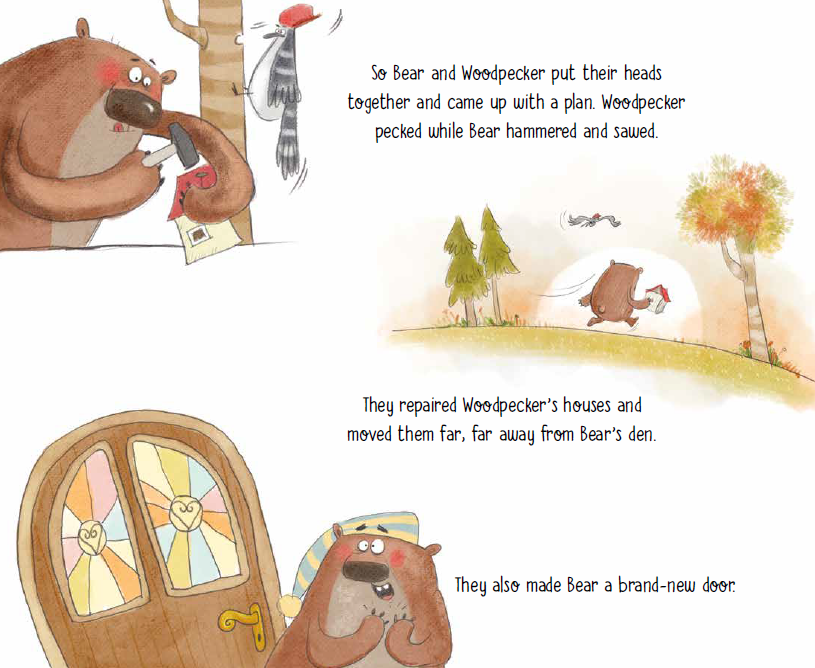
With hurt feelings, Bear tucks himself into bed. But Woodpecker is upset too. He apologizes and the two of them put their heads together to figure out a solution.


After Bear wakes up from his long sleep, the two friends can't figure out what a fuzzybutt is, and as they say, they live happily ever after.

                                                    ****

Authors often want to include a message in their books. I admire how both A CAPE! and DON'T CALL ME FUZZYBUTT! have positive messages of imagination, respect, friendship, and problem solving are woven into these stories. 

GIVEAWAY

I'm giving away both of these books. To enter, leave me a comment by 5 PM on Friday, August 27; continental United States addresses only. MAKE SURE you leave your email address if you are new to my blog.

Wednesday, August 18, 2021

THE KITE THAT BRIDGED TWO NATIONS: A Picture Book Review

 I can't seem to get enough of beautiful nonfiction picture books. I'm particularly drawn to "unknown heroes" who authors discover and bring to life. As my husband's 91-year-old uncle has said to me many times, he wishes he had books like those when he was a child. 

REVIEW


The Kite That Bridged Two Nations (Calkins Creek, 2013) is the second picture book by Alexis O' Neill that I have reviewed. (See Jacob Riis's Camera for the first). Both books capture the protagonist's emotions and a great many details that makes each book memorable.  Jacob Riis's biography spans most of his life and is written in third person POV narrative with a few free verse poems. Kite is a slice of life story based on the true story of Homan Walsh, the 16-year-old teenager who flew a kite across Niagra Falls and is written in free verse first person POV.

Here is the first illustration and the accompanying text. (Note the poetic use of alliteration and personification.)


Whenever wind lifted off the river 
and sent the trees to dancing, 
I'd itch to fly a kite. 


I'd race to the great Niagra, 

plumes of mist rising from plunging waters, 

wind licking at my face. 

A boy like me know, just knew, 

which day would be perfect for flying kites. 


Homan's family immigrated from Ireland. His merchant father wanted him to focus on his studies. Instead, Homan studied the wind, the lift of his kites, and how much line he needed.

Homan heard of a kite-flying contest. Ten dollars would be awarded to the person whose kite spanned the falls. That person's string would be the beginning of a bridge between the America and Canada.  Homan got to work. 

Historians think that Homan built a "barn door kite"
that was shaped something like this.

He measured, cut, and used over a thousand feet of string to reach across the gorge. When Homan was done, he named his kite, Union.

Homan trudged through the snow with a "confetti of kites" flying in the wind, climbed down "endless stairs" and took the ferry across the "roiling river" to Canada. Marvelous illustrations depict this momentous day and how "the inky night spilled on the sky... and the crowds urged him on." But then...disaster struck. 


As midnight dropped,
 so did the wind, 
My heart quickened-- 
a landing near at hand. 
Now with a jolt, the string pulled tight. 
It caught and held. 
America at last!   
Then suddenly, a sag, a jerk. 
The heavy line went slack! 
It snapped on ice below. 


No kite. 
No cord. 
No union. 

Although Homan wanted to find Union, "ice choked the river's throat" and blocked his journey home. After eight days the ferry ran again and he was able to return home, where his father placed his broken kite in his hands. 

Homan set to work, remaking his kite.

At last, when "a favored wind was blowing" Homan retraced his steps to Canada. This time, he stood on the Canadian cliff that was closest to America and "in that calm, the string spooled out!"


As if she knew 
her purpose greater than to fly, 
Union danced above the rapids. 
 She danced to heaven's gate, 
and then she landed swiftly, safely, strongly 
on the American side.  


My Union held secure! 
The prize was mine. 
But better still 
was my father in the cheering crowd.


A boy like me had joined two countries!


Thick strong lines were attached to Hamon's kite's string. After that, Charles Ellet, Jr. strung a cable from which he built the first bridge to span the Niagra River. 


And though this happened in my youth, 
this much is true: 
whenever wind lifts off the river 
and sends the trees to dancing, 
I still itch to fly a kite.


Terry Widener's phenomenal acrylic paintings augment the text. Back matter includes an author's note explaining her choice of first person POV; the facts about Niagra Falls, the kite-flying event, the weather, and the ferry. I found it interesting that Alexis also mentions the facts she didn't know and what she supplied from her imagination. The rest of the story and a timeline of the Niagra Suspension Bridge, provide additional information for curious children (and adults!) 

NOTES

I asked Alexis a few questions about her writing process. I was curious how she found the topic and her decision not to write it as a straight biography. She said, "I heard about Homan Walsh through an editor who asked if I wanted to write a book about him and the kite-flying event. I researched it deeply, tried writing it as straight nonfiction, but it had no life and didn't get to the emotion of the contest and kite flying. So I switched to first person POV and suddenly the book came to life." 

No giveaway this week since this book now resides on my "mentor text" shelf. But, here's a free download of the musical based on the book. There are several activities on Alexis O'Neill's website making it a great curriculum resource for grades three and up. And here's the book trailer:


Congratulations to Rosi Hollenbeck who will receive a copy of I WANT MY BOOK BACK when it comes out. 

Wednesday, August 11, 2021

You Heard It Here First: Viviane Elbee's SECOND Picture Book, a Cover Reveal, and a Giveaway!

 I always consider it an honor when a friend asks me to host their cover reveal. In Viviane Elbee's case, this is a double pleasure because "back in the day" we were members of the same SCBWI-Carolinas critique group in Charlotte AND I got to post the cover of her first picture book, Teach Your Giraffe to Ski (which by the way had over 500 views!).

Her second book is I Want My Book Back! and is illustrated by Nicole Miles. It'll be coming out in March, 2022 by Little Bee Publishers. Today you'll get a sneak peek into this clever book, Viviane's path to publication, and some of Nicole's thoughts.  

BOOK BLURB

Daryl loves to play with his favorite library book about dinosaurs. His imagination takes him to prehistoric places, and he pretends to be a triceratops, microraptor, and even a T. rex! But Daryl does not want to share his book, so when he has to return it to the library, Daryl goes wild. Using all of his roaring and stomping dinosaur skills, Daryl tries his best to get his book back. But when a clever librarian notices Daryl's passion, she encourages him to share his favorite book and make some new friends along the way. This playful, silly, funny, tale about reading, books, and sharing is sure to be a hit with any child.


BOOK JOURNEY

One day, back in 2016, I was reading reviews about another library picture book, and one of the reviewers mentioned that she would like to see a picture book about the magic of libraries that did not have any magical or fantasy elements in it - because, as she pointed out, libraries are already wondrous places. Her comment got me brainstorming about library-themed book ideas that would show just how incredibly special libraries are, while remaining mostly realistic. On my brainstorming list about why libraries are special, I wrote "sharing books you love with others." 

Gradually, a story idea grew. I sent the pitch to my agent Natascha Morris, who said this was a winning idea and I should work on it. I revised the manuscript over and over. 

My critique group was very helpful with revisions. An earlier draft of the story was “quieter" and they helped me make it more active. I’m so grateful for my critique partners!

I took it to an SCBWI conference (pre-pandemic) and Tammi Sauer gave encouraging & useful feedback on how to improve it. Finally, Natascha felt it was ready to submit to publishing houses. Little Bee Books came back with a revise & resubmit, so I revised the manuscript some more and we sent it back to them. I was delighted when Little Bee Books made an offer!

I was really excited to see the illustrations and the cover. When I first saw black and white sketches of the book, I was impressed, and with color, it’s even better! I was also elated to discover that the book will have an undie--the illustrations under the jacket are different from the cover. I love it! Nicole is very talented and she did a great job. 

Although I didn’t talk to Nicole directly about the illustrations, LittleBee sent me black and white sketches and I was able to provide feedback. I could also see all the comments Little Bee had - their comments were very thorough and thoughtful. A book is truly a team effort! 

*******   

Thanks, Viviane. I enjoy hearing every author's path to publication. 

And now, a word from Nicole:

THE ILLUSTRATOR NOTES


I loved that this story was a great opportunity for dino-themed fun and lively action. The illustrations flowed pretty easily after reading the manuscript. I quickly fell in love with Daryl and his mum while working on it! I tried to bring the energy and liveliness to the illustrations that attracted me to the story; I hope readers feel that energy when they read I Want My Book Back

Covers are such a tricky thing because they are the visual calling card for the book and when so much happens in a story, it can be hard to decide which emotional note or action-packed moment to put forward. I like to provide as many options as possible to the art director so I submitted seven possibilities at the sketch phase and ended up working up two color roughs. Options ranged from the loud to quiet; and from literal to abstract. In the end, the team liked the energy and expression in the sketch that ended up being the final cover. Since they preferred the colors of the second rough color sketch, I inserted the color palette of the second rough into the first option. I think it works really well to capture the sweet character's quest for dinosaurs! 

*******

I hope you will connect with both Viviane and Nicole here: 
Twitter- @VivianeElbee and @NicoleMillu  

COVER REVEAL!


GIVEAWAY 

Please leave me a comment with your email address (if you are new to my blog) if you would like to win a copy of I Want My Book Back when it is available February, 2022. If you want an extra chance, share this post on social media. Let me know what you do and your name will be entered twice. The deadline to enter the giveaway is August 13 at 6 PM. I'll also be reviewing the book closer to the book's publication so you'll have another chance to win the book then. 

Wednesday, August 4, 2021

BUGS DON'T HUG: Six Legged Parents and Their Kids- A NonFiction Picture Book Review and Author Interview

After I took a webinar with Heather Montgomery on the "Dynamics of Science and Nature Writing," I knew I wanted to share her book, BUGS DON'T HUG (Charlesbridge, 2018) with you. 


Not only is each page filled with interesting and unusual facts, but showing bugs as babies with their mommies and daddies, makes the information completely accessible to even very young readers. 

Check out this opening spread creatively illustrated by Stephen Stone.


From a bug lifted from his crib to four bugs gathered around the breakfast table, young readers will relate to baby bugs. Each laughable concept (a mother bug making scrambled eggs and toast) to it's real counterpart, (a mother cricket who lays special eggs for her babies),  Montgomery and Stone have brought entomology into the pre-school through second grade classroom.


Normal parts of a parent's day are compared with what bugs do. So, "Daddy bugs don't clean up dirty diapers" but,


"At lunchtime bugs don't plea with picky eaters..." But, 


In the same way, the author and illustrator show fantastical versions of bugs not rocking their babies, serving birthday cakes, or tucking their babies in--juxtaposed (with a page turn) of illustrations depicting real bugs doing, well...just about that!


In the end the reader is asked...


Which is answered on the next page:


The back matter includes three pages with information about the nine featured bugs, a short recommended reading list, and an introduction to scientific language. The note to parents emphasizes that our reaction to insects will shape how children will feel about them.

*****

I was super-impressed with the rhythm which Heather created for the reader.  Naturally, I had to ask about her creative process.

CAROL: I love how you set the book up with statements and refutations from the bug world--the pacing and page turns are so cool. Did you envision it like this? Did you request that the book be set up in this manner? 

HEATHER: It took me a long time to figure this book out, but yes, the manuscript I submitted included the vision to use page turns to (1) allow kids a chance to predict (2) help separate the fantastical and realistic depictions. I did not, however, include specific page turn instructions in the manuscript. Later, after the book was acquired and the editor asked for it, I shared a book map to convey this vision (which she loved!). 

I think that in nonfiction books we often put all the information about one animal/topic on one spread and miss the opportunity to use the page turn for drama and as a pause to encourage thinking. As an author, I wanted to take advantage of that aspect of the picture book format; as an educator, I wanted to give kids an easy in to (and adults an excuse to discuss) thinking about the two different presentations of each animal. I'm all about encouraging critical thinking and thought that exagerating the playful/realistic depictions would help kids "get" the need to read words and visuals carefully.

CAROL: And of course the inevitable question...how did you come up with the idea? I guess that's sort of like a chicken and egg type question. Did you know certain bugs took care of their young in these specific ways, or did you imagine the book first? 

I'm a bug nut and am always looking for ways to invite others to love bugs. I had read this fascinating book, The Other Insect Societies by Dr. James Costa, about the subsocial insects. We all know about social insects like ants and bees which live in colonies and about insects who drop their eggs and leave, but Dr Costa's book opened my mind to this world of insects that give some form of parental care. I used up about a thousand sticky notes to flag phenomenal facts in that book and had been trying to figure out a way to incorporate them into a book for kids. One day as I was taking a walk with a friend and her young kids, I found my way into this book. Her son and I found an earwig and, uncomfortable with the creep factor, my friend stepped away.  But when said, "Hey, it's a bug mommy!" she showed a bit of interest. Then I told her son that this mom had to shop in the forest for her kids favorite foods, and my friend stepped closer. By the time I said that the bug mom has to give her eggs a bath every day to keep dangerous fungus away, my friend was leaning over my shoulder to see more. Right then it clicked. 

The book needed to be for adults as well as the kids. For all those grown-ups who feel squeamish when their little one brings them a six-legged treasure . . . For that moment when they want to squash the bug but their child loves it .. .  If I could just give adults new insight, I might be able to turn conflicted moments into moments of shared wonder. 

And then, with a "big idea" firmly in mind, I could finally pick out the useful pieces from my junk heap of research and make progress towards a publishable book.

CAROL: As an adult who feels squeamish about bugs, I love how you "found your way" into this book.  Thanks for introducing adults and children into these many dimension of bug life!

                                                *****        

Congratulations to Danielle Hammelef who won Isabel and Her Colores Go To School, and to Janet Sheets who won The Color Collector. No giveaway this week. My grandchildren are adding BUGS DON'T HUG to their library!


Wednesday, July 28, 2021

Two "Coloring" Books from Sleeping Bear Press: Two Reviews PLUS Two Giveaways!

Today I'm sharing two new books from Sleeping Bear Press. Although they're not coloring books per se, they each use colors to teach important friendship lessons. Written for the pre-K through first grade crowd, teachers, librarians, parents, and caregivers will enjoy sharing these sweet books with young readers.

The Color Collector 


(Written by Nicolas Solis and illustrated by Renia Metallinou.)


Notice the color palette and simple text on the first page:

On the next page, the boy remembers what it's like to be the new kid and greets Violet. He watches her walk home from school. "I was on one side, she on the other." 

"Until one day." The boy watches her pick up a red candy wrapper and put it into her backpack. 

He notices how she picks up many different things. Here is the first full color spread:


When the boy asks her what she does with what she collects, she invites him to her home, where she proudly shows him her room:


 Each brightly colored wrapper

        piece of trash and speckled leaf

        has a place on her walls, her ceiling, her door.

        They are no longer forgotten bits blowing in the wind.

        Along her wall they are one.

        They are her sky,

        her beach,

        her village.

       They are beautiful.  


Violet tells him about her people that she left behind. In the process of sharing this with him, she is no longer alone. She has a friend. 


In the end, the boy has acquired a new friend...and a bright red leaf that he picks up, and puts in his backpack.


Isabel and Her Colores Go to School


(Written by Alexandra Alessandri and illustrated by Courtney Dawson.)


Here is the opening page:


"She was ready for class, except..."


That night, she dreams of everything that can go wrong. The next day, she wakes up and doesn't want to go to school. But, her mother isn't swayed by her daughter's tears. She kisses her goodbye and in a voice that is "soft and amber like a ripened mango" she tells Isabel that it is okay to be scared. 

That doesn't relieve Isabel; she is an outsider when she peers into the classroom. Despite not knowing English, Isabel does her best to copy her classmates--but makes the mistake of counting in Spanish.


Another little girl tries to be her friend, but Isabel can't understand what she is saying.  Isabel is miserable and decides that school is no fun.


But finally, her teacher announces that it's coloring time and Isabel guesses what colorear means. When Isabel shows her picture of two girls holding hands in which she uses every color imaginable--the other girl gets the message.


And when her teacher holds her drawing up for everyone to see Isabel decides,

Stormy blues and blizzard whites softened to a brilliant aguamarina--just like home. Maybe school wouldn't be so bad after all.

This English/Spanish book includes a Spanish glossary in the back.

GIVEAWAY


In your comment please indicate if you have a book preference. Make sure you leave your email address if you are new to my blog; continental U.S. addresses only. Giveaway ends July 30th at 6 PM. 

CONGRATULATIONS

Susan Rice won FRANKENSLIME from last week's blog. Thanks to all of you who entered! 


Wednesday, July 21, 2021

FRANKENSLIME : A Review, Illustrator Interview, and an Autographed Giveaway!

 Today I'm pleased to review Frankenslime (Macmillan, 2021) written by Joy Keller and illustrated by Ashley Belote. I'm particularly excited since Ashley is the Carolinas-SCBWI illustrator coordinator and this is her debut picture book.

Take a look at this amazing cover!


REVIEW


Here is the book's simple, yet captivating first line:

Victoria Franken was a slime scientist.

What kid wouldn't want to keep reading after that?


Victoria loved experimenting and creating different slime combinations, but quickly became bored...


Along with her trusted research assistant, (her dog, Igor), Victoria set out to try some new combinations. Following the scientific method, Victoria didn't stop trying, even when she didn't exactly meet with success.


Victoria started creating slimes that were so amazing that people lined up to get them!


But Victoria wasn't satisfied. One night she got an idea that wouldn't let her rest. She and Igor went to her attic laboratory. While a storm raged outside, she poured and mixed until...


  Victoria held her breath. Igor whimpered. 

They watched as this newest slime became ALIVE!

Although Victoria initially runs away from her creation, "cursing her chemistry skills," in the end, Goop (as Victoria names him) becomes her new lab partner, and together they come up with slime recipes which they share at the end of the book.


Both children and adults (who are familiar with the Frankenstein story) will enjoy this book. The recipes at the end are a nice addition to a fictional picture book. The author has inserted a STEM connection too as Victoria learns the importance of recording her observations and results.

ILLUSTRATOR INTERVIEW 

(Information for us picture book writers who want to know more about the illustrator side of things!)


CAROL: Did the manuscript come to you with illustrator notes? 

ASHLEY:  There were only two art notes in the manuscript. 

CAROL: Were you give total freedom to create the illustrations? 

ASHLEY:  I felt like I had tremendous creative freedom and was able to incorporate my ideas into the work.  After I sent in my first round of sketches, the art director provided feedback that I applied to the work and that direction ultimately resulted in a better book. There were a couple more rounds of changes and then I moved into the final, color artwork. I learned a lot throughout the entire process!  

CAROL: Did you interact with the author at all? 

ASHLEY: Nope! Joy is an amazing writer and this story is so imaginative. We didn't have any contact during the process. We interact a lot on Twitter which is fun. Now that the book has been released, we've been tweeting at each other quite a bit in order to celebrate the book and do some marketing. We do have an event scheduled together next February, so I'm really looking forward to that! 

CAROL: What is your style? What medium did you use?

ASHLEYMy style is definitely whimsical. I tend to illustrate for young, picture book age audiences and skew towards the cute, humorous side of things. My goal is to bring laughter to viewers!

The medium I used for FRANKENSLIME was digital. I am working all digital now using my IPad and Procreate. They are a great combo and I feel like my work gets done efficiently. Procreate is easy to learn and a lot of fun to experiment with!

CAROL: What's up next?

ASHLEY: My debut author/illustrator The Me Tree early reader is being released on November 2 from Penguin Workshop. Valenslime, another book with Joy, will also be released on November 16.  Listen Up, Louella will be released by Fiwell and Friends (Macmillan) in June, 2022.

CAROL: That's great, Ashley. Thanks for joining us and sharing your debut picture book as an illustrator!

Here is Ashley's contact Information. Please follow her at:

GIVEAWAY

One fortunate blog reader will win a personally autographed copy of this fun picture book. Since I know Ashley through SCBWI, let me know in the comments if you are a member and I'll enter your name twice. Giveaway ends July 24 at 9 AM. Please leave your email address if you are new to my blog! Continental U.S. addresses only. 

WINNER FROM LAST WEEK & A THANK YOU

Congratulations to Virignia Rinkel who won Saving Lady Liberty last week. 

Here's a note from Claudia Friddell:

"Thank you for all of your wonderful comments and thanks, Carol, for your review and interview for Saving Lady Liberty. It was a joy to write, and I loved having the opportunity of sharing Pulitzer and Lady Liberty’s story with your readers!”

Thursday, July 15, 2021

SAVING LADY LIBERTY: An Author Interview with Claudia Friddell--Part II

Two former posts in this mini-series include my review of Saving Lady Liberty: Joseph Pulitzer's Fight for the Statue of Liberty and Part I of this author interview. 

RESEARCH


CAROL: When you were researching Saving Lady Liberty, how did you know what information would fit into your story and what you should leave out? Similarly, how did you know what to save for the back matter? (I can’t believe Carolyn Yoder gave you 8 pages for all your information. Lucky you!!)


CLAUDIA: Well, that’s a great question! Usually, I figure that out along the way. I always start out by including too much information, and as I whittle my story down, I decide what goes to the back matter and what gets left behind. It’s like starting with a block of wood and chiseling away to find the shape of the story. I know I can only keep the facts and details that help move along my plot. Of course, I find all kinds of fascinating nuggets while treasure hunting that I can’t wait to share. I save those for the back of the book. As a former teacher, I want my back matter to be as interesting as my story. I want teachers, librarians, and students to find lots of extra fun facts and enriching material at their fingertips. Fortunately, Carolyn Yoder understands and values the importance of back matter!


Claudia at her writing desk in her river house.
(Does any other writer covet that space besides me?)

IMMIGRATION THEME


CAROL: As a child of 2 German Jewish immigrants, I was touched by the fact that this is an immigrant’s story. Have you received any feedback from teachers or children about immigration? 


The immigration theme to this story is what interested me the most. I was fascinated to find that Lady Liberty’s journey to America parallels that of Joseph Pulitzer and millions of other immigrants in many ways. I chose to completely personify the statue. I always refer to her as Lady Liberty because of her very human story—she was raised in another country, she had a long and dangerous journey, she arrived in America with an uncertain fate, and she found firm footing in a new land of opportunity through the generosity of everyday Americans. I also love knowing that immigrants built the pedestal. The immigration theme has been a great interest to the teachers and students I’ve talked to, and I will never grow tired of hearing their stories of how it’s important to them!


JOSEPH PULITZER


I assume you found lots of other information out about Pulitzer.  Have you thought of writing about other aspects of his life? (ie, The Pulitzer Prize?) 


CLAUDIA: I was fascinated to learn about Joseph Pulitzer’s life from reading James McGrath Morris’ excellent biography, Pulitzer. While there were many different facets to Pulitzer’s complicated and accomplished life, most of them, unfortunately, are not kid friendly! 


He left instructions for the Pulitzer Prizes in his will so I’m not sure if there’s a book there. I think it would be fascinating if someone wanted to write about the history of Pulitzer revolutionizing the newspaper. He was responsible for making the template for our modern-day newspapers to make them entertaining, informative, and readable for all Americans. And he lowered the price to a penny so everyone could afford to read them! 


RELEVANCE 


CAROL: How do you think your book is relevant to children today? 


CLAUDIA: This is the most important question I ask myself.  I think Saving Lady Liberty is relevant in so many ways for kids. Like countless other children, Joseph Pulitzer faced and overcame great adversity and loss as a child. As a Jewish boy in Hungary and a Jewish man in America he faced discrimination his entire life, but he never let any of these obstacles keep him from pursuing his dreams. Through hard work and perseverance Pulitzer not only survived—he succeeded in becoming one of America’s greatest success stories. 


Most children today are familiar with crowd funding, so I was excited to introduce them to the very first crowd funding venture. Pulitzer proved that the small contributions from ordinary folks united by a good cause can accomplish amazing things. He used his newspaper to remind his readers that in a democracy they had a voice in speaking up for liberty. Pulitzer’s passion for a free press inspired him to modernize newspapers to inform and entertain readers of all ages and backgrounds, and his passion for excellence inspired him to create the Pulitzer Prizes. It is timely and relevant for kids to learn that staying educated and informed of facts and events, not only inside one’s community but far beyond as well, can help them find their way in the world. 


Patriotism is the obvious term for Pulitzer’s motivation in Saving Lady Liberty, but for children, I like to describe it as gratitude. Pulitzer never forgot that only in America could he have reinvented himself and lived his rags to riches life. He wanted others to appreciate that it isn’t just a gift to live in a free country. There are responsibilities that go along with keeping those freedoms alive. He seemed to know that people not only need a welcome—we all need reminders, so we never forget and never take our freedoms for granted. I hope, after reading Saving Lady Liberty, kids and adults alike will be as inspired as I am by Pulitzer’s love of liberty and his devotion to democracy, a free press, and equal opportunities for all.


GIVEAWAY

Each time you leave a comment on one of the three posts about Saving Lady Liberty your name will be entered. Giveaway ends on July 16 at 4 PM. Continental U.S. addresses only. 


THE NIGHT WAR: A MG Historical Novel Review

  By now you should have received an email from my new website about my review of THE NIGHT WAR by Kimberly Brubaker Bradley. (It'll com...