Rory is a 12-year-old street smart orphan who keeps her
promises.
First, she is determined to keep her promise to her dying
mother that she’ll take care of her younger sister, Violet.
Second, she will absolutely not break her promise to five-year-old
Violet: Nothing will ever, ever separate them.
It’s just that keeping these promises proves to be a lot
more difficult than even spunky, Irish Rory Fitzpatrick ever imagined.
 |
| From http://christinabakerkline.com/blog/my-next-novel/ |
Co-authors, Michaela MacColl and Rosemary Nichols use the
facts of the Orphan Trains in this fictionalized account starring Rory as the
sharp-witted, courageous heroine. Between
1853 and 1929 250,000 orphaned, abandoned, or homeless children were put on
trains and brought out west. The Children’s Aid Society of New York sponsored
many of them. At times, the families used the children for underage labor; this was before there were child labor and foster care laws. On the other hand, The Foundling, a Catholic organization, took great care to place the orphans in
their care in “good, Catholic families.”
 |
| http://www.chsfs.org/blog/evolution-orphan-train-new-practices-and-waiting-children |
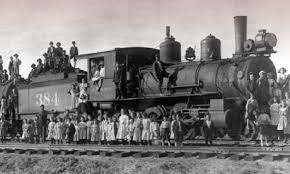
Although Rory herself is a fictional character, many of the other characters in the book are real: Sister Anna, the nun in charge of
placing the children; George Swayne, the agent who worked with The Foundling; Father Constant Mandlin a young French priest who couldn't communicate well with his parishioners
as well as the white women who were furious when Mexican working-class families
received children and they didn’t.
 |
| http://www.neh.gov/humanities/2007/novemberdecember/feature/lost-children-riders-the-orphan-train |
But I am getting ahead of the story.
Rory’s goal to make sure she and Violet stay together drives
this story forward. As far as she’s concerned, not even plans to take Vi out
west to the Arizona territory will stop her. Although she successfully sneaks on board the orphan’s
train, her journey is not without moments of doubt.
Families who couldn’t have children of their own wanted cute little 5-year-olds—but
would anyone want her sister also?
But the more happy families she saw, the more she wondered if Vi had a future that might not include Rory. If Vi had a chance for parents
and a home, could Rory stand in the way of that? p. 144
After a stressful journey, when the train finally arrives in Clifton, Arizona Territory
everyone is shocked. First, the stench
of sulfur and a building belching dark smoke greet them. Rory soon learns that
the town revolves around mining copper. In the small station, a mob of
loud, white women pound on the train’s windows. Later Rory is told,
"This place is bad for making babies. The air is thick with
fumes and the water is full of metals from the mines. Nothing grows here. No
trees. No babies.” (pp.171-2)
A new conflict—one based on history—enfolds. The Protestant
women believe they have a right to the children since they are the same race
and skin color. But the children have been promised to the Mexicans so they can
be raised in “good, Catholic homes.”
The white women are demanding and ugly. Rory is actually relieved
when Violet and a little boy, William, are assigned to two kind Mexicans, Elena
and Ramon Martinez. But her relief that Violet has found a family is tempered
by her anguish of wanting to stay with her sister. Can she find a way to
convince the Martinez family to adopt her also?
 |
Downtown Clifton, circa 1915
http://visitcliftonaz.com/rich-history/ |
Rory’s concept of family--people who look alike--is
challenged and her courage and loyalty are severely tested. She needs every ounce of her abilities to think
quickly and to act fast to help the orphans and to keep her promises.
At the risk of including a spoiler, I must share one of my
favorite parts of this book. At the end,
when she tells Violet about the Martinez’s plan to take them both to Mexico
Rory says,
"We’ll never see the Foundling again—or Sister Anna or the
other kids,” she warned. “We’ll have to learn a new language too, Vi. And there
won’t be any American kids to play with. We’ll always be different."
“Special?” Vi asked, her blue eyes shining with pleasure.
“”I guess so,” Rory said ruefully. (p. 250)
Leave it to a five-year-old to
have a different perspective on what their new life will be!
Thanks to the generosity of Boyds Mills Press, I’m giving away a copy of this middle-grade novel for girls. It documents a little-known period in
American history, when Mexican families fought for the right to adopt white
children. Also useful as a classroom book, Rory’s Promise will spark some interesting discussions about diversity. If you are interested in adding this book to
your library or donating it to a classroom, please leave a comment by
Thursday, June 4. If you are new to my blog, please leave your email address also.


