Saturday, March 11, 2023

What's Next?

 Six weeks ago, I shared my excitement that HALF-TRUTHS was finally on submission. At that point, the answer to the question, "What's Next?" was to query agents and editors. For those of you who are writers, you know that process can take a long time. Agents and editors are backed up and although I've sent the full manuscript in response to a few requests, it can still be months before I hear back from anyone.

Meanwhile, the best antidote to obsessively checking my email is to get busy with a new project. Without further ado, I want to introduce you to my next WIP (Work in Progress) a middle-grade graphic novel that I've tentatively titled ESCAPE FROM NURENBERG. The story is based loosely on my father's and grandfather's experiences in Germany from 1935 to 1938.

When my parents died, I became the keeper of their papers. These included an assortment of documents and photographs. There were several versions of my father's autobiography, personal letters, my grandfather's report cards from medical school in the early part of the 20th century (that a friend translated), and a speech he gave to doctors in Ohio after he immigrated to the United States. 

My father, Henry Federlin, is on the left. He is standing with
 his mother Elsie and his father Sigmund.
Circa 1945
As I looked through these precious documents and pictures I wondered if there was a story that I could write. I usually answered that question with "no" because there are already so many Holocaust stories for kids. But there was one unique event in my grandfather's life that occurred before he left Germany. It wasn't a story by itself. But maybe it was the ending. And when I thought about my father's account of how he was bullied in the public school I thought--that could be the beginning. 

All I needed was the middle.

I made a note to myself in my phone:

  • Learn how to use Scrivener for writing a script.
  • Learn how to write a graphic novel.
  • Learn what was happening in Germany during this time period.
  • Come up with a story arc. 

In the last six weeks, I've done all four.

SCRIVENER

Based on what I read online, Scrivener's scriptwriting program was ideal for writing a graphic novel. The only problem was that I had no idea how to write a script! Fortunately, I found a ton of images and tutorials online and within the Scrivener software itself. Since I learn better by trying my hand at something rather than reading about it, I jumped in and created a project. Like all software there's a learning curve, but I'm getting there. I love keeping track of my research, the story, and images all in one project--with the ability to simultaneously work in two documents:


WHY A GRAPHIC NOVEL?

I spent 16 years writing HALF-TRUTHS and I wanted a break from that form of storytelling. I also asked the KidLit 411 Facebook group how to tell if an idea was better suited for a "regular" novel or for a graphic novel. I tagged Kirsten W. Larson and she responded, "I would think about the visual possibilities for your story. Like picture books, graphic novels are visually driven. You have to ask yourself the same questions about whether you have scenes that are visually interesting and distinct from each other." Since I was already picturing the action in many of the scenes, I thought I was on the right track. 

This blog post describes the process that I stumbled into. A graphic novelist imagines each panel as the reader will encounter it.  Kirsten Larson told me that the process of "paneling" takes time. I believe it. Imagining what will be shown on a page of panels can easily take hours of research. 

I'm also studying graphic novels and seeing how the author employs transitions, and shows dialogue, captions, and narrative information. As I did with HALF-TRUTHS, I'll be reviewing some of these books here

LEARN ABOUT GERMANY

I'm a hands-on learner. Whereas some novelists may choose to research and then write, I prefer to jump in, learn, save new information, and incorporate it into my WIP.

Although my parents were both born in Germany and had family who died in the Holocaust, by the time my brother and sister were born in 1950, my parents were ready to put those events in the past. I came along three years later and my parents rarely talked to any of us about their childhood growing up in Germany. My best friend's mother had a tattoo on her arm from being in a concentration camp--but we never talked about it. I knew the names of the cities where my parents grew up, but it wasn't until I was an adult, that my father started sharing some of his experiences before leaving Nuremberg

Fortunately for my siblings and I, my father composed several short, type-written autobiographies. My mother's memory wasn't as good as my father's, but I interviewed her a few times and have some glimpses of her life as a child in Speyer.

I'm embarrassed to admit it, but I knew only a thimbleful of information about the Holocaust. I am rapidly rectifying that situation through books and amazing websites like the United States Holocaust Museum with information such as this about children. When I enter various museum websites it's like diving into a deep hole. I go from link to link and come back to Scrivener having forgotten what I was looking for. 

When my dad told me he grew up in Nuremberg, I didn't realize how Hitler used that centrally-located city as his propaganda launching pad. Not only did it have a huge park that Hitler transformed into his political Rally grounds, his antisemitic follower Julius Streicher, published the virulent Der Stürmer newspaper there. 

This is what my father had to say about Striecher:

"My public elementary school was right across the street from an anti-Semitic weekly newspaper, Der Stürmer published by one of Hitler's favorite cronies, Julius Streicher, Nazi boss of Franconia, a noted pervert and one of the most unsavory characters in the Third Reich."

As I pictured my father attending school across the street from a widely-read tool of Nazi propaganda--my story became more real. 

A group of young German boys view Der Stürmer, Die Woche, and other propaganda posters that are posted on a fence in Berlin.
A group of young German boys view Der Stürmer, Die Woche, and other propaganda posters that are posted on a fence in Berlin. ——US Holocaust Memorial Museum, courtesy of Julien Bryan Archive

THE STORY

I had story nuggets for the beginning and the end but I didn't know what was going to happen from Point A to Point Z.  My unofficial "research assistant," my sister Barbara Federlin, and I brainstormed possibilities.  The more I read, researched, and imagined what my father's and grandparents' lives were in Nuremberg, the more a story began to take shape.


Fifteen years ago I toured Nuremberg with
my oldest daughter, Lisa, and my husband.
We visited the medieval city and saw the street
where my father grew up. These images help construct my story too.

WHAT'S NEXT?

Kirsten W. Larson is mentoring me as I plunge into the graphic novel world. I took a webinar with her last year which convinced me that the Kidlit publishing world is wide open to this genre. She encouraged me to create a synopsis using this template. You can use it at any step of your writing process. Filling it out even if your WIP is not a graphic novel and even if it might change, will help you imagine your entire story arc.

Thanks for joining me on my next writing journey. I'll be sure to let you know what happens next. 

                                                ****

GIVEAWAY NEWS

Congratulations to Becky Scharnhorst who won THREE CANADIAN PIGS and to Marci Whitehurst who won GOOD MORNING, SUNSHINE. Thanks to everyone who entered. Stay tuned for more contests--I have a stack of books to review and give away!


Monday, March 6, 2023

TWO CANADIAN STORIES + TWO GIVEAWAYS

This week I have two very different picture books for you courtesy of Sleeping Bear Press; both are related to Canada's national winter sport--hockey. If you want to win either of these books, make sure to include your name and email address when you leave a comment and let me know which book you're interested in. 

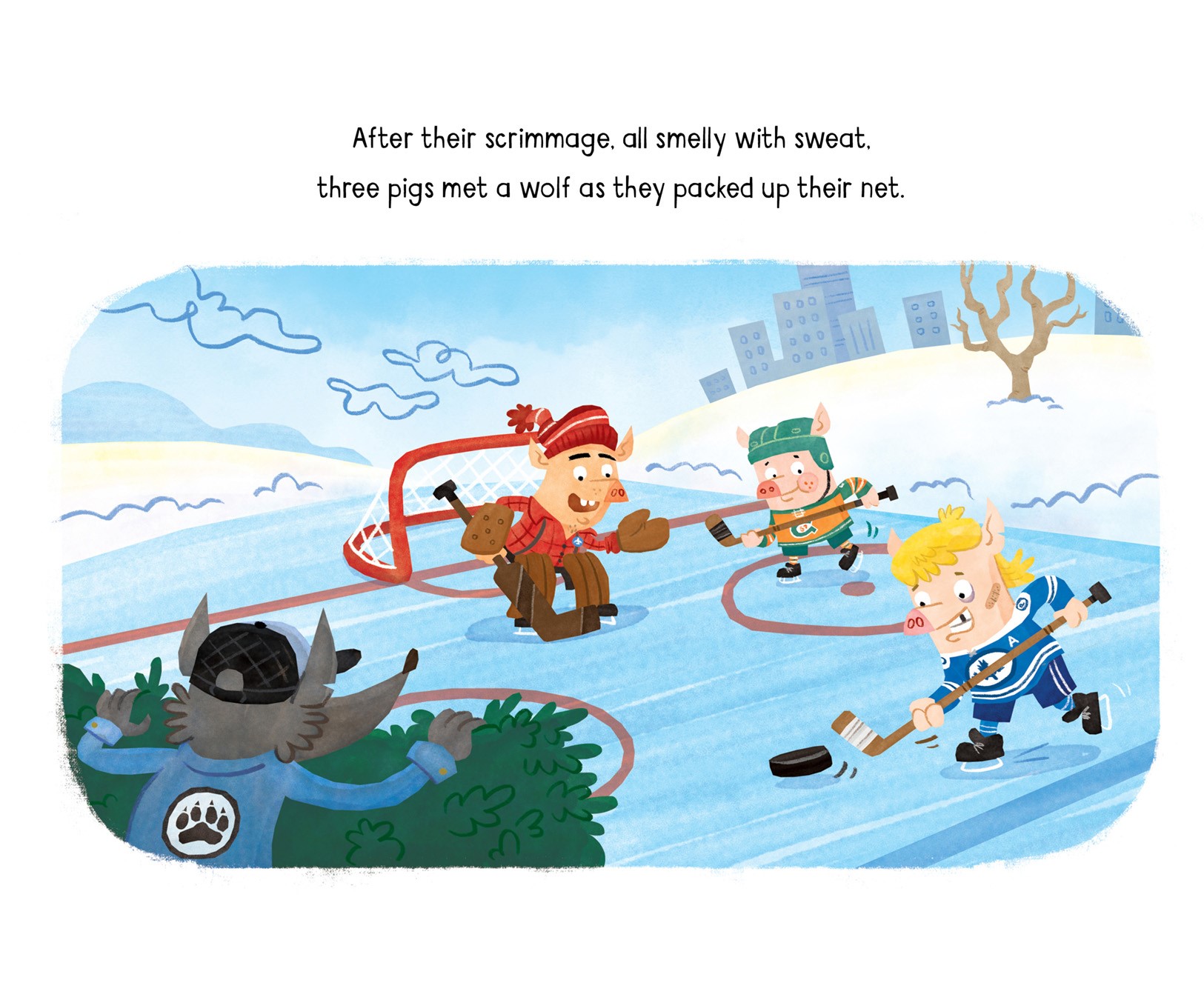
The Three Canadian Pigs  by Jocelyn Watkinson, illustrated by Marcus Cutler


Jocelyn Watkinson took The Three Little Pigs, gave them a Canadian twist, and produced a fun picture book that children--and the adults who read this book to them--will really enjoy. 

When Wolf chases him down in his fancy Zamboni, the pigs cry out, 

"I'm sorry there, Wolf, you are sorely mistaken--"

and Wolf responds, 

"Oh no!  But I'm not! You're Canadian bacon!"

The puns and Canadian references only get better from there. 

Of course, Wolf goes to their modern-day snow fort cleverly designed by Marcus Cutler and of course, he tries to "huff and puff and blow it down." And of course the pigs reply,


Despite enlisting his friends Bear and Moose, the snow fort cannot be shaken. The pigs demand to settle their feud the "Canadian way"-- which of course, means on the hockey rink.


It's no surprise that the pigs take the lead. Wolf gets mad and resorts to some nasty moves.


Moose and Bear come to the pigs' defense and Wolf leaves with an empty tummy. But since the pigs are an honorable sort, they invite everyone back to their fort.

Now, wait up there, eh! There's no need to take off!
There's tons of great food back at home in our trough!

Wolf apologizes, "Pigs, I'm so sorry that I was a brute."

They wave him off with,


Then they all turned on the game, and they put up their feet...

and Wolf announces,

Being friends with Canadian bacon is sweet! 

                                                    ****
Jocelyn told me that she wrote The Three Canadian Pigs because she had moved to the U.S. and was homesick for Canada. She was working on some fractured fairytales when her mother said, "Do the three little pigs but make them Canadian!" This goes to show, we ALL need to listen to our mothers!

GOOD MORNING SUNSHINE! The Joey Moss Story by Lorna Schultz Nicholson, illustrated by Alice Carter


Lorna Schultz Nicholson has crafted a heart-warming story about Joey Moss, a man who became a Canadian hero.

The first spread shows the reader how Joey Moss loved to make people smile--just by being himself.  Then the book flashes back to September 1963 when Joey was born in Edmonton, Alberta, Canada. 


The fact that he was born with Down Syndrome didn't change how his family of eleven siblings welcomed him and incorporated his tambourine playing into their musical act.

Joey graduated from a special school for children with developmental disabilities and got a job working at a local bottle depot. It wasn't much fun and Joey had to catch several buses to get to work.

But, things changed when a family friend, Wayne Gretzky, saw Joey shivering at a bus stop one day.


Wayne helped Joey get a job working in the Edmonton Oilers equipment room. Despite being made fun of at times, Joey loved it!


Joey worked hard and the team loved his friendly enthusiasm.


The TV cameras focused on him when he sang the national anthem before games. After the Canadian Football League asked him to work for them also, he became so popular that people asked him for his autograph!

He helped out at charity golf events and modeled clothes at the Edmonton Down Syndrome Society fashion shows. 

Whether it was belting out "O Canada!" before a hockey game,


or helping people, Joey loved making people smile.

For the rest of his life, Joey Moss continued to be an inspiration for people and an advocate for those with disabilities.

Just by being himself, Joey showed the world that everyone can be a force for good, active in their community, and a positive role model.


                                                    ****
Joey Moss was an inspiration to Lorna and she is happy that she got to dance with him at the Edmonton Down Syndrome Society fashion show. The illustrations by Alice Carter are warm and inviting--just like Joey was. 

Here is a Joey Moss Tribute video that will help you realize why Lorna wrote this inspirational book. 


GIVEAWAY

I am giving away both of these books! Leave a comment with your name and email address, or send me an email if you prefer. Please let me know which book you prefer. If you share this on social media, you will get one extra chance; if you follow my blog you will get another chance. Tell me what you have done and I will enter your name accordingly. U.S. postal addresses only.  Please note that your comment will not show up until I approve it. The giveaway ends on March 9. 


Monday, February 27, 2023

A HISTORY OF TOILET PAPER (AND OTHER POTTY TOOLS): A Review and Giveaway

 If this is not a title and cover that will grab your attention--I'm not sure what will!


Sophia Gholz is no stranger to my blog. I have reviewed BUG ON THE RUGJACK HORNER, DINOSAUR HUNTER; and THE BOY WHO GREW A FOREST. But I must say, A HISTORY OF TOILET PAPER (Running Press Kids, 2022) is different from all of her other books. The book includes facts that curious kids will love, humorous illustrations by Xiana Teimoy, and witty word play.

In the beginning, potty time meant the great outdoors, with stones and seashells, grass, moss, leaves, and water or snow. 

Technology advanced from there to,


Potty tools changed over time.

Sophia gathered all sorts of facts which will grab the interest of everyone from potty-training toddlers to their older brothers and sisters:

  • The Romans pottied in public and didn't mind sharing tesorium (bum brushes). 
  • A Chinese inventor, Cai Lun, created paper in the first century. But it took a thousand years before the imperial family figured it was not only good for writing documents, but also suitable for wiping one's rear end. 
  • The first flushing toilet was invented by Sir John Harrington. But,

(Did you catch the word play?)

  • Across the pond, colonists found that corn as well as the Farmer's Almanac were useful outhouse accessories.
  • Less than two hundred years ago, Joseph Gayetty's invention of medicated wipes were not well received. You could say they went down the drain
  • It wasn't until the close of the 19th century that perforated toilet paper became a common household item--courtesy Clarence and E. Irvin Scott brothers


In the end, Sophia Gholz concludes,

...whether you prefer your potty to be fancy, simple, shared, private, or in the great outdoors--or whether you have paper, grass, sticks, or water--when it's time to go, it's time to go.

                                                    ****

I bet if you watch this trailer with a child, she'll beg for the book. 


For the backstory about this clever and informative book (that includes Covid and toilet paper shortages), see Kathy Temean's interview with Sophia.

GIVEAWAY

I'm giving away a copy of this book through the April issue of Talking Story which is on Change. As you can see from the trailer and my review, there is a lot of historical change shown in this nonfiction picture book! Leave me a comment and I'll add your name to the giveaway list; the winner will be drawn in mid-April. If you're an educator you will have two chances, if you enter through Talking Story you'll also have two chances. U.S. postal addresses only.  If you are new to my blog, please make sure to include your email address!

Saturday, February 18, 2023

JEFFERSON'S SONS by Kimberly Brubaker Bradley: A Middle-Grade Review

 When my 13-year-old granddaughter highly recommends an author, I listen. Last year she recommended Kimberly Brubaker Bradley's books, The War that Saved My Life and The War I Finally Won. I loved them both and immediately had to find out what else Bradley wrote. When I discovered Jefferson's Sons, it became a must-read. For those of you who have read my Half-Truths page, you'll see why.


Many years ago I read Sally Hemings: A Novel. The story of Jefferson's hidden romance with his slave has stayed with me. Bradley took the facts about that 38-year relationship and put "meat on the bones." The names of their seven children are historical facts. The author took those names, researched their backgrounds and the time period, and did an amazing job of imagining their stories. The story is so well-written that I had to keep reminding myself that it's a work of historical fiction.

As the Kirkus review points out, this book is told from the third-person point of view of two of the sons, Beverly and Madison, as well as from an enslaved boy. This last perspective provides important insights into the entire Jefferson story--contradictions and all. Bradley transitions so smoothly from one point of view into the next that I had to stop reading to realize what had just happened. 

REVIEW

Sometimes I review books by typing out portions of the book (this is also a good way to learn how to write!). Since Bradley's re-creation is so powerful, I decided to do that this time.

The first perspective is from the oldest boy's POV, Beverly when he is about seven. His mother, Sally Hemmings, is the first speaker.

"There is nothing inside, either one of you, or anyone else--Joe Fossett or Uncle John or me or anyone--that makes you a slave, that says you have to be one, that says you're different from somebody who isn't a slave. This difference is other people--people who make laws and put other people into slavery and work to keep them there."

Mama's eyes blazed. "But you aren't really slaves either," she said. She rocked Maddy back and forth in her arms. "You remember that. You'll never be told and you'll never be beaten and when you turn twenty-one you'll be free...That's a promise. A promise your father made me about all the children we might have. You'll be free."

"How can he promise that?" Beverly asked. "He can't just make us free."

Mama paused, growing. "He can," she said.

"Because he's the president?

"Because he owns us," Mama said. "He owns all of Monticello. The buildings and the farms. The people too."

Harriet asked, "You mean, because he's our daddy?"

Mama shook her head. She said, "Because he's Master Jefferson." (p. 35)

                                                                ****

About two years later, Mama gives Beverly a genealogy lesson. She draws lines to all of Beverly's great-grandparents so he can see he has seven white ancestors and one black ancestor. 

Mama nodded. "The law says that any slave's children are always slaves, but it also says that any person who has seven out of eight white great-grandparents is legally white. So you and Harriet and Maddy are white people. You're slaves, but you're white."

"Nobody acts like I'm white," Beverly said.

"No. They won't, because you're a slave. But think on it, Beverly. Someday you won't be a slave. You'll be a free white man."

Beverly thought of the white people he knew. They got to be bosses, mostly, and they lived in nicer houses than the black people he knew. Still. "I don't want to be white," he said. "White people are mean."

"Not all of them," Mama said..."It's easier to be white," she said. "It's safer."  (P. 82-83)

Two years later Mama sharply reproves him for talking about how Jefferson is his father in public. Family members and visitors often see the family resemblance between the two. She responds to his anger about the situation:

"It's already been in newspapers once, years ago, about me and your father, but he lived it down and it's mostly been forgotten.  Somebody decides to publish the truth about you and your siblings, and guess what? You'd be famous. Thomas Jefferson's half-white son." Mama's eyes blazed. "A famous slave, Beverly. You'd never get away from it. You'd never really be free."
                                                        ....

"If you pass for white you'll be safer and if you're known to be my son by Thomas Jefferson you will never be allowed to pass.  (pp. 113-4).

http://www.mountolivethistory.com/stories-in-stone-blog/the-other-tjs-other-daughter
"First paragraph of James T. Callender's newspaper editorial, titled "The President Again," which first exposed the purported relationship between Thomas Jefferson and Sally Hemings, one of Jefferson's teenaged slaves. (from the Richmond Recorder, Sept 1802)"

In these conversations, Beverly learns powerful lessons about himself, his father, and the world. 

                                                    ****

About a third of the way into the narrative, the story shifts to Beverly's younger brother, James "Maddy" Hemming's. He longs to get his father's attention and when he hears that Master Jefferson's pet mockingbird died, he catches another one and brings it to him. The President pays him fifty cents which is a lot more money than Maddy had ever had before. But that's not what he was looking for. 

The coins were cold in his hand. Inside the cage, the bird made a sudden, wild squawk, and beat its wings against the bars.

Maddy swallowed. The most awful feeling came over him, all at once, like water poured out of a bucket onto his head.

That bird had been free, and now it was a slave. From now on it has to live where Master Jefferson wanted it to live, eat what Master Jefferson gave it to eat, even whistle the songs Master Jefferson wanted it to sing. He, Maddy, had sold that bird into slavery. (p. 144)

                                                                ****      

Like his older brother Beverly, Maddy also struggles to understand the implications of his skin color. In an interchange with his friend, Maddy claims that he needs to learn to read for the time when he's going "to be white." After comparing the color of their hands his friend says. "I already know I'm not white." He paused again. "Neither are you."

                                                ***    

When Master Jefferson sells his friend, Maddy is angry.

Harriet, his older sister, asks him, "What, "she said, "do you think slavery is?"

Maddy glared at her. Harried took no notice. 

"I'll tell you," she said. "It's not having any say. Any choice. Not about you, not about your family, not about anything. Forget not having to work for someone. Forget not being paid. It's the way. The not having any say."

"I know that," Maddy said.

"You act like you don't. You act like you're just now discovering what everyone else understood all along."  (p. 227)


"An interesting miniature portrait sold on eBay in 2012 which was said to be of Harriet Hemings. One of the papers inside the piece indicates the subject as "Harriett Hemings", president Thomas Jefferson had two daughter's with his slave Sally Hemings, named Harriett, one dying shortly after birth, and the other, often known as "Harriet II", was born at Monticello in 1801 and was known to be working in the textile factory by age 14. It was well known that she was very light skinned and could "pass for white". The interesting thing here that the artist truthfully portrayed was that although she had very light skin, she still had African American features."

As you can tell from these quotes, this is a powerful work of historical fiction. Although it is out of print--which I find hard to understand--it can still be bought through used books sites. Teachers, you'll find that is an important resource when your class is studying colonial America, black history, and slavery. 

                                                    ****

Congratulations to Julie Lyon for winning A TAKE CHARGE GIRL from last week's blog.

Don't forget to stop by Greg Pattridge's MMGM blog for more great MG books.


Monday, February 13, 2023

A TAKE-CHARGE GIRL Blazes Her Way To Congress: The Story of Jeannette Rankin. A REVIEW, 2 INTERVIEWS, and a GIVEAWAY

 From the moment the reader opens this book, she will know that Jeanette Rankin was a hard worker. As a teenager, Jeannette was someone who was as quick to help a hurt horse as she was to help her mother care for her six younger siblings. 

She was a "take-charge" girl.


REVIEW

Jeannette grew up in Montana, but in 1907 when she was 27 years old, she visited San Francisco. When she saw the destitute conditions of the residents in the tenements of Telegraph Hill, she pitched in to help the children. 


That's when she got her first big idea: she would become a social worker and help improve the lives of children and their families.

But, she soon realized that social work alone was not enough to change the lives of suffering families. She wondered, who had the power to improve health care, living conditions, and social services for the poor? Then she realized--it was the lawmakers.  But they were all men and didn't care about these issues.

In 1910, Jeannette threw herself into the suffragette movement and spent four years giving speeches all across the country. Along with other like-minded women she printed leaflets and organized meetings.

In 1914 Jeannette wrote to every (male!) voter asking them to support a woman's right to vote. After they won Jeannette had her next BIG idea. 

She decided to run for Congress.


She and her siblings sent postcards to every woman in the state. Jeannette Rankin clubs were formed. She vowed to improve labor, and housing conditions and to improve health care.

After a day of fretting and worrying, Jeannette found out she had won. She was the first Congresswoman in the United States!

On April 12, 1917, Jeannette strode into the Capitol to take her seat in the House of Representatives. 


BACK MATTER

There are seven pages of back matter which teachers and librarians will love. These include a not-so-positive poem that appeared in the NY Times shortly after Jeannette won her congressional seat, a timeline of her life, and a bibliography.

1917
https://en.wikipedia.org/wiki/Jeannette_Rankin

AUTHOR INTERVIEW

Author Gretchen Woelfle is not new to writing about trailblazing women. She has written several other historical books as well as an award-winning middle-grade biography about Jeannette Rankin. 


Carol: Can you tell us a little about your research journey? What were some of the highlights?

GretchenJeannette Rankin lived a long life: from 1880-1973. A TAKE CHARGE GIRL covers just a slice of that life, her childhood through to April 2, 1917, her first day in Congress. 

My research began conventionally, reading biographies and histories of women’s suffrage. Then I ordered the Jeannette Rankin Papers from the Schlesinger Library, at the Radcliffe Institute. They arrived on microfilm at my local library and I spent days browsing through Rankin’s newspaper clippings, official and personal letters, speeches, and articles which gave me anecdotes and quotes to add to the narrative. Photos online from the Library of Congress, the Montana Historical Society, and the University of Montana showed the times, places, and fashions that Rankin favored. 

But best of all were transcripts of hours of interviews she gave in 1972 as part of the Suffragists Oral History Project at the University of California, Berkeley. I read dozens of stories in her own words, describing her Montana childhood, her years in New York studying social work, her four years traveling the country giving thousands of suffrage speeches, enduring insults and abuse from men, befriending other progressive women, feuding with a few women’s suffrage leaders, and collaborating with her brother and four sisters.

I wrote a middle-grade biography, Jeannette Rankin: Political Pioneer, published in 2007 by Boyds Mills/Calkins Creek which covered her whole life.  That book was well-received, winning several awards, and appearing on Best Books lists. But eventually, it went out of print and Jeannette Rankin faded from bookstores and library shelves. 

I didn’t like that one bit! So I asked Carolyn Yoder, my Calkins Creek editor if she’d consider a picture book biography of Rankin. You see the result. 

Carol: That is fascinating! I never heard of an author being able to do that before. What challenges did you face distilling down your middle-grade biography to a picture book?

Gretchen: This format meant focusing on just one period of her life and one of her passions. I bypassed her lifelong commitment to pacifism, feeling that was too complex a subject for younger readers. Instead, I created a narrative arc that began with her caring for her younger siblings, moving to her social work with disadvantaged women and children, to political action to give women a voice in choosing leaders to pass social welfare laws and to become one of those leaders in Congress.

I showed her actions expanding from the personal, to the public, then to the political, driven by her unflinching determination to take charge of her own life, and blaze a trail for others to follow. That is the heart of the story I chose to tell.

ILLUSTRATOR INTERVIEW

Rebecca Gibbon lives in the U.K. but that doesn't prevent her from illustrating subjects from American history and culture.

Carol: Can you tell us about your choice of palette and favorite materials?

RebeccaTo be honest, I don’t actually think about the palette, I’m drawn to different tones of blue and shades of red. I actually used a lot of sepia brown ink, which is quite appropriate as all the photographs from that time period I used for research were in sepia.

I use a combination of acrylic inks, colored pencils, and gouache. The inks are so versatile and a little goes a long way. They can be used neat, like acrylic paint, giving a bright, intense coverage or watered down for more of a loose, watercolor effect. I also like using my fingers & thumbs to make unusual marks, so I look quite a mess after a day in the studio!


Carol: Please tell us about your research process. Is it hard being in Britain and illustrating an American story?

Gretchen: I love the thrill of delving into history when researching a new book, it takes me on a journey and I learn so much from it. I have many books on Edwardian fashion, the History of women’s rights, and old advertising books from the 1900s that I have amassed from past projects. I looked at vintage postcards of Montana & California, magazines, and advertising snippets and I use Pinterest as a scrapbook, trawling through images to find room interiors, fashion, hairstyles, pastimes, anything, and everything. I become completely immersed in that world and become so familiar with the subject, that by the time It’s been sent to the publisher, I feel like I’ve lost a friend, as I’ve spent months drawing and painting them. 


Before the internet, researching a project was trickier & more laborious, as information was harder to find. But so much information is available online, it makes things so much easier. Being British, there were some aspects of American History I had no idea about, such as how many stars and stripes there were on the USA flag in 1910…. But now I know!


My intention is to bring unsung, amazing, and groundbreaking women alive… I hope that I’ve achieved that! 


GIVEAWAY

This past week, Gretchen has been on a blog tour with her publisher, Astra Publishing. I'm happy to have been part of this tour and to offer a copy of A TAKE-CHARGE GIRL. If you want to win this book, please leave me a comment by February 16 along with your name and email address. If you are an educator or librarian, please include that information and your name goes in twice--including homeschool parents. (U.S. addresses only).

WANT TO READ MORE?

As a book reviewer and blogger, I find it interesting to see how others take a different approach to reviewing the same book. Here are three other blog posts highlighting A TAKE CHARGE GIRL.

Picture Book Builders

Behind the Scenes with Beth Anderson (A look at how Gretchen came up with the title)

Nerdy Books (An Illustrious Collaboration)

Saturday, February 4, 2023

CLOAKED IN COURAGE: A NONFICTION PICTURE BOOK REVIEW and 2 MINI-INTERVIEWS

Without a bit of shame, I admit it. I'm a Beth Anderson groupie. Ever since I read Tad Lincoln's Restless Wriggle and Franz's Phantasmagorical Machine and discovered Beth's relentless research to discover the heart of each biography--I want to read and study each book she writes.


REVIEW

Deborah Sampson's Spirit was always a little too large. 

Maybe it was the stories of her Pilgrim ancestors seeking freedom. Maybe it was the Revolutionary times in Massachusetts when colonists protested British rule.

Maybe it was just Deborah.

In under 40 words, Beth delivers insight into Deborah Sampson's character, peeks into her background, and establishes the setting. That is masterful.

After the first page turn, the reader is immediately sucked into action and conflict. At five years old Deborah is "put-out." Without enough money to raise her large family, her mother did the best thing she could do--she "scattered her children them to different homes to earn their keep."


In each chore, hardship, and book, Deborah discovered pieces of herself.

Deborah became a servant of Master Thomas and his household of boys. She listened to dinner conversations and discovered that America was in the middle of great change.


She chose independence over marriage and got a job as a weaver. She listened to stories about battles with the British and women who were arrested for posing as soldiers.

She took the risk and signed up.


Before she could join her first muster, she was found out, and in trouble. She signed up a second time under a different alias and drilled "harder and longer hiding behind excellence."

She took a musket in her leg and bore the pain--only to come down with a fever and rash that swept through the troops. The doctor examining her was shocked when he discovered she was a woman. He "whisked her away to heal in private."


Despite fears of being jailed and shamed, her commanding officer, General Paterson gave her an honorable discharge.

She headed east--her boundless spirit ready to discover more pieces of the person she would become. All she needed was a chance.

BACK MATTER

Six pages of back matter provide wonderful insights into both Deborah as well as Beth's research process. Beth explains how she dove into primary and secondary sources--sometimes having to question what appeared to be legitimate primary sources. "My goal was to tell Deborah's story as close to verifiable truth as possible." I'd say Beth did a terrific job--one that Deborah would be proud to read. 


MINI-INTERVIEW with Beth Anderson

CAROL: From reading your blog, I know that finding the heart of your character's story is very important to you. How did you find Deborah's?

BETH: Deborah Sampson’s story started with a focus on her as a mystery. It was structured sort of between research and narrative. While it seemed an interesting way to tell the story, it didn’t pull a reader in. One of the ideas that shone through early on was family. She was removed from hers, and it wasn’t until she served as a soldier and as General Paterson’s “waiter” that she felt like she was part of a “family.” So this brought her “want” for the story—belonging. A hook, too. The pieces were there, but the story felt dead in the water and sat in the drawer for 6 months. 


When I returned to the manuscript, the driving question for me as I wrote was “What makes us who we are?” While this is something I wonder with every main character, Deborah’s history seemed to offer clear building blocks of her life. That driving question was still too general to be the heart, so I kept digging in as I wrote. I went wider and deeper with research on the setting. 


The heart popped out when I explored her being “put out” or “bound out” when her mother couldn't support all her children after her father deserted the family. That fact was a challenge as an inciting incident. It needed to launch the story, not be maudlin. It was the time of “The World Turned Upside Down,” so I tried to flip it. Could I find a positive in this situation? I looked through a mother’s eyes. It had to be an awful realization. But by putting Deborah out, her mother gave her daughter a chance in life. A chance! 


When I used that lens for other scenes, I saw that was the only chance she was GIVEN. (Don’t we all say - “give me a chance”?) With that, “a chance” was drilled down into something more specific. Throughout her life, Deborah RECOGNIZED and GRABBED chances where no one else might have seen them. THAT was the heart. Chances aren’t always given, you have to recognize them. Instead of bemoaning her sad life, she took charge of it, found strength in challenges, and blazed a trail. That heart grew from my initial driving question but it drilled down to something very specific. And with that heart, the ending fell into place.


For other great interviews with Beth, click on these links.

http://deborahkalbbooks.blogspot.com/2022/12/q-with-beth-anderson.html

https://kathytemean.wordpress.com/2022/11/03/book-giveaway-cloaked-in-courage-uncovering-deborah-sampson-patriot-soldier-by-beth-anderson/

Click here for a comprehensive discussion guide.


MINI-INTERVIEW with Illustrator, Anne Lambelet


CAROL: Can you speak about the research you did to create the illustrations?  I am also curious about your palette and style choice.

ANNEWhen I started working on the art for CLOAKED IN COURAGE, although I obviously wanted my own personal style to come through, I also wanted the illustrations to feel authentic to the period and the subject matter. I looked at a lot of 18th-century paintings depicting scenes from the revolutionary war, and I ended up borrowing a lot of my color palette and many of my stylistic choices from those. For example, in The Battle of Bunker Hill by Winthrop Chandler or The Battle of Germantown by Xavier della Gatta (at the Museum of the American Revolution here in Philly!), you can see how the soldiers, buildings, etc. are drawn as if viewed at eye level while the rest of the scene is tilted upward as if viewed from above. You can also see in these paintings the pea soup greens and grey blues that I used in the grass, trees, and sky. 

As for specifics regarding the “costumes” and the “props” in every scene, I had a lot of help from Beth and the historical expert that was brought onto the project. There were so many little details that I never would have even thought to double-check. For example, in the spread where Deborah is serving the general’s dinner, I originally had a plate of fish on the table. The expert caught that and informed me that beef and potatoes would be more accurate fare. I never would have been able to catch mistakes like that on my own so I’m really grateful for how collaborative the vetting process became. I can be totally confident in the end that we’re giving readers an accurate look at Deborah’s life down to every last button and bayonet. 

                                ****

No giveaway this week--I'm keeping Cloaked as a mentor text for the biographies I'm writing. If you are a writer, I encourage you to follow Beth's blog in which other Kidlit authors share how they found the heart of their stories.


THE NIGHT WAR: A MG Historical Novel Review

  By now you should have received an email from my new website about my review of THE NIGHT WAR by Kimberly Brubaker Bradley. (It'll com...