Showing posts sorted by relevance for query clay. Sort by date Show all posts

Monday, September 1, 2014

Digging for Clay and a Giveaway!

Congratulations to Linda Phillips, for winning Words with Wings on last week's blog. As some of you know, Linda is a close writing buddy but I can assure you--there was no hanky panky in her winning this book. As far as I can tell, www.random.org does not keep track of previous winners!
**********
Let's start with a multiple choice question. How would you complete this comparison:

Pottery is to clay as books are to _______. 

a) words
b) drafts
c) paragraphs
d) all of the above

In ancient times, the hard work of digging up clay to make pottery was often considered slave labor. Potters throughout the centuries, and even today, still dig to find the perfect clay. It is messy, hard work.

Men Digging Clay for Pottery Making, Pamunkey Reservation, King William County, Virginia
Over the last few years, I haven't been a slave--but digging out the clay of my story, inspecting it, throwing some out, and digging deeper for more--has definitely been labor.

Years ago when I first dreamed up Half-Truths, I knew it would be about a white girl and a light-skinned black girl in Charlotte in 1960 who discovered they were second cousins. But, I didn't know much else. 

I spent months researching the time period and the place and found many interesting, historic facts. All of which I wanted to include. 


For example, I was thrilled when I found this article about the National Guard Engineers who left for Korea from Charlotte in 1950. I spent a lot of time digging around for information about Kate's father and how he could have been an engineer in Korea, where he went to school and how the family ended up in Charlotte. 

It took me a long time to figure out that Kate's story didn't start with her father leaving for the Korean conflict--even though that was the inciting event that brings her to Myers Park where she meets Lillie. Clay got discarded. Draft #1 was written totally from Kate's POV and completed in December, 2010.

At the SCBWI-Carolinas conference in 2011 I met Mary Cate Castellani who recommended writing the book from both Kate and Lillie's perspectives. New clay had to be dug for the second draft

Once again, I got interested (some might say side-tracked) into interesting historic details. Wanting to show the inequality of the Jim Crow era and hearing that every good novel should have a romance and a death, I decided Lillie's brother would die as a result of a racial incident and unequal treatment at the "Coloreds Only" hospital, Good Samaritan.

I had placed a scene when the girls discover a piece of china belonging to both families at the end of the book. 


At a plot workshop last fall, Rebecca Petruck, my writing coach, pointed out that the beautifully researched and tearfully written scenes about Lillie's brother's death were tangential to the story. And the china teacup scene belonged in the middle of the book where it would provoke a crisis between the girls. I needed to focus more on Kate and Lillie's story. 

I needed to dig more clay.

Five-time New York Times bestselling author Wally Lamb referred to this stage in a recent Writer's Digest interview. He was asked, "At what point do you usually know your ending?" and answered,

"Usually, just before the ending. And I'm talking about first draft. Of course, after you get the whole lump of clay, then you being to shape it and mold it and cut away stuff and everything. But, first draft--what happens is that I find characters that I both love and worry about. And then I have to keep writing to see if they're going to be OK or not. And there's no guarantee in my process that they are going to be OK. So that's my motivation. It's certainly more motivation than finishing a book so that I can get a royalty check. (Writer's Digest, "Wally Lam: The Weight of Words" by Suzy Spencer. March/April 2014)

Lamb uses his clay-making time to find out who his characters are and what trouble they're going to get into. Some authors call this a discovery draft. A time of finding out what their story is. 

Since last October when I took a plot workshop with Rebecca, I wrote just to get the story out. For example, I didn't obsess over the type of material in the dress Kate wears to the charity ball. I realized there was a good chance the scene would be cut or changed.  The third draft was full of questions, comments, and phrases highlighted in yellow. 

Here is a sample of two paragraphs from Chapter 19 from Kate's POV:

She gives a funny laugh. “What can you do? You’ve got everything you want/the world at your fingertips. You got grandparents who are so rich that all you got to do is point to a picture of a dress in a catalog and they’ll have it ordered by the next day. (HOW TO SAY THAT WHAT SHE WANTS ARE THE OPPORTUNITIES/POSSIBLITIES THAT L. HAS.)
I pull my hand back as if a hornet just stung me. It must have shown on my face because she says, “I shouldn’t have said that, Miss Anna Katherine. I’m sorry. I guess there’s something about this place,” she waves her hand to take in the gardens and pathways[describe better], “that just makes me feel like I can say whatever I want to say. It just feels…” her voice trails off.


When I sent the draft to Rebecca a month ago, it was rough but it was done. Linda Phillips and other writer friends told me to celebrate the completion of this draft. Everyone said I'd reached a milestone. But I wasn't ready to celebrate. Not until I received Rebecca's affirmation, "Yes, now I think you have the clay," was I ready to celebrate. 

I have five pages of notes to work through, serious thinking about deepening my characters and Kate's plot line to strengthen--but I'm thrilled. My hands are itching to get dirty-I can't wait to prod, tweak, sculpt, and shape it.
I once heard to put each draft of your book into a notebook.
It makes it feel real! 
I'm celebrating this stage in my novel's journey by giving away a copy of James Scott Bell's top-selling book, Plot and Structure Leave me a comment with your answer to my opening question or your experience with "clay-digging" and I'll enter your name to win: 

Leave me a comment by 7PM on September 5 with your name and contact information. If you post this on social media or become a new follower of my blog, I'll enter your name twice!


Wednesday, February 27, 2013

Two Winners and Some Winning Writing Advice

In another totally random drawing, Rosi Hollinbeck, the SCBWI critique group coordinator for SCBWI in Northern California,  won last week's giveaway contest! A copy of Chris Woodworth's new middle grade book, Ivy in the Shadows is on its way to California. Tracey Adams of Adams Literary kindly offered two copies and the second name I drew was Carolyn Abiad, a member of my SCBWI critique group.  The moral of the story? It pays to follow my blog AND to be a member of SCBWI!

Today I'm offering something different: some advice via Writer's Digest and a link to a fantastic blog post. Both of these resources made me think about upping the ante in my scenes in Half-Truths. Not so coincidentally, this is next week's topic for my "Writing for Children" class at CPCC

First, here are seven points about narrative forces from Steven James' article, "Go Organic" in the March/April 2013 issue of Writer's Digest. He outlined the points within the article and then asked corresponding questions in a sidebar. For the sake of this blog, I'm going to list his points and then follow each with his questions to writers. His questions make a great checklist for all of us! Here is the excerpt:

"Imagine a ginat ball of clay being held by a group of people. As one person presses agains the clay, the clay's shape changes.

"The clay is your story; the people surrounding it represent the narrative forces pressing in upon it to shape it. For example:

  • Escalation: The tension must continue to escalate scene by scene until it reaches a climax after which nothing is ever the same again. Does this scene ratchet up the tension of the one before it? How can I make things worse?
  • Believability: The characters in your story need to act in contextually believable ways. All the time. What would this character naturally do in this situation? Is he properly motivated to take this action?
  • Causality: Everything that happens must be caused by the thing that precedes it. Is this event caused by what precedes it? How can what I want to happen bow to what needs to happen for this story to work?
  • Scenes and Setbacks: If nothing is altered you not have a scene. If your characters solve something without a setback you do not have a story. Have I inadvertently included scenes just for character development? Are there necessary interludes or moments of reorientation between scenes?
  • Inevitability and Surprise: Each scene should end in a way that's unexpected and yet satisfying to readers. The end of every scene must be not only logical but, in retrospect, the only possible conclusion to that scene. Does this scene end in a way that's unexpected and yet inevitable? How can I ensure that readers don't see the twist coming?
  • Continuity: Continuity develops through pace (the speed at which things are happening) and narrative energy (the momentum carrying them along). Do my revelations happen at the right moments in the story? Have I used foreshadowing to eliminate coincidences, especially at the climax?
  • Genre Conventions: Readers enter a story with expectations based on their understanding of its genre. You need to be familiar enough with genre conventions to meet or exceed those expectations without resorting to cliches. What obligatory scenes are inherent to this genre? How can I render them in a way that's not cliched?
Just in case you need more to think about when you're creating scenes that sizzle, check out Lorin Oberweger's blog on Writing Scenes: Cooking at the Right Temperature. Like James' article, this is also chock full of the reasons you want to write high temperature scenes, and how to accomplish that. 

I read that blog before and during my writing session today. It made me aware of creating conflict between my characters and taking power away from my protagonist (sorry Lillie!). 

What are yours technique to create powerful, reader-gripping scenes? I'd love to hear about them!

Wednesday, May 19, 2010

Bragging On My Buddies

In our last issue of Talking Story for this academic year, Joyce Hostetter and I offer some fun family and classroom activities, four cool giveaways, and several book reviews.  If you haven’t already subscribed, you can still do so by clicking here.

In addition, we announce two book developments. Joyce’s book Blue has just been released in paperback which is a huge step for an author. “Blue in paperback is more affordable for the reader who doesn’t have deep pockets.” Joyce explained. “And paperback also travels better on vacations!  Also, certain reading lists or programs like ‘Battle of the Books’ favor titles that are available in paper.” You can find a brief review of Blue on my blog here, or more lengthy reviews here


Secondly, Clay Carmichael, whose book Wild Things I reviewed this spring, is excited that her book was just released in audio format. "I'm thrilled and grateful to see that Wild Things continues to enjoy such success and to see the audio format expand readership.” Clay wrote in an e-mail. “Last week the book was named a 2010 Bank Street College Best Children's Book and nominated for the 2010-11 North Carolina Children's Book Award--nominated by NC, which please me no end."


I’m proud of both of these North Carolina authors. Both books are great reads for upper elementary school students and if you’re looking for good summer reading for your students or children, I heartily recommend both.


Technorati Tags:
, , , ,


Thursday, April 12, 2018

A is for Astronaut: A Picture Book Review and Author Interview


To celebrate the International Day of Human Space Flight, I am pleased to give you a peak into a new book by retired astronaut, Clayton Anderson (Sleeping Bear Press, May 2018). 


A is for Astronaut: Blasting Through the Alphabet, will appeal to readers of many ages. Like other books in Sleeping Bear's ABC list, each letter of the alphabet is anchored by a short poem for readers ages 5-8 and a longer exposition for 9-11 year-olds. 

Illustrated by the talented Scott Brundage, each picture amplifies the text as in, B is for Blastoff.

Amazing illustration!

Here is the poem for N which stands for...NASAWhat else?
The world loves outer space; it's a grand destination,  
And NASA's the group representing our nation.  
The N stands for National, and it gives us such pride  
when a rocket is launched with our flag on its side! 


Don't you love the young astronomer's t-shirt?


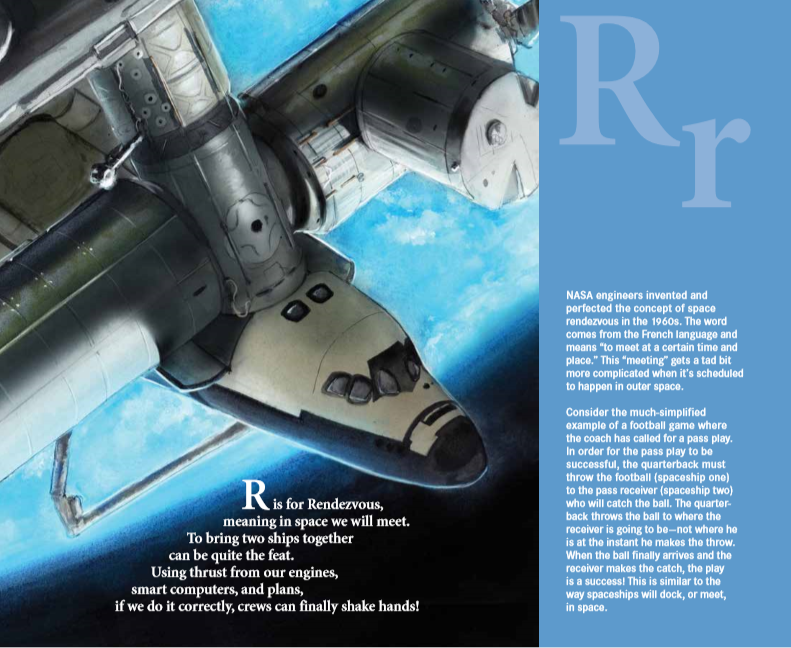
I liked the R page because of the accessible description of Rendezvous. Here's the second paragraph:

Consider the much-simplifed example of a football game where the coach has called for a pass play. In order for the pass play to be successful, the quarterback must throw the football (spaceship one) to the pass receiver (spaceship two) who will catch the ball. The quarterback throws the ball to where the receiver is going to be--not where he is at the instant he makes the throw. When the ball finally arrives and the receiver makes the catch, the play is a success! This is similar to the way spaceships will dock, or meet, in space.


That's an explanation I will remember!


BEHIND THE SCENES


“Astro Clay”–Astronaut Clayton Anderson's story is one of perseverance. He applied 15 times before NASA selected him as an astronaut in 1998; and he spent 30 years working for NASA, 15 as an engineer and 15 as an astronaut. He is the first and ONLY Astronaut selected from the State of Nebraska. 

This STEAM book will be a great addition to any school or home library. Here's a brief interview about how this book came to life.

CAROL: What prompted you to write A Is For Astronaut?

CLAY: I was in Omaha, NE at the West Town Barnes and Noble, preparing for a book signing with my first book, The Ordinary Spaceman.  The store manager kept pulling me over to the nearby children’s section.  “You should write a children’s book,” she said.  

Hesitant, I shrugged my shoulders and replied, “Yeah… maybe one day.” 

She pointed out specific publishers, continually mentioning Sleeping Bear Press (SBP).  “They don’t have ‘A is for Astronaut’,” was her firm “suggestion.”  Shrugging my shoulders once again, and feigning only brief interest, I was overjoyed when the actual book signing began and turned my focus onto something I actually understood!  

A few months later, during some idle time at home, I did a Google search on SBP.  It was then that I finally woke up and saw their tremendous success with their alphabet book series.  Electronically investigating “A is for Airplane,” and a couple other titles on their highly populated series list, I thought to myself, "I can do this!”

Immediately I began to formulate the words I would use for each letter of the alphabet.  A was easy… astronaut.  B followed suit with Blastoff.  I was cruising until I got to letters like F and K and I.  Some more research via the internet gave me all 26 letters and a corresponding space term.  Then came the poems. I actually finished the entire book in about 1.5 weeks! 

CAROL: What was the most difficult part to write—the poems or the expository text? Why? 

CLAY: The expository text was the most difficult for me, although difficult is a relative term.  The poems simply “flew” from my brain (do you like that space reference?!)  Writing them was a tremendously fun process. With the text however, a different challenge was presented.  I was seeking to entertain, educate, and inform, while at the same time creating interesting reading material that was technically correct and had the ability to “stretch” the young reader’s vocabulary. 

Certain space concepts (e.g., rendezvous) forced me to dig a bit deeper as a writer.  Often speaking to young children in schools, I use visual demonstrations to communicate some of the more technical aspects of flying in space.  It became a simple matter of putting those demonstrations down on paper.  A second part of the challenge was technical accuracy.  I don’t claim to be an expert on “all things space.”  Heck, I’m just an astronaut.  Finding adequate reference material to ensure that what I wrote was valid and correct, required a bit more digging than I thought would be necessary.  In the end I think we succeeded masterfully, but I’m partial!


When speaking to kids and young adults around the nation, I constantly implore them to remember that “…they are just like me.”  They can be anything they chose to be.  It will take hard work, a lot of help, and a little bit of luck, but the future is theirs.  They must dare to make it extraordinary. 

VIDEO

Check out this fun video starring Clayton Anderson--as himself! 

Thursday, November 5, 2009

Authors Visit


Since I live in the city where AASL is having their national conference, and since my passion is writing and books, then you may have guessed that besides presenting two workshops, I invited several author friends to spend the night here. The only "price" to stay at my home was a copy of a book--which these three authors cheerfully paid. Left to right in this picture is:
Louise Hawes, North Carolina author of Black Pearls.. Watch the book trailer on her website and you'll be hooked!
Clay Carmichael, another North Carolina whose new book Wild Things is receiving wonderful reviews.
Margriet Ruurs is the author of many picture books, several novels, a few books for Maupin House, and edits a wonderful online magazine which publishes children's' work.

Excuse me now. I have some reading to catch up on!
Technorati Tags:
, , ,

Monday, January 4, 2016

2016 Challenge: Focus!

Congratulations to Judy Penz Sheluk who won the second critique from Joan Edwards. Thank you to everyone who left comments.
***********

Raise your hand if you remember this commercial:


If so, then you may understand how I felt three weeks ago when my mentor, Rebecca Petruck, wrote: 
Omigosh, I'm really liking the look of this outline!

Mikey's brothers couldn't touch my excitement. 

Faithful readers of my blog may remember a post in September, 2014 when, after completing the third draft of my book, I announced I'd discovered the "clay"of my story. 

As it turned out, the clay I'd thrown on the potters wheel still needed trimming. 

In Rebecca's editorial letter about Draft #4 she identified twelve different threads I'd (oh so carefully!) woven together into Half-Truths. That did not count the threads I had in place for my two protagonists. (Do you sense a problem here?)

Rebecca wrote: 

Here is what Half-Truths wants to be:

  1. A white and black girl become friends, despite social norms of 1950s Charlotte.
  2. A white and black girl discover they are related, and the implications of that.

Consider: what moments show this. Every scene has to be related to this.

She also pointed out the multitude of locations and recommended thinking about my book as if was a play. Which sets would be created? She suggested just five. That was a whole lot more than were in this draft.

There were also too many injured animals and she suggested I choose one. Bird or goat? There was never a question in my mind which would win out. 

But the hardest part was when Rebecca and I skyped and I realized that the girl's love interests--which I'd spent a HUGE amount of time crafting and sweating over--pulled the reader away from the girls' friendship.

The boys got moved to the back seat.  

In November I spent several weeks writing a new outline. I drew closer to each girls' internal and external journeys and eliminated a bunch of settings. I patted myself on the back, sent it off to Rebecca, and started writing Draft #5.

As it turns out, my self-congratulations were premature. 

In mid-December (on my birthday no less!) I received these notes from Rebecca:
It can be difficult to tell from an outline, but this version seems to keep the girls separate for a lot of the novel. They have their own story lines and only sometimes interact with each other. I think what you want is for them to have a combined story line, with mini-B stories that reflect their shared story.
In very broad terms, this is the shape of a story about a friendship.
Act 1: Girls meet, forced to interact multiple times, not sure they like each other.
Act 2: Maybe we can be friends. Fun & Games is becoming friends for real.
Act 3: Being friends is harder than we thought for several reasons, including…holy cow, we’re related?!
Act 4: It’s discombobulating to know the truth, but not only are we friends, we’re family, and that’s worth any discomfort.

The only elements that get layered in are ones that reflect this journey in a different way.
......
During our last conversations, I felt you needed to do some serious pruning. Instead, elements have been added....I think it will be helpful to examine each chapter and each scene, and be super honest about how it affects the friendship. Some elements may work in different places, but go back to that first quick outline I noted about the shape of each act in relation to the girls being friends. I think we’ll need to do some shifting and rethinking.
I was crushed. I'd thought I was ready to write. In fact, I was five chapters into Draft #5!
For one night I let the pity party run its course. Then I went back to work. I thought about the basic four acts which Rebecca outlined. I pinched and pruned. I cut out another favorite location (Wing Haven gardens which I visited 20 years ago and was the genesis of this novel. I blogged about how it fit into my book here). I thought about how the girls could be together in almost every chapter. I skyped with my best writing buddy, Linda Phillips, and she offered a magnificent solution for a thorny plot problem. When I focused on how Lillie's and Kate's actions impacted each other--I finally discovered the essence of my story. 
Five days later, I sent Rebecca a new outline.
The next day she posted this on my Facebook page:
Just read your revised outline. *fires confetti canon* I'm so excited for HALF TRUTHS and proud of you and all the work you've done!!!

The pitch for Half-Truths has been the same for several years: In Charlotte, NC in 1950 two teens in Charlotte--one white and one black--become unlikely friends and discover an heirloom belonging to both  families. 

But the execution of that idea--has been far more complicated. I went far and wide and gathered a lot of ideas before I discovered the precious nugget which was right under my nose.  The girls' friendship is the heart of my story. 

Which reminds me of Professor Higgins's triumphant song in My Fair Lady:

(I dare you to not start singing "The Rain in Spain" now!)

Only two beta readers read Draft #4. Their probing feedback helped me confirm my decision to take the boys out of the book. Since then, they've read the first five chapters of Draft #5. One told me, "My biggest observation is that you're saying more with fewer words."

Which came from writing all those previous drafts.

Which led me to gaining more focus.

How about you? 

What are you focusing on in 2016?

THE NIGHT WAR: A MG Historical Novel Review

  By now you should have received an email from my new website about my review of THE NIGHT WAR by Kimberly Brubaker Bradley. (It'll com...