Wednesday, April 26, 2023

JOSEPHINE AND HER DISHWASHING MACHINE: A STEM Picture Book Giveaway

Have you ever wondered who invented the dishwasher? Read my review and you'll find out!

This STEM picture book by Kate Hannigan starts with an introduction that gives the reader an idea about this spunky woman and the historical context of the story. And I love how illustrator, Sarah Green, shows Josephine looking out of the page as if she's looking into the future.

Next, we see the inciting incident: chipped dishes!


Josephine puts on an apron and goes to work. But,

Stuck at the sink washing dirty plates, Josephine's fingers weren't free to tickle the ivories at the piano. Or pick her favorite flowers....or even scratch the furry ears of her beloved hounds! (Isn't that a clever way of showing Josephine's interests?)

So, she decided to find a way to get her dinnerware clean without dings and nicks.

She pondered.

She sketched

She tinkered.

                ....

She measured saucers and soup bowls, calculating how big her contraption would be.

She used pliers and wires, shaping metal baskets to hold plates, glasses, and spoons.

(Did you notice the alliteration and the internal rhyme?)


 Despite the grief and financial worries after her husband died, Josephine and George tested and tinkered and pushed and persevered until she was satisfied.

Josephine submitted a patent application and waited a year. In December 1885 she was awarded a patent for her dish-washing machine!


https://www.uspto.gov/learning-and-resources/journeys-innovation/historical-stories/ill-do-it-myself

Josephine's next obstacle was to find investors who would help build her business. She took her machine to the 1893 Columbian Exposition and she took home the highest prize!

She found financial backers and orders poured in from hotels, restaurants, schools, and hospitals. 

https://www.uspto.gov/learning-and-resources/journeys-innovation/historical-stories/ill-do-it-myself

Even into her seventies, Josephine was marketing her machine to hotels and modern department stores.


I love how this book comes full circle, mirroring Josephine's initial dreams--and how the illustrator gave Josephine a special place--on the front of a lovely teacup. 

This STEM book is a great curriculum resource for K-3rd grade as an aid in discussing inventions, women's history, and the industrial revolution. For more backstory on why Kate Hannigan picked Josephine's story, see Beth Anderson's blog. For more information about Josephine's patent process, go here.

How would you like to own this dish-washing machine? 

https://kidsdiscover.com/quick-reads/meet-the-woman-who-invented-the-automatic-dishwasher/

GIVEAWAY

To enter this giveaway, please leave your name and email address (if you are new to my blog) by April 29. U.S. addresses only. If you prefer not to leave your name, you can email me instead. Educators and librarians get a second chance, just identify yourself in the comments.

Congratulations to Hewi Mason who won Mr. Thatcher's House and to Danielle Hammelef who won Luna's Green Pet.

Tuesday, April 18, 2023

TWO FRIENDSHIP PICTURE BOOKS BOOKS + TWO GIVEAWAYS + ONE AUTHOR INTERVIEW

 It's time for another double review and giveaway courtesy of Sleeping Bear Press!


LUNA'S Green Pet


This is a delightful debut picture book by Kirsten Pendreigh and illustrated by Carmen Mok about a girl who feels left out because no pets are allowed in her apartment.


Her friends make suggestions but none of them felt right. Until one day Luna finds something very unusual.


She names her plant, reads to it, and even takes it for walks--which usually works out well.


Her pet was perfect, even if her friends disagreed. 

But,  one day, strange clumps of bumps appeared. Luna worried.


During the night, the bumps burst open! A powerful perfume woke Luna...Stephanie's sweet scent wafted through the building.

Luna was thrilled. And when the pet parade walked down her street, Luna was proud to display Stephanie.


Stephanie offered one more surprise. She grew a pod!


I love the sweet ending that shows seeds floating away on the night wind with Luna saying. "Someone out there is waiting to love their own Stephanie."

The back matter includes why houseplants make great pets, recommendations for which houseplants to try, and information about Stephanotis Floribunda.

Mr. Thatcher's House


Kristin Wauson wrote and illustrated this clever and funny debut book. Make sure you read her author interview below to see how she came up with her ideas.  

In the beginning, the reader finds Mr. Thatcher building the perfect house. (Aha! The character and his goal in one simple sentence!)


But no matter how hard he tried, something always seemed missing. So, he kept on working and the house grew and grew--but it still wasn't perfect. (Aha #2! We get the character's internal drive and obstacles!)

One morning, his work was interrupted by one of his neighbors.


Of course, Mr. Thatcher doesn't want her to stay in his imperfect house, but the witch makes herself at home baking goodies.

There's another knock on the door.


Mr. Thatcher is suddenly surrounded by the sound of music provided by the three pigs.

Who should also need a house? None other than,

Mr. Thatcher went back to work, but there were MANY interruptions. And the next time he heard knocking, he panicked.


Mr. Thatcher had enough. He moved out. 

But then he stopped and looked inside his house and saw that cakes were baking and a stew was bubbling. There was music and laughter and the comforting crackle of logs in the fireplace. For the first time, his house felt like home.


AUTHOR INTERVIEW WITH KRISTEN WAUSON

 CAROL: I would like to know how you came up with this fun idea! I love how you integrated the fairy tale characters into the story. Can you tell my readers a little bit about how you developed that idea? What was your inspiration? 


KRISTEN: In 2018 I wrote down the idea that became Mr. Thatcher’s House. I was participating in Tara Lazar’s Storystorm, which is something I always like to do. My husband and my father-in-law build Craftsman-style homes and I was inspired by my father-in-law, who has been remodeling his own house, in his spare time, for the past 30 years. It’s going to be perfect one day—if he can ever finish.


I started thinking about all the classic stories I remembered from childhood and realized that many of those stories involved a house problem. In the most obvious one, a trio of pigs had their houses reduced to rubble by a pesky wolf. But, I started having a lot of fun thinking of all the reasons different fairytale characters might need new homes. The bears had suffered a home invasion by Goldilocks, and Hansel and Gretel keep eating a poor elderly woman’s house.


And what did all these characters need? They needed a master carpenter – someone to build them the perfect house!


CAROL: Is this your debut book as an author-illustrator? 


KRISTEN: Yes. This is my first published book!


CAROL: Can you tell us about your path to publication?


KRISTEN: I always liked to draw, and I worked as a graphic designer before coming to children’s books. I left my job in 2015 after my youngest son was born. In 2016, I joined SCBWI and attended my first conference. I knew very little about children’s books, so was extremely lucky to be awarded a mentorship with a published illustrator at that conference.


In 2018 I put together the dummy for Mr. Thatcher’s House, which helped me connect with my agent, Adria Goetz during a #PBPitch event. After I signed with her, we polished the dummy and she sent it out for submission in late 2019. Then 2020 happened and everything slowed down considerably, but we accepted an offer in February of 2021, the book was announced in May and it came out in the fall of 2022.


GIVEAWAY

Please leave me your name and email address (if you are new to my blog) and which book you'd prefer to win--I try to honor requests. This giveaway ends on April 21. American addresses only. Subscribe to my blog and/or share this on social media and I'll enter your name twice. 


Tuesday, April 11, 2023

WRITE2IGNITE PRESENTS: A Master Class on Hooks, Queries, and Proposals

 The spring 2023 Zoom Write2Ignite Master Class is on a topic that many writers fear: writing the dreaded query letter or proposal that will make catch an editor's attention. For those of you who are writers, you know exactly what I mean.

Write2Ignite is pleased to host writer and speaker, Kim Peterson, on April 22 for a day of learning, and writing along with opportunities to submit to two editors. Here's an interview with Kim on what she plans to cover.


The schedule includes three workshops; three breakout sessions to work either on your hook, query, or proposal; and interviews with Deborah Wuehler, Senior Editor and Director of Production at The Old School House, and Acquisitions Editor, Katherine Easter, at Zonderkidz. 

All this for only 69.00! All participants will have access to the class for three months afterward PLUS the opportunity to submit to the editors!


You can register here. I'm leading one of the breakout sessions and I hope to see you there!

BONUS: We have several door prizes and are offering a student discount. 


Friday, April 7, 2023

GAIJIN, BOMB, MAUS and I SURVIVED THE NAZI INVASION : Four WWII Graphic Novel Reviews

When a writer begins a work of historical fiction, she must start with research. For me, that means hours of reading Holocaust websites and books.  

As I mentioned in my first blog about Escape from Nuremberg, I decided to try my hand at writing a graphic novel. So, of course, that meant reading them to understand the genre. Here are the first few that I found at my library. 

GAIJIN by Matt Faulkner


Matt Faulkner's story of a Japanese-American boy is based on Faulkner's great-aunt's experiences. 13-year-old Koji Miyamoto faces prejudice and persecution after the attack on Pearl Harbor. He worries that his father might be fighting for the Japanese but doesn't receive word from him. 


Koji is put into an internment camp and his mother chooses to go with him. There he faces even greater pressure from the other boys who call him "Gaijin" (foreigner); he is a stranger and alien in his own country. He is pressured into committing petty crimes but eventually chooses to do the right thing. 

In the end, six years later, Koji is reunited with his father in Japan.

Since this was my first WWII graphic novel, I was interested to see how the passage of time is shown simply through small text boxes on the page and how much of the story is communicated through the illustrations.  It made me appreciate the art behind the graphic novel genre--a book told through vivid images and sparse text. 

In the Author's Note, Faulkner describes his great-aunt's trauma of being sent to an internment camp.

BOMB written by Steven Sheinkin and illustrated by Nick Bertozzi


This graphic novel adaptation of Steve Sheinkin's novel, BOMB: The Race to Build--and Steal--the World's Most Dangerous Weapon, was hard to put down. The recommended reading level is from 10-14, but it's a complicated story with flashbacks and multiple characters. I think it would be challenging for the average ten-year-old although it would show him the immense story behind the bomb's development, and probably demand a second read for true comprehension. Full of science such as physics and chemistry and history, I think it's suitable for older readers and adults as well.

BOMB is a story within a story. The "bookends" of the book are images of the FBI coming to arrest Harry Gold in May 1950 and then showing him put in prison. The story of the bomb's creation is set within the context of Harry telling the FBI agents how he leaked atomic secrets to the Soviets. 

A ton of information is included: world politics and politicians,  prestigious scientists who played different parts, places where the bomb was tested, the spies and unsung heroes, and the men who dropped the bomb are all mentioned. Although Sheinkin clearly shows why the bomb was developed and detonated, he and Bertozzi also show the devastation and destruction in Hiroshima and Nagasaki. 

In keeping with the serious nature of the book, the colors are dark and foreboding. 

BOMB_Excerpt_p62.jpg


MAUS by Art Spiegelman


Although MAUS: A Survivor's Tale, was not written to be a graphic novel, it has become a classic that tells the Holocaust story from the perspective of a survivor (William Spiegelman) as told to his son, Art Spiegelman. Notably, it is the first comic book to win the Pulitzer Prize in 1992 and is graphic in its portrayal of the Holocaust and its effects on victims and their children. 

Like BOMB, this story is also bookended by the narrator and there is the same story-within-a-story motif. The reader gets a brief glimpse into Art's childhood which foreshadows what William experienced in the war. The books moves quickly to Art's adulthood in which he is estranged from his father. The book shows Art's desperation in capturing his father's story. Was this so he can write and publish it? Or is it because he longs for reconciliation with his father. One can only wonder. 

The reader views William's trauma as the Polish Jews are terrorized and murdered, but we also see Art's trauma following his mother's suicide, his conflicts with his father, and his feelings of worthlessness and despair.  The multi-generational effects of the Holocaust are disturbing. 

Spiegleman's art is very different than Bertozzi's. His panels are in black and white as seen from a scene in the opening of the book. (I found it on this Pinterest board).


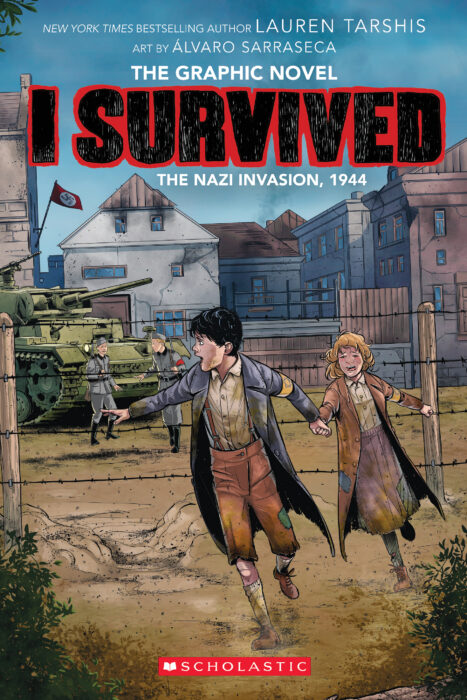
I SURVIVED: The Nazi Invasion, 1944 from the novel by Lauren Tarshis, adapted by Georgia Ball, illustrated by Alvaro Sarraseca, and colored by Juanma Aguilera.


This book follows Max and his younger sister, Zena, who live in a ghetto in Esties, Poland. Their father was taken away by the Nazis and they're on their own. Finding a chance to escape, they hide in a hayfield where a sympathetic farmer gives them shelter. 

Much to their surprise, they find their aunt hiding in the same farm. She is a member of a partisan group that is resisting Hitler and conducting raids against Nazi factories and trains. 

Max and Zena are led to their hideout in a swamp, but their journey is filled with peril as the Nazis spot them. 

The ending is satisfactory as the children are reunited with their father, but the devastating effects of war are not minimized. 

The graphic novel is adapted by Georgia Ball from the award-winning novel by Lauren Tarshis. The text and illustrations (by Alvaro Sarraseca and colored by Juanma Aguilera) move the story along quickly. I had read about the partisan effort in Germany, but particularly appreciated learning more about their work in Poland. The book includes back matter about the Holocaust. 

All of these powerful books would be great curriculum resources in either middle school or high school. 


Friday, March 31, 2023

GARVEY'S CHOICE: A Middle-Grade Verse Novel and a Giveaway

Long-time readers of my blog may remember that I am one of Nikki Grimes' many fans. In the past, I reviewed Ordinary Hazards, Between the Lines, and Words with Wings.  Nikki's poetry sings and she captures the conflicts and emotions of adolescents beautifully.

Garvey's Choice (WordSong, 2016) is no different. Except...it is different. Each of the 100+ poems which tell Garvey's story is written in tanka. WOW. At the back of the book Nikki mentions that she challenged herself to write a novel using this Japanese form of poetry. All I can say is that the result is lyrical, impressive, and AMAZING. 


Review

As I often do when I review a verse novel, I'm going to share a few of my favorite poems. It was hard to narrow my selections down. 

From page one, readers learn that part of Garvey's story is his problems with his dad. The sparse yet evocative language also hints at how he handles his pain.


It Figures

                    When I was seven

                    and crazy for Mr. Spock,

                    a Star Trek lunch box

                    was all I craved. Instead, Dad

bought one blaring the logo.


of some football team

I'd never even heard of

I shoved that thing in

the coal black of my closet,

then celebrated with cake. (p.1)


Garvey's best friend is Joe with whom he shares a love for astronomy, chess, and knock-knock jokes.  

One time after being dissed again by his father for not wanting to play basketball, Joe calls.


Phone Call

All evening long I 

try tucking in my sadness,

but it keeps getting

snagged on my voice when I speak.

Joe catches it when he calls.


"Hey! What's up? Joe asks.

Should I tell him? "Nothing you 

haven't heard before.

I wish my dad could see me.

That sounds crazy, huh?"


"Not really," says Joe.

"I get it. Seriously.

But you've got a dad.

Mine skipped out long time ago."

Why'd I open my big mouth?


Joe shrugs off his hurt.

"Knock, knock!" he says. "Not now, Joe."

"Come on, man! Knock, knock."

I give in. "Who's there?" "Your friend,

Joe, who's always here for you." (p. 19)


At school, Garvey is teased for being overweight. Nikki tucks small references to Garvey finding refuge in music. Listening to his music and his dad's music, and humming (to drown out teasing) are all part of how Garvey copes. 

Along the way, Garvey learns some things about his father's love for music and how his father used football to bring the two of them together. The musical insights and details about his father slip in and foreshadow the climax. 


Morning Classes 

Blue notes, sad as me,

wail their way from a classroom

I've never been in.

"Chorus," says Joe when I ask.

"It's a new club. You should join.


You're always singing,

or at least humming out loud."

"Yeah, but I don't know."

"Look," says Joe, "your voice is choice.

You should let others hear it." (p. 46)


Garvey makes a new friend in chorus. Manny is an albino who wants to be a chef.


Advice

...

"I was wondering 

how you stand kids teasing you."

"I'm honest," he says.

"I've got albinism. Fact.

I look strange. No changing that.


Is there more to me?

Sure. Kids yell 'albino boy.'

I don't turn around.

Choose the name you answer to.

No one can do that but you. (p. 66)


Changes begin to happen.


When I Sing

When I sing, my heart

floats full and light, as if I'm

a balloon of song, 

rising with every lyric,

reaching the edges of space. (p. 75)


Spring Thaw

Peeled myself from bed

for the morning rush to school

(Better beat the bell!)

Belted a blue-jean surprise:

loose weight by nearly one size!


Round still, but that's fine.

Feeling good outside and in.

Maybe I'm not thin

But skinny isn't perfect.

The perfect size is happy. (p. 99)


The climax is Nikki Grimes perfect.


The Talk

"Son, I should tell you,

I used to sing in a band,"

Dad says in the voice

he saves for secrets. I smile,

and pretend that I'm surprised.


"Really? When?" I ask.

"Oh, it was a long while back..."

That's how it began--

the longest conversation

I've ever had with my dad. (p. 104) 


Giveaway


I will be giving this book away through the upcoming issue of Talking Story on CHANGE. Leave me a comment along with your email address, and I will add your name to the list. If you're an educator or librarian let me know and I'll add your name in twice. U.S. addresses only. 

Congratulations to Danielle Hammelef who won DOWN TO EARTH on last week's blog.

And don't forget to check out Greg Pattridge's wonderful collection of middle-grade book reviews every Monday.


Thursday, March 23, 2023

DOWN TO EARTH: A Middle Grade Book Review by Guest Blogger, Elliot Kurta and a Giveaway

As a freshman in high school, Elliott Kurta, one of my first student guest bloggers, is pretty busy with his academic workload and volunteer work at the library. But he returns to my blog today with a book he genuinely enjoyed, Down to Earth by Betty Culley. 


REVIEW

In Down to Earth, Henry Bower, an aspiring scientist, and water dowser, witnesses a meteorite fall from the sky and land in his backyard. Henry, his sister Birdie, and his best friend, James, are at first in awe of the gigantic, space-borne stone. But soon, as the meteorite draws attention around his rural Maine town from the press and the scientific community alike, the meteorite is cast in a negative light. A gushing river has spouted near where the meteorite has landed, forcing the Bower family to evacuate their home, and all of the wells in town have begun to run dry. As the community begins to turn on the Bowers, Henry finds his voice to stand up to what he knows to be right. Aided by his sister, parents, best friend, and a genteel museum curator, the meteorite inspires Henry to find his place in the world.

Henry, the intrepid protagonist of the novel, is without a doubt the heart of the story. His curiosity and earnestness serve to heighten the story; this novel is worth reading for his narration alone. One example of Henry’s simultaneously warm and analytical voice is his use of percentages to measure his emotions as he tries to work through his conflicting feelings. Henry’s narration is light-hearted but realistic, even as the townspeople become disgruntled that Henry’s family happened to recover the meteorite, for which a large reward has been offered. Despite the optimism expressed by the Bowers throughout the novel, the arrival of the meteorite is foreshadowed by tragedy, as the Bowers lose their home early in the story due to flooding caused by the meteorite’s landing.

            An important, recurring element in Down to Earth is the connection Henry and his family share with nature. Henry has grown up watching his mother forage for food in the nearby forest, collecting fiddleheads and cattails. His father is a dowser, and works alongside his brother, Henry’s uncle, to drill wells for the townspeople. The deep respect Henry feels for the natural world can be seen when he first greets the meteorite, on page 24.

            I want to say something to the big rock myself, to welcome it the way my parents make visitors, or even strangers, feel at home. Then I remember what my mother says when she finds a mushroom or fern she can’t identify.

            “I don’t know your name, but I’m glad to meet you,” I say to the big rock.  

            Down to Earth is written for the natural scientist in each of us, and recaptures the wonders of childhood while at the same time showing Henry’s journey as he finds his place in the world. Henry’s optimism and respect for the natural world around him serve to root the story, and his narration makes even the most prosaic of things—such as a seemingly ordinary rock—take on a new life. The novel, through Henry’s exuberant narration and the coincidences that lead Henry to discover his voice, makes a powerful case for living life down to earth. 

Elliott is a prolific reader of various genres who is more than happy to share his opinions on books. In his free time, he enjoys writing, reading, and running. He is a 9th-grade student in Charlotte, NC.    


GIVEAWAY

If you are interested in winning this book, please leave a comment by March 28. Make sure to include your name and email address if you are new to my blog. U.S. addresses only. Please note that your comment will not show up until I approve it. 

Don't forget to check out the other wonderful middle-grade books on Greg Pattridge's MMGM site. 


Thursday, March 16, 2023

MOON TREE: The Story of One Extraordinary Tree-- A Review, Book Journey, and Giveaway

Sometimes authors stumble upon their stories. And even though that story takes time to write, that initial connection remains strong when the book is brought into the world. 

As you'll read in the book journey below, that was the case for Carolyn Fraiser's debut STEM picture book, MOON TREE: The Story of One Extraordinary Tree (Reycraft Books, 2022) illustrated by Simona Mulazzani. 


REVIEW

Carolyn Fraiser, my SCBWI-Carolinas friend, makes writing a picture book look easy. The text is sparse yet lyrical.  But actually, the process of uncovering the "of course!" structure came only after many revisions. 

The story seems to begin with an ordinary sycamore in an ordinary forest. But actually, here is the true beginning many years before that tree was alive:

One ordinary boy

who dashes among the trees

At home, he watches

war planes soar

in the Oklahoma sky

and dreams that one day 

he will fly. 


He grew up to be...


He became a pilot who races through the skies. He watches others touch space.  Maybe one day, he'll fly even higher.

He does! And becomes,


the one NASA astronaut who packs his bag with seeds to honor the men who rescue trees.

But, back on earth, the container holding the seeds breaks and the seeds scatter. 

Along comes one forest researcher who watches them sprout and,

decides to send the "Moon Trees" to camps, schools, and state forests to celebrate the bicentennial. 


Everyone forgets about the trees until one third-grade girl finds a sycamore at her camp that is "named after the moon." She is curious and encourages her class to find out why it is called a moon tree.


In the end, the girl and the class discover the story of the Moon Tree--the book that your students, kids, or grandkids, will enjoy reading over and over again.  As you can see from the images I've included in this review, Simona Mulazzani's illustrations are out-of-this-world imaginative, and beautiful!

CAROLYN'S BOOK JOURNEY

I spent 20 years writing for adults before I decided to pursue writing for children, and it still took me 10 years to get a book published! Since I had written a lot for adult magazines, I started with children's magazines and had several pieces published. But book publishing was harder. I wrote and submitted many stories before I even started working on Moon Tree. 


I wanted to write Moon Tree from the day I stumbled across our local moon tree at the Cradle of Forestry in Pisgah Forest. I had never heard of the moon trees and the story fascinated me. I spent 6 months diving deep into research. I wasn't sure how to approach the story so I looked at it from every angle I could -- from Stuart Roosa's biography to the history of the Apollo program. I interviewed people with NASA and the US Forest Service, listened to interviews, read tons of newspaper articles, and watched every documentary I could find on the Apollo program. When I came across the story of the 3rd-grade class project, I had the opportunity to interview the teacher, and I knew I wanted to include that angle in my story. But my initial drafts were far from what ended up being published. 

My first draft was close to 1500 words with lengthy sidebars on every page. Then I wrote a fictionalized version from the perspective of the tree. I tried some other angles, but none of them really stuck. Then an agent challenged me to try a lyrical approach, which was more in my wheelhouse than anything else I had been trying. I let the idea simmer for several months before trying again. 

I  began to think about each element and person of the story and how if any of those pieces were missing, the story might not have happened or may have been lost to history. That's what gave me the idea of starting with the concept of "one" because each one made a difference -- right down to the third-grade girl. I didn't know if it would work, but it did!   
I literally put all my research away and focused on the essence of the story. What came out was the final version that ended up in print

Rejections? Oh, there were A LOT! I think I had about 50 rejections from this manuscript alone, but most were from early versions of the story. Once I had the final version, I saw interest pick up almost immediately. 

I had been familiar with Reycraft from my research with various publishers and friends who had published through them. I had been selected for a mentorship with Vivian Kirkfield who convinced me that the version I had was ready to go out. I think I put the pitch out there for a few Twitter pitch contests. A friend saw it and thought it would be a good fit for Reycraft. She suggested that I submit it to them, so once I got the green light from Vivian, I did. 

A BOOK WITH KID APPEAL


As you know, I love giving books to my grandkids. MOON TREE is one that I'm sure will be read over and over again. The boys loved counting all the trees! And of course, my granddaughter insisted on reading it herself. 


GIVEAWAY

Reycraft is donating a copy of MOON TREE. I'm giving it away through the spring issue of the Talking Story newsletter. Leave a comment with your email address if you are new to my blog and I'll add your name to the giveaway list. A winner will be chosen on April 17th. U.S. addresses only. If you are an educator, decide to follow my blog, or also leave a comment through the newsletter, I'll enter your name twice.

THE NIGHT WAR: A MG Historical Novel Review

  By now you should have received an email from my new website about my review of THE NIGHT WAR by Kimberly Brubaker Bradley. (It'll com...