Showing posts with label generational story. Show all posts

Monday, April 18, 2022

HELLO, BABY! I'm Your Mom and BEVAN, A Well-Loved Bear: 2 PICTURE BOOKS, 1 Giveaway

Today I have two books that are perfect for the very youngest readers who you hold in your arms and cuddle on your lap. Both books are courtesy of Sleeping Bear Press.

HELLO, BABY! I'm Your Mom


This simple but beautiful rhyming book written by Eve Bunting with vivid illustrations by Jui Ishida, will be a family bedtime favorite. The sing-song repetition will delight toddlers too!

Here is the first page:
"Baby darling, you're so sweet!
Your tiny hands, your tiny feet!
I love you. I'll take care of you
like other loving mommies do."
From there, the book goes on to show ten sets of mommies and babies. Here are some of my favorites:


"Hello, my little kitty-cat.
I'm your mom. Imagine that!
I'll share my nice soft bed with you.
It's cozy and there's room for two!"


Mama Porcupine-


And Mama elephant surrounded by her baby's family.


From a furry Mama-


"My precious, tiny polar bear, 

it's could outside, but we don't care.

Our den is warm, and when you grow,

we'll hunt together in the snow."

The book returns to where it began, with a baby who has grown!


   "Ever since the world began 

    this has been the perfect plan.

    Hurrah for moms and babies, too!

    I was a baby. So were you!"

Back matter includes two spreads with photographs of the animals and more information about each one.  


Bevan, A Well-Loved Bear


Petra Brown, the author illustrator of this sweet generational tale, has created a story that like Bevan, may be passed down from one family member to another. As I read this opening line, I imagined the scratchy fur of my well-loved childhood stuffed toy. 

"Bevan is a very, very old bear. His fur is a little patchy and his paws are rather scrappy but he still smiles."

"When Bevan was a brand-new bear, he lived in a large nursery with three children and Nanny."

Bevan passed from Nanny to her granddaughter, who cherished Bevan and treated him like a king. When her father gets a job at a light house, Bevan enjoys feeling the wind ruffle his fur from the top of the tower. The girl marries and Bevan shares a saddle with her son as they ride around their ranch. 

The boy grows into a teen and gets a job at a local soda shop.
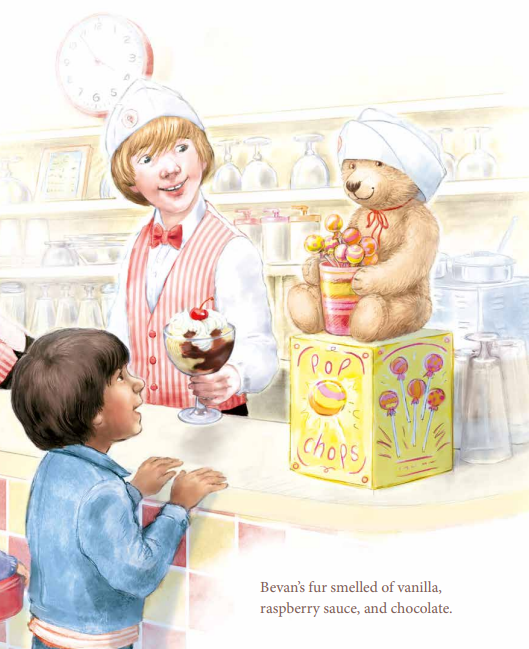


The boy and his friend save money and take off in a colorful bus. Of course, Bevan rides in the front seat.


Bevan gets his picture taken all across the United States, but then one day--he gets left behind! A scruffy dog brings him home to his owner, an artist. Bevan is getting a little worn by now, but still has the job of greeting a new baby.


Baby girl grows up, goes to camp, and takes Bevan along. But, he falls down behind her bunk and is forgotten. 


Bevan gets cleaned up, and taken to a thrift store. There, he doesn't have to wait long. "My mom saw him on display in the window looking very dapper. She fell in love with him and brought him home to me!"

"His fur is a little patchy and his paws are rather scrappy, but he still smiles. And I love him very, very much!"


I love how the narrator of the book is a little girl who has imagined her bear's life before he comes to live with her. 

A GIFT AND A GIVEWAY

Both of these books would make wonderful baby gifts-- or in my case, a grandma gift! I'm saving Bevan for my new grandson who will be making his debut in June--I think his big sister, Eleanor, will love reading this to him and her other brothers. 

If you are interested in winning Hello Baby, I'm Your Mom, please leave me a comment by April 21. PLEASE LEAVE YOUR EMAIL ADDRESS if you are new to my blog. NOTE: Marci - can you please leave your last name and email address? I don't have it on file and I need it in case you win!


Monday, July 24, 2017

Just Fly Away: An Audio CD Review and Giveaway

Congratulations to Connie Saunders who won THE WOLF'S BOY.

Please note that since this is a review of an audio CD, the following quotes might not be exactly correct; I did my best to capture the words.

*********

REVIEW

What do you do if you find out that your father had an affair eight years ago and you have a half-brother you never knew about?

That is fifteen-year-old Lucy Willows' problem and the crux of JUST FLY AWAY (Algonquin, 2017), the debut YA book by actor Andrew McCarthy. When her father discloses the information to her and her sister Julie, Lucy is furious. How could her mother continue living with him? How can anything ever be normal again? How could he have lied to them--pretending they were a perfectly regular family--all this time? Lucy begins a quest to find her brother Thomas. In her suburban New Jersey town this proves to be pretty easy--he lives within biking distance of her home. 

Soon after Lucy finds out about Thomas, she "falls in love" with her best friend's brother, Simon. In Save-the-Cat language, Simon provides the B-story; the love interest who supposedly provides some nuggets of truth. To be honest, as a secondary character, Simon fell flat for me. Although Lucy is crazy about the way he looks and how he kisses, until the end of the book Simon doesn't do a whole lot to warrants her effusive affection. When Lucy tells Simon how angry she is about Thomas, Simon remarks, "It's not his fault you know." True, but not an earth shattering revelation. 

In my opinion, the book bogs down in the middle. There were too many scenes that didn't show more than two teenagers smoking dope and kissing. I kept waiting for more to happen. The book became more interesting when Lucy impulsively decides to run away from home and take a bus to her grandfather's house in Maine; although I wasn't convinced that this type of impulsive behavior was built into her character. In fact, it's not until she happens to see a poster of Maine that she makes this decision and throughout the journey shows little emotional reaction to leaving home. The bus ride had some interesting moments but felt drawn out. 

I love generational stories so I found Lucy's interaction with her grandfather to be the best part of the book. As they walk along the rocks near the coast, Lucy dares to ask him why he is estranged from his son. His answers helps her to understand that her grandfather wrongly took his anger out on her father. Her grandfather remarks, "We see them [people] the way we see them. Other people may see them a different way...We never see our parents as just people. They're our parents. And that ought to be enough for them. But it's not enough."

The walk along the breakwater is the most suspenseful part of the book. Although the walk ends in tragedy, it ultimately leads to more risk-taking and honesty between Lucy and her father. 

In the car back in New Jersey, Lucy asks her father, 

“I guess you can never really know everything about a person, can you?”  
"The best we can try and do is let another person know who we truly are. To let them see us. That is, if we love them and trust them enough. And to do that, we have to reveal ourselves to the other person.” 
Her father admits that he covered up the affair because he didn't want to be seen in a bad light. Lucy babysits for Thomas and while at their house picks up a book that had been her favorite as a child. In it a Japanese farmer wisely looks at several different events from both a positive and negative point of view. At which point Lucy concludes that maybe it's not so bad having a little brother after all- a satisfying ending.

GIVEAWAY


This book could be used as a conversation starter for a teen who has gone through an event such as this or is just having trouble talking with her parent.

I am giving away the audio CD, courtesy of Recorded Books. Leave me a comment by July 28 to be entered in the giveaway. Make sure you leave me your email address if I don't have it.

Monday, February 6, 2017

Making Friends with Billy Wong by Augusta Scattergood: A Review with Help from David Corbett

Congratulations to my fellow blogger, Clara Gillow Clark, who won a copy of TWICE BETRAYED on last week's blog. Stay tuned friends, I have lots more giveaways coming up!
********

One of the writing blogs I follow is Writer Unboxed. When I find an article by one of their contributors in Writer's Digest, I pay extra attention. 

Soon after completing Augusta Scattergood's middle grade novel, MAKING FRIENDS WITH BILLY WONG (Scholastic Press, 2016),  I read David Corbett's article "To Change or Not to Change?"(Writer's Digest, January, 2017). Thanks to Corbett, I found a terrific template to review Augusta's book. (Quotes from his article are in bold.)


Every story implicitly asks two simple questions: 1) What happened? and 2) Why? These questions may remain unanswered, but they cannot be escaped...we need to keep in mind what Les Edgerton means when he says every story is about the same thing--trouble--or what Steven James means when he says that stories are not about what happened, they're about what went wrong. (Writer's Digest, pp. 26, 27)

For Azalea Morgan, the protagonist in MAKING FRIENDS, her life goes wrong in the first paragraph: 
All it took to send my summer on the road to ruin was a fancy note and a three-cent stamp. The minute that envelope showed up, Mama was packing my suitcase. (p. 1)
The reader quickly discovers the three types of problems which Corbett says characters try to answer:
  • External challenges: tasks in pursuit of a goal in the physical world. 
For Azalea, that means surviving a summer in Arkansas without her best friend and being asked to help a cranky grandmother she doesn't really know.  
  • Internal questions: doubt concerning deep-seated issues such as one's worth, purpose, nature, identity--in which characters are forced to ask, Who am I? What kind of person do I want to be? 
Azalea doesn't make friends easily and when she finds out her grandmother expects her to be friends with Billy Wong, the local grocer's grand nephew, Azalea thinks,
Like it or not, I was going to meet more people than I was ever friends with back in Texas. (p. 26)
           **********
Would this Billy Wong boy want to talk to me? Did we speak the same language? I wasn't so great at talking to ordinary boys back home--boys who didn't look like they'd just arrived from some faraway country. Mama says I'll get over that talking-to-boys thing. I doubt I'll get over it this summer in Paris Junction, Arkansas. (p. 29) 
  • Interpersonal Relationships: efforts to grow closer to or distance oneself from another character or characters. 
In spite of her doubts about being friends with a Chinese boy, Azalea begins to see the ostracism Billy faces. That, along with his friendliness, draws the two together. After they get ice cream at the drug store, Billy asks her if she wants to bike at the creek or hunt turtles. 
If I hadn't already talked more than I'd talked in my entire lifetime to a boy, I'd be explaining that no, I will not be exploring a creek. I will be fixing dinner and watering Grandma Clark's garden till the cows come home....Even though it was easy eating ice cream together, I had a hard time picturing being good friends with a boy. Especially one so different. 
But today was fun. So I looked right at Billy Wong, and I answered, "Maybe." (p. 64)
In the Writers Digest article David Corbett wrote, 
When a protagonist of any kind changes, it's usually because the struggles and conflicts he has faced have forged a different understanding of himself, his abilities and/or his world, including the people in it. (p. 28)
By the mid-point of the book, Azalea is calling Billy her friend. She is also surprising herself by becoming braver than she ever had been in Texas. She discovers hidden truths about Willis, the town bully, as well as about her grandmother. These discoveries spawn new actions.  

Despite her fears, towards the end of the book Azalea climbs up her grandmother's tree behind Willis, who has been throwing acorns down on her and Billy. She asks:
"You doing this because you're mad at me? What'd I do?"
"This was my tree till that Chinese boy came. Now every time I climb it, he's around." 
When a breeze rustled the tree's leaves, I grabbed hold of a thicker branch and held on. "Ever think about being friends with Billy?" I asked, still not quite believing I was perched in a tree with Willis DeLoach. (p. 173)

With that interaction, the reader knows that Azalea is well on the way to growing and changing. 

Like Kirby Larson's LIBERTY, Augusta Scattergood inserted poems from Billy's point of view. Her sparse use of language gets to the heart of how Billy is feeling. This is one of my favorites:


Keeping Notes on Lucky Foods, My Private File

The screen door pushes open.
The bell ting-a-lings.
A white man steps inside, tall, frowning.
Hat pulled close over his forehead.
Eyes darting fast
from Kay's Cookies to Dum Dum suckers,
cash register to cigar boxes.

"Need me some garden fertilizer," he snarls.
"Near the fishing lines," I answer, nicely.
He draws his words out.
"Bologna? Cheese? Bread?"
"Right this way, sir," I say.

I reach into the cool case of cheese and lunch meat.
Weigh a thick wedge of cheddar.
Punch the cash register's round buttons.
Hand the man groceries.
Watch him leave.

He'll go in my stories.
Mixed together with
track meets,
Future Farmers,
Student Council,
dusting soup cans,
pricing crushable cracker boxes.
And new friends.              
Property of Billy Wong, Spy (p. 123)

Corbett concludes the article, 
Look to your story to determine whether your main characters must change, and the degree of change they will undergo. Change is by no means a requirement--but when the story leads to self-examination, or revolves around a relationship, it is all but inevitable that the action will create the re-evaluation of self that we equate with change. (p.29)
******
Teachers and home school educators: Augusta just posted her classroom discussion guide on her website. You can download it here.
Augusta and I have been Facebook friends for several years.
We enjoyed meeting in person a few weeks ago, half-way between our homes in Florida.
We talked about books and writing for three hours-
and now I have a new "real" friend!


Monday, October 3, 2016

AIM: A Review, an ARC Giveaway, and The Hero's Journey


The Backstory

What do you do if you write a book based on a story in "your own backyard" because of an editor's advice (BLUE, Boyds Mills Press, 2006.  The polio epidemic in Hickory, NC) and then the main character keeps talking to you and you want to know what happens next? (COMFORT Calkins Creek, 2009. Anne Fay deals with the effects of polio and her father's return from WWII.)

If your name is Joyce Hostetter and these first two books are award winners, your publisher then asks you to write a prequel to these books starting with the letter "A." And if you're as great a writer as Joyce is, then you imagine the world before BLUE and write Junior Bledsoe's story and name it AIM


I've been privileged to be a part of AIM's development from the time that Joyce asked her Facebook friends for suggestions on a book title beginning with "A." (I think she might have already had a title in mind, but it was fun hearing everyone's thoughts.) She bounced story ideas off of me and I read several drafts. Since I have learned so much from Joyce ("less is more when crafting dialogue, internalization and action"); I was honored that Joyce incorporated some of my suggestions into her book. 

As I've done previously, this review uses craft principles I've learned from another writer. This time, I'm drawing from Jillian Sullivan's presentation of The Hero's Journey at Highlights Summer Camp.  


The Review

Hand me that wrench," Pop wiggled his grease-covered fingers. 

I gave it to him, but I wanted real bad to get my hands on his repair job. "I could do this if I had me half a chance," I said. (p. 7) 
 In less than 50 words Joyce brings the reader into the world of Junior Bledsoe: a world full of unmet desires and tension. In this powerful first chapter, many of Junior's conflicts are foreshadowed. At fourteen, he longs to show his father what he is capable of doing, ("Sometimes I wondered if I'd ever get to show him what I could do."); feels the sting of not being as close to him as Ann Fay is with her father who "go together like biscuits and gravy"; reads in the paper about America preparing to go to war; and hears his father poke fun of him for wanting to stay in school. "After the first day, quit. Least you can say you went to high school."

His father's last words as he drives off in the car come back to haunt Junior later: 
"Find yourself a job and take care of your momma." He climbed in the car. "I'll be back before you can say, 'Yankee Doodle Dandy.'" Then he drove off and left me to put the tools away.  
"Yankee Doodle Dandy," I said. And he wasn't even out of the driveway yet. (p. 14)

Junior's father never returns. 

Jillian Sullivan talked about the reluctant hero--the character who is forced on a journey when one way of life ends and another begins. This is an appropriate description of Junior. AIM narrates the grief and anger-filled year of his life when he searches to find out who he is and where he is headed. 

Jillian pointed out that surpassed desires and conflicts can trigger a hero's journey. In Junior's case, his quest to discover himself is prompted by his father's death. But in the process desires and conflicts emerge and he is presented with choices. 

"Choices are made when the character must decide what he will give up in order to move on," Jillian said. "Each of these decisions and choices represents a death to self so that by the end, the character must overcome his ego to make a courageous decision."

For Junior Bledsoe, choices assault him on a variety of levels. How he will respond to sharing his bedroom with his cantankerous grandfather? What will he do when faced with the temptation to skip school or steal a car? What will he have to give up to earn self-respect? Can he be different than the generations of men who've gone before him? 

Jillian said that heroes often cross several thresholds as they overcome trials, confront their own egos, and ultimately make a courageous decision. In this beautiful coming of age story, there is one scene in AIM that I will never forget. In a moment of introspection, Junior crosses one of these mini-thresholds. He has just tried working at the cotton mill and found it much harder than he'd imagined. He comes home and pulls off his shoes and socks because he wants to feel dirt on the bottom of his feet.
Eleanor was already bawling and I knew there was gardening to do. There wouldn't be time for going into the woods. I tended the animals, and on the way back to the house I plopped myself down onto a sweet potato crate under Pop's oak tree. I hadn't managed to rake up the acorns last fall, and one of them had sprouted into a small tree not four feet away. 
It was only six inches high, but it had four perfect leaves and was doing its best to become a real tree. Any other time I would've pulled up a sprout like that. Today, though, I didn't have the heart to destroy it. After all, what if the big oak tree was hit by lightening one day? The seedling would be there to replace it. (p. 239)
Even now, I get teary-eyed over that marvelous piece of introspection and characterization.  

What are you waiting for?


For fans of BLUE and COMFORT, you will be amazed at how AIM's ending is a perfect set-up for BLUE. On the page it appears effortless. But here's a secret: Joyce wrote that chapter first. It gave her a powerful starting point in her mind. From there she created the wonderful story of a boy named Junior Bledsoe, who spends the year after his father's death learning what to aim for. 

If you haven't read BLUE and COMFORT, what are you waiting for? AIM's (Calkins Creek, 2016) pub date is TOMORROW and you can order it here or here. You can download an educators guide for all three books here.


********
Last February I shared Joyce's cover reveal and began the giveaway for this ARC. I will add your name to the list of those vying to get their hands on this book if you leave a comment along with your email address, if I don't have it. I already have a long list of contenders, but there's good news--I have TWO ARCs to give away! I'll pick the winners on October 6.


Besides being good friends and critique partners,
Joyce and I co-publish Talking Story. (To sign up, see article in the sidebar)
This was part of a "photo shoot" this summer when we
were getting pictures for the newsletter.
Photo by Linda Phillips

This review was originally published on LitChat.

Monday, November 9, 2015

Mississippi Trial, 1955: A Book Review and a Writing Exercise

I recently submitted the fourth draft of Half-Truths to Rebecca Petruck for her critique. In a future blog I'll clue you in on my marching orders for Draft #5, but today I'm sharing a specific part of her feedback about writing scenes. This is a longer blog than normal, so grab your favorite beverage and get ready to learn about a great book and about the writing craft. 

Craft-wise, writing scenes is your weakest element. That’s partly why I asked you to write the slow down scene. You might want to read Make a Scene by Jordan Rosenfeld. For exercises, I suggest choosing a few scenes from three novels and deeply analyze the arc—what did the MC want as she entered the scene? What did she get? How did the author show the external action? The internal action/reaction? How much dialogue is used relative to narrative text? How did the author set the scene? End it? 
Then, look at one of your own scenes, and critique it for the elements listed above. Does the scene have an arc? Is there room for the reader to experience what’s happening? Time for the reader to feel what’s happening? How might you deepen the scene? How might you create more tension? Raise the stakes? - Rebecca Petruck
The first novel I chose to study scene making was the award winning book, Mississippi Trial, 1955 by Chris Crowe. I anticipated learning more about Jim Crow. I gained that, and much more.

Crowe's debut novel (Penguin Putnam, 2002) is based on the true story of the kidnapping and murder of Emmett Till. Crowe created a believable white protagonist, Hiram Hillburn, whose life is irrevocably changed following Emmett's kidnapping and murder. 

As a young child, Hiram spent several years in Greenwood, Mississippi living with his paternal grandparents. He has fond memories of Grampa Hillburn and a town steeped in cotton and Southern traditions. Hiram doesn't understand the deep conflict between his father and grandfather and blames his father for the alienation between the two men.

At 16, Hiram returns to Greenwood after his grandfather suffers a stroke and meets Emmett who is in town visiting his uncle. Hiram reconnects with R.C. Rydell, a boyhood friend who drinks too much and bullies Negroes; and R.C.'s sister Naomi who he likes. R.C. convinces Hiram to go fishing together, and the two meet up with Emmett who is cooling off in the river. R.C. mercilessly bullies Emmett while Hiram stands by helplessly. Afterwards he feels ashamed of himself and later becomes convinced that R.C. was involved in Emmett's death. 

This scene follows Hiram reading a newspaper report of Emmett's death:
When I put the newspaper down, my hands were shaky and cold. Emmett was dead, murdered. The article said nothing about R.D. Rydell, but I figured the sheriff must still be looking of him. Was R.C. involved in the murder? I knew he was, and I hoped the police would find him--soon.    
And what about Naomi? If R.C. skipped town or ended up in jail, she'd be left alone with her dad. I didn't even want to think how much more miserable her life might become in that shack down along the Yazoo.    
Grampa interrupted my thoughts when he whistled softly after reading the article. "I can't believe they killed that boy." He rubbed his hand across his face and muttered to himself, "There's going to be hell to pay now." He still looked pale as he folded the paper on his lap, creased it carefully in half, and set it on the table next to his chair. "Hiram, those boys went too far, way too far. For his sake, I sure hope your friend [R.C.] wasn't involved in this mess. I never did think much of R.C. Rydell, but I never took him for a murderer."    
"R.C.'s not my friend, Grampa," I reminded him without looking at him. "I told you how he acted."  
 "Of course he's not your friend. A Hillburn usually has better sense than getting mixed up with people like these." Grampa rapped his knuckles on the folder newspaper. "People all over the United States are hearing about what's happened down here and wondering what kind of uncivilized brutes live in Mississippi. Those peckerwoods who did this are a shame to all of us in the Delta. No self-respecting Southern gentleman would lover himself to of this far."    
Grampa's reaction bothered me. He seemed more concerned bout the negative press than about what had happened to Emmett Till.    
He kept on complaining. "The radio said that colored boy's mama up in Chicago is blaming everyone in Mississippi for what's happened, said she said, 'The entire state of Mississippi is going to pay for this.' The woman's grief is understandable, Hiram, but she's go tho cause to blame all of us for what a couple redneck peckerwoods did in the middle of the night.  
 "Before we know it, the NAACP and all those bleeding-heart Northerners are going to use this as another excuses for integration. They're going to come down here and cry about how we treat our Negroes and how we've got to mix the races in our schools. That's what really makes me mad, son: Those ignorant boys have stirred up a hornet's next of trouble."    
"But what about Emmett?" I asked. "They killed him. Doesn't that make you mad?"    
"Of course those boys went too far. Whatever that colored boy deserved, he didn't deserve getting shot and tossed into the Tallahatchie, that's for sure."      
I wanted to yell at Grampa. A boy was murdered just for acting cocky! I wanted to say something, something mean and hard that would knock some sense into him, but I knew nothing I could say would change him, and I had a glimpse into why Dad and Grampa never got along. (p. 123-5)

*******
Here are Rebecca's questions:

What did the MC want as he entered the scene? 
Hiram wants comfort/justice over Emmett's death

What did he get? 
He got a "glimpse" into why his father and grandfather don't get along, and a new picture of his grandfather. 

How did the author show the external action? 
Reports the grandfather complaining, shows Hiram arguing.

The internal action/reaction? 
Hiram's observation that his grandfather was more concerned about negative press than justice is a huge "Aha!" moment. His appreciation for his father initiates a change in his attitude. 

How much dialogue is used relative to narrative text? 
Dialogue and internalization carried this scene; not much narration. 

How did the author set the scene?
"When I set the paper down." Opens the scene.

End it? 
With Hiram's new realizations. 
********
I picked this scene because it was pivotal to Hiram's burgeoning questions of the culture he accepted as a child as well as his new understanding of the tensions between his father and grandfather. The reader sees Hiram's conclusions so that when there is a switch at the end, Crowe has paved the way for a surprise ending. 

Rebecca has told me before that I need to go deeper into my character's internal experiences (I guess I'm a slow learner!). But copying out a scene pushed me inside Hiram. I saw his grandfather and father in new ways and found a model for what I needed to work on in Half-Truths.

How about you? Have you ever deeply studied a scene from a novel? If not, I hope you'll try this exercise. If you have, what book did you study? I'd love to hear from you. 

And I hope you'll read Mississippi Trial, 1955. You won't regret it; and besides, you need to discover the surprise ending which wraps up this important book so well.


THE NIGHT WAR: A MG Historical Novel Review

  By now you should have received an email from my new website about my review of THE NIGHT WAR by Kimberly Brubaker Bradley. (It'll com...