Monday, March 25, 2019

Behind the Scenes with The Thesauri Queens: An Interview with Angela Ackerman and Rebecca Puglisi

Congratulations to Sandra Warren who won the 15 minute Zoom Author Interview with Marsha Diane Arnold from last week's blog. She donated it to West Marion Elementary School in Marion, NC.

*********

Many of you have heard me extol the virtues of ONE STOP FOR WRITERS a rich, on-line writing tool. I've also frequently mentioned the creators of the site, Angela Ackerman and Becca Puglisi, who have co-written and published seven Thesauri. I teased them that they are the Thesauri Queens--but you probably know them as two smart, generous women who are being exactly what their website proclaims: Writers Helping Writers.

I bet many of you have used their resources and that's why you're here today--because like me, you're a nosey writer and want to hear how these two women have successfully collaborated for fifteen years.

But first, if you don't know about how Angela and Becca met online, please see Natalie Aguirre's interview. You'll also find out how they developed their unique brand. 


This was taken the first time Angela and Becca met in Disney World!

Now, without further ado-- let's get this interview going!


CAROL: What was it like when you met in person three years after only knowing each other online? 

ANGELA: Because we live in different countries, 99% of our communication is online. However, many years ago I took my family to Disney World, and as Becca lived close by, she agreed to meet us at the Magic Kingdom for the day, just outside Cinderella’s castle. We had traded pictures of one another of course, but as we pulled into the parking lot that day it hit me that a) I’d forgotten my phone at the hotel, and b) MK was huge, and c) 32,000 people entered the park every day that time of year. As this was my debut visit to the park, I began imagining scenarios where Becca would be at one part of the castle and I’d be at another, endlessly waiting for the other to arrive. So, I did what any desperate person might do…I made a sign with her name on it. 

Ironically, I never needed to use it. Somehow despite Magic Kingdom having several ferries and a sky train that transported people to and from the park, Becca and I ended up on the same packed ferry about ten feet from one another. This type of crazy coincidence was only the first of many for us; Becca and I are convinced the universe wants us to be together!

BECCA: One of the things I liked best about this day was the absence of the expected awkwardness that comes when you finally meet an online friend in person. (Well, except for that moment when I realized my car key had fallen out of my pocket on Space Mountain, and I thought we might be spending a huge portion of the day in the parking lot. Luckily, my key was sitting there in the seat, not wedged into a coaster track somewhere, so that was good.) We just picked things right up and enjoyed our day. It was a really good feeling to meet in person and confirm that she was the wonderful, kind, generous, and freaky person I’d always thought she was.

CAROL: How do you work together as a team? How do you figure out who does what?

ANGELA: Luckily Becca and I have writing styles that mesh quite well, but we have different strengths when it comes to business skills. She’s terrific at organization and tracking the million little things that keep us up and running as a business, like knowing book production processes, managing our accounts, making sure bills are paid, and working with third parties (formatters, designers, distributors, etc.). I handle the marketing side of things, our outreach, and steer business strategy. I think our partnership works so well because we trust each other’s knowledge in areas where we are not subject matter experts, and whenever we need to come to a consensus on something, we can talk it through.

BECCA: We assign duties based on individual strengths, which is a pretty simple process because we’re very compatible in our giftedness (or lack thereof). And the rest of it, we just divvy up between us. It’s a simple system, but because we’re each able to look at ourselves realistically and put the ego aside, it’s easy to say, You’re better at this, why don’t you handle it? or You’ve got a ton going on, so I’ll do this one.

CAROL: What have been the bumps in the road to successful collaboration? Do you have advice to other writers who are considering collaborating on a book or project? 

ANGELA: I won’t lie, there are some things we disagree on. For example, Becca hates pickle chips. It’s hard for me to overlook this horrifying flaw, but that’s what you have to do sometimes to keep the peace. Okay, that’s frivolous…but it illustrates the nature of most of the friction between us: superficial. 

However, we have different backgrounds, life views, and comfort zones, so we aren’t twins. Certain content we’re not comfortable writing about might be a sticky point and when this happens, we talk it through and come to a consensus. Another way we differ is that Becca and I have different comfort zones when it comes to risk. But again, it’s fine because we discuss it and challenge the other to convey their point of view better so we can reach an understanding. I love this because it means we always move ahead on the same page, or “on the same page for now,” leaving things open for reassessment down the road. 

My advice for collaborating is to make sure each person is in alignment before jumping into a project. Not only does there need to be a huge amount of trust and respect, collaborators should have complementary communication styles, the same vision and goals, and a strong work ethic. 

BECCA: Yes, to all of this, except the bit about my dislike of pickle chips being a flaw. That’s just a result of having functional taste buds. I would add that potential partners should go into the collaboration with eyes wide open, knowing that, no matter how well you get along, there will be conflict and disagreements. Ironically, this becomes more pronounced if you find success, because success leads to increased complexity, requiring the business to grow and change. Recognizing that choppy waters are ahead can be really helpful in navigating them.

CAROL: What have been the high points of your collaborative work? 

ANGELA: Honestly the best part for me is our friendship; Becca is my better half. I have such tremendous love and respect for her and am eternally grateful for how she helps me grow as a writer and a human being. She’s an advocate for me and everything I do (and I for her), and that’s pretty powerful stuff! 

Another high for me is how we took an idea on how to help writers in a more practical way and helped shape the industry’s ideas of what a writing guide is and isn’t, and what a thesaurus is and is not. This, I believe, has opened the box a bit for all creators as now there are many books-slash-tools called thesauruses (or something similar) that incorporate lists to help writers in some way. Another thing I love is how Becca and I continually innovate, even to the point where we think beyond a book format. Creating One Stop for Writers with Becca and Lee is one of the coolest, most rewarding things I’ve done. In many ways I feel we’ve only scratched the surface of what we can do there, and that’s exciting. Our ability to be more open-minded about what is possible is a direct result of hearing from readers about the impact our books have made. Knowing we’re making a difference is a feeling that can’t be beat. 

BECCA: My gosh, there are so many high points. There’s this exponential thing that happens when we put our heads together; the results are typically way bigger than we originally planned. For instance, I came up with a very basic version of the Emotion Thesaurus back when we were critique partners, but it was Angela’s idea to turn it into blog material. And of course, that ended up becoming such a successful book. We’ve achieved so much more together than I believe either of us would have on our own. There are many, many examples of this throughout our journey together. It’s a beautiful thing.

CAROL: Have you always had the same vision? Do you invest equal amounts of time and energy as the Thesauri Queens? 

ANGELA: I think so--mostly? I’ll have to wait for Becca’s answer to know for sure, haha! I guess maybe a better way to phrase my answer is to say that we each have a huge desire to help others and it drives us. We may have our own ideas on how to best accomplish this but the magic between us is we are very good communicators. Because we discuss everything and make it a practice to incorporate the other’s insight before moving forward, we become flexible thinkers. This helps us choose a path that feels right for us both, one that means we’re helping writers and running a sustainable business. And when we don’t quite agree, if it’s important to the other, we compromise because we have such a strong bond of trust. Resentment or negativity is not part of our relationship.  

BECCA: I think it’s truthful to say that we want the same things and we each give as much as we can in pursuit of those goals. It helps that we also see ourselves with a certain duality: we are individuals with many and varying responsibilities outside of work, and we’re also two parts to a professional whole. Real life happens, and there are times when we each have personal stuff going on. In those moments, the other person steps in to fill the gap. I know that Angela has my back, and she knows that I have hers—both personally and professionally. I thank God regularly for bringing the two of us together.

CAROL: Thank you so much, ladies, for sharing your working relationship and your encouragement to all of the men and women who are becoming more skilled writers because of you!

For those of you who haven't used any of Angela's or Becca's Thesauri, you can begin by reading my blog about their latest book, The  Emotional Thesaurus, Second Edition. 


No matter what genre you are writing or if you write for adults, children, or young adults, ONE STOP FOR WRITERS is the writing resource you need. It's the first place I go when I'm stuck writing a scene. I haven't begun to plummet the depth of writing helps that are included. By the way, their Pinterest board is pretty amazing too!


Monday, March 18, 2019

Badger's Perfect Garden - A Review, Author Interview, and A Zoom Author Visit Giveaway

When Sleeping Bear Press asked me if I was interested in joining Marsha Diane Arnold's blog tour, I was happy to agree. I blogged about May I Come In? here, and look forward to sharing her other new book, Mine. Yours. next month. Diane is a prolific picture book author with over a million copies of her books sold!

REVIEW


When Badger decided to plant a garden with all the different seeds he had stored in the spring, he received help from his friends Red Squirrel and Dormouse.


Badger made sure that the bumpy seeds were planted in one row, round ones in another, and whirly ones in a third. He was excited thinking about his perfectly planted garden with its orderly rows.

Until...a huge storm came. 

Badger grabbed his umbrella and rushed outside. He ran up and down the rows, trying to cover his seeds...The ground began to slide.
His garden and his hopes are ruined. Badger's friends tried to comfort him with hopes of future plantings, but to no avail.


One summer day Badger's friends drag him out of the house to see a wonderous sight.


"It looks like a celebration, it's the most wonderful garden of all!" 

This picture book, beautifully illustrated by Ramona Kaulitzki, will delight both children and the adults who read the book to them. The message of joy in spite of what looks like hopeless disaster, can be a great starting point for a conversation.


INTERVIEW

Carol: What was your inspiration for Badger’s Perfect Garden? 

Marsha: When I lived in Sonoma County, California, I had a wondrous half acre flower/fruit tree garden and a manzanita/oak forest that was home to forest creatures. That may have been the impetus to begin this story about gardens and sweet animals.


Images from Marsha's garden and forest in California.
Truly inspirational!

Carol: Were you trying to “educate” your readers about being open to new possibilities when something doesn’t work as they expected?


Marsha: I don’t think of my writing as “educating,” but simply writing a story my readers will enjoy. Naturally, my values and personality peek through. For much of my life I have been somewhat of a perfectionist, so the story is about “letting go,” about surrender, and about appreciating the “imperfections” in life, imperfections that are “perfect” in their own way, like Badger’s jumble-tumble garden. 


Carol: Years ago, anthropomorphized animals were frowned on in the children’s publishing industry. Obviously, your books break that rule and I suspect you’ve had no problem selling them! Do you ever receive negative feedback about this? 

Marsha: I see this warning fairly often in essays with titles like “Ten things not to do when you write a picture book.” 

I suspect these warnings spring from editors having read too many substandard stories with talking animals. But many popular writers anthropomorphize animals, food, and even furniture! It’s all in how you write the story. Editors have their preferences and some do not appreciate anthropomorphism. The lesson is to read popular and award winning authors and see what they’re doing and to know what a particular editor’s preferences are.


Carol: Do you take care to make sure your animals show some of their animal traits? For example, Red Squirrel seems friendly and curious. 

Marsha: I like my animal characters to possess characteristics of the real animal, but the story is always my highest priority. Squirrels, though timid, are also curious and social, like Red Squirrel in my book. Badgers can be quite aggressive, but that’s not at all like my Badger. 

I also like my fictional animals to be from the same country or ecosystem. The animals in Badger’s Perfect Garden can all be found in England - the European Badger, Red Squirrel, Dormouse, and Weasel. 


GIVEAWAY


We're switching up the giveaway this time.  Marsha is giving away a free 15-minute Zoom video chat with an educator and his or her classroom. Please leave me a comment by March 21 if you would like to be entered, along with your email address if you are new to my blog. Media specialists--this includes you! Please share this blog post with your favorite teacher or librarian. 

Monday, March 11, 2019

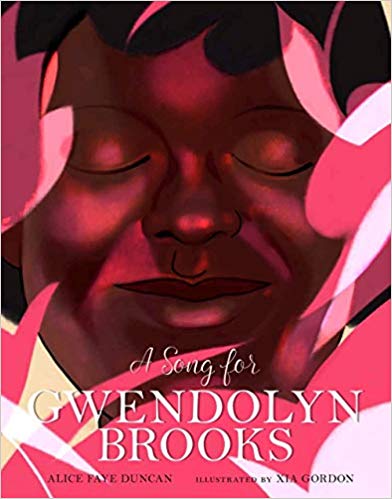
A SONG FOR GWENDOLYN BROOKS: A Review and Picture Book Giveaway

Congratulations to Danielle H. who for a second week in a row won a book from my blog. The Wizard's Daughter is on its way to her!

*************

Back in November I promised you a review of another book by Alice Faye Duncan. Several blog posts later and in anticipation of National Poetry Month in April, I'm making good on that promise. 


Before today you may not have heard of Gwendolyn Brooks. She won the Pulitzer Prize for poetry in 1950 making her the first African American to win a Pulitzer.  Fittingly, Ms. Duncan chose to celebrate Ms. Brooks work by writing her biography in verse and interspersing it with Brooks' own poetry.


The year is 1925. 
Gwendolyn Brooks is eight years old. 
Gray bursts of smoke hide the yellow sun. 
Can flowers grow without sunlight? 
Gwendolyn leans on the front yard gate. 
Gwendolyn is unsure.
As a young girl, Gwendolyn translates her observations and thoughts into poetry.


Her parents encourage her writing but a teacher accuses her of plagiarizing her poems. Her teacher retracts her charge, but Gwendolyn is angry and pens a poem which ends up being prophetic:


FORGIVE AND FORGET
If others neglect you,  
Forget, do not sigh. 
For, after all, they'll select you 
In times by and by. 
If their taunts cut and hurt you, 
They are sure to regret 
And if in time, they desert you 
Be sure to forgive and forget.  (Gwendolyn Brooks, 1928)
Her parents recognize her talent and give her time to develop her talent; her poems are published in The Chicago Defender. 

Gwendolyn writes, revises, studies, and wins prizes for her poetry. She marries Henry, has a son they name Junior, and writes.


SING a song for Gwendolyn Brooks 
She whittles her sonnets with perfect grace. 
Like Edna St. Vincent Millay and Robert Frost.
Gwen paints poems with paintbrush words 
And Gwen takes home a Pulitzer Prize.


GIVEAWAY AND EXTRAS

This book would be an excellent curriculum resource. Educators, feel free to use this lesson plan.

You'll find some of Gwendolyn's poems here. 

I'm giving away a copy of A SONG FOR GWENDOLYN BROOKS (a part of Sterling Children's Books "People who Shaped Our World" series) in conjunction with the March issue of Talking Story on WOW Women in History. Leave one comment here and I'll enter your name once. Leave a comment through Talking Story and you'll earn a second chance to win. Giveaway ends April 1. Please leave your email address if you are new to my blog. 


Monday, March 4, 2019

The Wizard's Daughter: A Book Review and Autographed Giveaway

Congratulations to Danielle H. for winning The Smallest Tadpole's War in the Land of Mysterious Waters.


********
If you, or a teenager you know, is a fan of clean science fiction/fantasy, then The Wizard’s Daughter by Jeff Minerd, is a book you should consider.


Minerd sets his three-book series, The Sky-Riders of Etherium in a world that is futuristic and yet also includes medieval/steam punk elements. The story opens with Brieze, the teenage protagonist, watching her mother jump off the edge of their floating island and into space. Brieze straps on her parachute pack and rescues her from impending death. In the process, Brieze learns that the man they are living with, the Wizard, has proposed to her mother. But, Patentia, can’t let go of the idea that Brieze’s father—her first love—still loves her and will come back for her.

With that, Brieze is thrust into a new normal and into her quest: to find her biological father, Kaishou Fujiwara, and to demand an explanation for why he abandoned her mother. She knows her journey to the Eastern Kingdoms will be fraught with dangers, but she is determined to not let anything stop her. 

The reader meets the other point-of-view character, Tak, a warrior in his own right and Brieze’s romantic interest. (He is the star of the first book in the series, The Sailweaver's Son.) Tak tries to talk Brieze into allowing him to accompany her, but she refuses—a decision she regrets during the long and lonely flight. 

The wizard, her adopted father, gives her a great surprise when he provides the airship she will need for her journey. Painted with a new pigment, the ship takes on the color of its environment. Delighted with the camouflage, Brieze names her airship, Devious. As a sky rider, Brieze “craved the weightless freedom of flying.” This powerful urge, along with Tak’s flying lessons, and her desire to confront her father propel her into a perilous journey and unknown future. 

Minerd's world-building is admirable. I'm quite sure that I could never imagine the complexity of the worlds, strange creatures, and dangers which Brieze encounters. Here is an example that shows some of the world that Brieze navigates in search of clues about her father's disappearance. 


She looked over the ledge. The clouds that covered the roots of the Wind's Teeth [dangerous, sharp mountains in which she had almost crashed] were only a few yards below her, looking like gray mist. She used the sturdy rope with the knots to lower the pack over the ledge, foot-by-foot down through the mist, toward the unseen ground below....
The glowing light stick on the pack dimmed as it descended through the fog....
A hundred knots passed...four-hundred twenty feet...
[She descends over five-hundred feet to the roots of the Wind's Teeth]
When she planted both feet on the ground, they sank in a little, as they would in mud. Brieze took a few cautious steps. The ground supported her, but it was definitely soft. She hadn't expected that. She bent down and scooped up a handful of the whitish-colored stuff she was walking on. It was like dirt, but much finer and dryer. It flowed like water between her fingers...
"Liquid dirt," she said to herself. "Fascinating."
......
[That night at her campfire] Sand slithered and hissed as the wind pushed it about.
Something moved in the darkness. She heard scrabbling sounds and the faint clink of metal on metal. Sniffing. Lips smacking and chewing. Satisfied grunts. Something was eating the goat strips she'd scattered in the dark...She saw the gleam of their eyes as they drew closer to the fire. Big, bulbous eyes, spaced far apart and glimmering green with the light reflecting off their retinas. There were two pairs of eyes and strangely, a single eye bobbing and blinking all by itself.
But they were Gublins.  (p. 199-4)
I referred to the map in front of the book several times; it helped me picture where Brieze was traveling. The prologue and epilogue were slightly confusing. Both reference characters and dragons that are not shown in the book. I assume they are important to the series, but I would have liked to see how they factor into The Wizard's Daughter.  In addition, I was left hanging at the end of the book. I assume that is because the author wants the reader to read the final book which he is working on, The Dragonlord's Apprentice. I would have preferred a greater sense of completion of this particular story. 


GIVEAWAY

If you are interested in receiving an autographed copy of The Wizard's Daughter, please leave a comment with your email address if you are new to my blog. Giveaway ends March 7.


Monday, February 25, 2019

The Smallest Tadpole's War in the Land of Mysterious Waters: An Audio Book Review and Giveaway

Florida became a state in 1845 and was quickly thrust into the Civil War. The Smallest Tadpole’s War in the Land of Mysterious Waters bridges the years from 1843  to 1900. The main character, Thomas Franklin Swearingen, was author Diane Swearingen’s husband’s great-great-grandfather. 

Thomas Swearingen, an uneducated farmer who settled northern Florida when it was home to untamed forests, black bear, Seminole ponies, and biting insects, went on to become a legislator, a drafter of the Florida constitution, and president pro-temp of the Florida senate. This is his story—and the story of Florida’s early years as a state. 


The Smallest Tadpole is told from the perspective of Henry, Thomas’s adopted son. Henry recounts that his favorite book as a child was Thomas’s diary.  Although Diane Swearingen fabricated Thomas’s diary and letters, she used county and military records as well as Thomas’s papers that now reside in the Florida State archives.  Historical accuracy permeates each diary entry and the entire book. 

Thomas left Georgia and settled in Wakulla County, Florida in the late 1840's. In 1855 when his best friend died, Thomas married his widow, Louise, and adopted Henry. In 1860, at the age of eleven, Henry became a man when Thomas left for the war. His boyhood days of fishing with Thomas in the Gulf of Mexico and camping out staring at the stars, were over. 


Henry remembers how Thomas, a prosperous businessman, had been invited to political rallies before the war. The local cotton farmers agreed that they shouldn't be taxed by the north. Although Thomas had been warned that slavery would remain in the South as long as it was a colony to the North, it was the unspoken issue at these rallies where secession was a huge topic. Although most of the farmers did not own slaves, (Florida's population was 140,000 in 1861; 63,000 were African Americans), wealthy cotton plantation owners held the purse strings and great political influence over the farmers. To speak against them was financial suicide. The political rallies became enlistment opportunities for the Confederate Army; the farmers were loyal to a way of life and to local economics rather than defenders of slavery.


Thomas was made a lieutenant in the Wakulla Guard because of his leadership and popularity in the county--not because of any prior military experience. (This verified the experience of Kate Dinsmore's great-grandfather. As the protagonist in Half Truths, I researched how her great-grandfather would have been made captain in Charlotte, NC under similar circumstances.)  With great pomp and ceremony, the Florida men left for war with families excited about the $100.00/month the soldiers would receive. 

But the reality of war set in quickly with women left alone to care for their farms and children, while news of injuries and deaths trickled in from the front. Thomas's letters reported the realities of war and Swearingen's portrayal does not hold back from describing the smell of death, ears that ran from cannon fire, and the screams of dying men. It put faces on the 16,000 Florida soldiers who never returned home. 

Henry's narrative of the war is sprinkled throughout with local stories of Wakulla County and his own enlistment prior to the war ending. There was not enough black cloth for all the widows to sew funeral attire. Carpetbaggers grabbed land because of taxes owed. The homeless and helpless were throughout the countryside. 

Although Thomas returned home injured, he was encouraged to run as the Florida representative of Wakulla County and from there held several political offices. Throughout his career Thomas was anti-slavery.

This audio version available through Audible, is expertly narrated by Jim Seybert.

WAKULLA’S BEAUTIFUL WAKULLA RIVER IS A SPRING FED CLEAR WATER RIVER THAT RUNS EVENTUALLY INTO THE GULF OF MEXICO.  TODAY, MANATEES SWIM UP TO WINTER IN ITS SPRING. FROM THE FLORIDA MEMORY COLLECTION.


GIVEAWAY


Thanks to Jim Seybert's generosity, I will provide a code for the winner to download this book from Audible's website. To enter, please leave me a comment by February 28 along with your email address if you are new to my blog. 


Monday, February 18, 2019

Celebrate Black History Month With These Books

Congratulations to Connie Saunders who won Vijaya Bodach's new novel, BOUND. Thanks to all of you for your comments the last three weeks; both Vijaya and I appreciated hearing from you.


*******

Many of you have been following my blog for years and some of you are new readers. My "old" followers are familiar with the books that have helped me write Half-Truths. To recognize Black History Month, I thought I'd provide links to these past reviews, particularly for my new readers. I hope you'll add some of them to your "to-be-read" list. 

The order in which the books are displayed reflects the order in which I read them; most recent book is on top.

Mothers of Massive Resistance: White Women and the Politics of White Supremacy  Written by North Carolina professor, Elizabeth Gillespie McRae, this book opened my eyes to the role that white women in the South played in maintaining segregation.

Memphis, Martin, and the Mountaintop Alice Faye Duncan's debut picture book told from the perspective of a young girl who "meets" Martin Luther King.

Eyes on the Prize This excellent book on the Civil Rights decade is written by Juan Williams. If you're looking for an in-depth overview of the Civil Rights movement, then you've come to the right book.

Be Free or Die: The Amazing Story of Robert Smalls' Escape from Slavery to Union Hero. This is a great panoramic view of South Carolina before, during, and after the Civil War and an eye-opening biography of an amazing man.

Crossing Ebenezer Creek This middle grade novel, based on true events, deepened my understanding of what ex-slaves experienced after "freedom."

Midnight Without a Moon. This book takes place in Mississippi in the mid-50's. Linda Williams Jackson's debut novel uses Emmitt Till's murder as a background for Rose Lee Carter's decision not to flee the South. 

Loving vs. Virginia. This is a great curriculum resource written in free verse which shows Mildred and Richard Loving's struggles to legalize their marriage in Virginia. 

The Lions of Little Rock This classic civil rights book is set in Little Rock, AK in 1958. I now use it as a comp title in my pitch for Half-Truths!

Carver: A Life in Poems. Lillian, my most important secondary character, wants to be a scientist. Reading about George Washington Carver helped me think more deeply about Lillian.

Primary Lessons: A Memoir by Sarah Bracey White Sarah grew up in the Jim Crow south and here I share excerpts describing her experiences. 

Dear Senator: A Memoir by the Daughter of Strom Thurmond. This book was a fascinating look into Strom Thurmond's bi-racial daughter and the many challenges she and her mother faced. I blogged about it extensively. 

The Color of Love. This is an autobiographical account of a boy whose mother falls in love with a black man in the Jim Crow South. 

Mixed: My life in Black and White  A candid autobiography written by Angela Nissel. She describes what it was like to grow up in Philadelphia as a bi-racial child during the second half of the 20th century.

Fly Girl A beautifully written YA novel about a young black woman who becomes a pilot during WWII.

A Lesson Before Dying. A book review of a powerful book portraying racism in Louisiana in the 1940's.

Here are a few of the books that didn't make it into this list!

Have you read any books about African American history that you would recommend? Please share in the comments below. 

(This post was originally published on the Write2Ignite blog.)

Monday, February 11, 2019

Behind the Scenes of Bound: Author Interview Part II

On last week's blog, Vijaya Bodach shared her inspiration for her debut YA novel, BOUND. This week she provides insights into her publishing journey and she and I talk shop.


PATH TO PUBLICATION


CAROL: Did you try to publish BOUND through “normal” publishers? If so, was there a pattern to your rejections?  

VIJAYA I tried the trade route for a couple of years, but got tired of even the good rejections. Many loved the writing and the characters but wanted a different outcome! That was non-negotiable. Early on, one agent sowed the seed for self-publishing. He said the industry was shifting and less open to publishing a book that was counter-cultural. When I was down to small presses, I remembered his words and decided to take all the risk to publish BOUND. It’s been so empowering, I feel a certain lightness. I would definitely recommend this as a path to publication.

CAROL: Can you share some of the ups and downs of self-publishing?

VIJAYA: I prayed about this decision for a year, but once I took the plunge (after another good rejection, lol) it was a whirlwind six weeks trying to learn everything necessary to publish BOUND myself. I still have much to learn, but what joy! I was able to use my contacts in the industry to hire a designer. I loved having the freedom to be true to my characters and have control over the entire process. And the best part is knowing that Rebecca and Joy are taking up residence in others’ hearts and minds as well.

But the most difficult part has been growing my readership. All my other books magically found their way into schools and libraries, but BOUND hasn’t been reviewed by any of the journals that librarians read, so they don’t even know of its existence.

I’m learning that to be successful in this business, one has to be good in three areas: writing, publishing, and marketing. I am good at writing, competent in publishing, but dismal at marketing. So this year, I plan to learn how to advertise more effectively. But at this stage, as a novice novelist, I believe my efforts are best concentrated on writing the stories that will make a difference and trusting that impassioned readers (like you!) recommend it to their circles, and so on and so forth to grow organically. I am grateful for each and every one of my readers. By the way, it will help if your readers request BOUND at their local library! 


SHOP TALK  


Vijaya was willing to discuss the choices she made while writing BOUND. Here are two observations I made about the novel and her responses. 

CAROL: I thought that Rebecca’s “conversion” from being against abortion to being pro-life was too abrupt. One minute she was taking Joy to the abortion clinic, the next minute she’s totally changed her mind. I actually found their father’s transformation was more gradual and believable.

VIJAYA: I’m glad you brought this up. Rebecca’s transition mirrors mine and it was like scales falling off my eyes. And speaking of mirrors, Jim Bell, talks about the “mirror moment” at the midpoint of a story. This is where a character is at a transition. She can see who she is and who she’s becoming. She must make a choice. It’s a moment of clarity. And in that scene (which ironically has Rebecca looking in a mirror) once Rebecca understands what’s at stake—the life of a child—she’s able to recall the wisdom of her mother’s words. And she does what she has to do without counting the cost. So yes, it feels sudden, yet natural. 

CAROL: The only parts that I found “didactic” were Rebecca's college interviews. I thought that Rebecca was long-winded and those could have been either shortened.

VIJAYA: I wrote BOUND for the ICL Book Course and my wonderful instructor, Nancy Butts, warned me about this exact danger. But by the third revision I knew that Rebecca had to articulate her position even if it cost her a seat in medical school.  


ONE LAST WORD FROM VIJAYA: Thank you for writing such an in-depth review and your thoughtful questions. I hope your readers feel encouraged to never, ever give up on a story they believe in. God bless all the works of your hands!


Bio: Vijaya Bodach is a scientist-turned-children’s writer, an atheist-turned-Catholic, and most recently, a writer-turned-publisher (Bodach Books). She is the author of over 60 books for children, including TEN EASTER EGGS, and just as many magazine articles, stories, and poems. BOUND is her first novel. To learn more, please visit: https://vijayabodach.blogspot.com/

GIVEAWAY

Leave me a comment if you want to enter to win an autographed copy of BOUND. It's fine if you already entered; I'll put your name in twice. If you are new to my blog, please leave your email address. The winner's name will be drawn on Thursday, February 14. A great book about love--just in time for Valentine's Day. 

Monday, February 4, 2019

Behind the Scenes of Bound: Author Interview Part I

Last week I reviewed Vijaya Bocach's new YA book, BOUND. Vijaya graciously agreed to an author interview and since she had a lot of information for readers and writers, I've decided to run it for two weeks. We hope you enjoy it! 


AUTHOR INTERVIEW- Part I


CAROL: I’m very curious about the inspiration for BOUND. Are they individuals you knew or are Joy and Rebecca from your imagination? 


VIJAYA: I borrowed the circumstances of my two cousins, Sangeeta and Aradhana, to explore many questions Rebecca was asking. Sangeeta was born deaf and had congenital heart defects requiring surgery due to my aunt contracting Rubella (German Measles) during pregnancy. The doctor advised an abortion because these children can have a lifetime of difficulties but my aunt refused and braved every challenge of raising a child with special needs. Later they adopted Aradhana, who nearly died in a fire as a small child. Both miracle babies!!! They are now happily married and Sangeeta is also a mother to a teenage boy. From the beginning, Rebecca and Joy were their own persons with their own agendas. Joy was my favorite character to write. 
  
CAROL: You have a lot of detail about burns and medical treatment. How much research did you have to do?

VIJAYA: I began with my cousins, who corroborated my memories as well as discussions with my aunt. I also read memoirs and a lot of medical texts on severe burns and their treatment. I am fascinated by the human body and how it functions, so really enjoy this type of research. 

Vijaya's cousins, Aradhana and Sangeeta

CAROL: Why did you write BOUND?  

VIJAYA: About ten years ago, our family was going through RCIA (Rite of Christian Initiation for Adults) and Rebecca was talking in my head and asking hard questions about life, love, and responsibility. It was clear that a short story wouldn’t give me the space I needed to explore the central dramatic question: “Are you your brother’s keeper?” Rebecca and Joy were the perfect characters to help me examine this through my newly-developing Catholic conscience. 

CAROL: Obviously, your ethnic identity comes out clearly in the book. Was that part difficult or easy to write? 

VIJAYA: The ethnic part is easy—it’s in my very cells  I grew up in India and so am very familiar with Indian mentality—there’s great diversity so there’s no such thing as a typical Indian. I had great fun writing Meanie Auntie. She came fully formed in my imagination.

CAROL: I also loved how there are many ways that the girls are different and also the same. Was that all purposeful on your part? (ie, both are damaged in some way.)

VIJAYA: Yes. My working title for this story was DAMAGED and from the beginning, I knew Rebecca would be a highly intelligent burn survivor like my cousin, with Joy damaged in the opposite way. I also wanted to make her an unfit mother in the eyes of the world. I thought about all the worst-case scenarios where people say it’s best to have an abortion and make a case against it through my characters.  

CAROL: I like BOUND so much better! It is a layered title that hints at the story. By the way--I think the cover is fantastic for the same reason!

CAROL: What has been the response to BOUND? 

VIJAYA: The response has been overwhelmingly positive. I love that I get a share in building His Kingdom. To God all the glory.  

********

GIVEAWAY

Next week Vijaya will share her publishing journey and we have some "shop talk" about decisions she made while writing the book. Giveaway date has now shifted to February 14. Each time you leave a comment I'll enter your name again. Remember to leave me your email address if you are new to my blog.


Vijaya Bodach is a scientist-turned-children’s writer, an atheist-turned-Catholic, and most recently, a writer-turned-publisher (Bodach Books). She is the author of over 60 books for children, including TEN EASTER EGGS, and just as many magazine articles, stories, and poems. BOUND is her first novel. 

Tuesday, January 29, 2019

BOUND: A Review and an Autographed Giveaway

Within the first pages of Bound by Vijaya Bodach, the reader realizes that this is going to be a book that deals with serious issues. The main character, Rebecca Joshi who was adopted from India at birth, was burned six years earlier over 50% of her body; her older sister, Joy, is intellectually impaired; their mother died a year ago and their father has emotionally withdrawn from his daughters. To be honest I thought, is all that drama necessary in one novel? 

Guess what?

It is.


REVIEW


Rebecca struggles for freedom. She wants to get rid of her burned skin--a constant reminder of how freakish she looks. She remembers her first "so-called cosmetic surgery... At age eleven-and-half. Yes, sir. Cosmetic. Because nobody ever died from looking hideous." (p. 13)

And she wants to get rid of her time-consuming and emotionally-draining responsibility for Joy. Rebecca, not their father, is the one who makes sure Joy gets to work. Rebecca is the younger sister who sticks up for her big sister when Joy is called a "retard." Their father, Rebecca concludes, is his own god. 

One evening Joy urges Rebecca to come folk-dancing with her. 
"I'll hold your hand," Joy says. "I'll never leave you." 
That's what I'm afraid of sometimes. I don't want us to be like a binary star system--circling each other forever. (p. 6)
Rebecca wants desperately to go to medical school so she can return to India and help impoverished children. Hand in hand with this desire is her yearning to fling off the burden of always watching over Joy.

Rebecca helps Joy become more independent which relieves her of some of the responsibility she inherited after their mother's death. But as a result, Joy spends more and more time with a man from work and gets pregnant. Although Joy feels letdown by her boyfriend who wants no part of being a father, she quickly becomes attached to her unborn child. Rebecca sees the baby as one more obstacle to her leaving home for medical school and takes Joy to an abortion clinic. 

At the abortion clinic Rebecca removes the ultrasound gel from Joy's belly and remembers her burn treatment.
They soaked me in a warm tub and my dead skin would peel off. What didn't come off had to be scrubbed off. They'd hold me down and rub away the stinking flesh. The nurses always said they knew I didn't have inhalation injuries because of my strong lungs. I wonder how I survived as I scrape the paper towel over Joy's beautiful belly one last time. She doesn't realize how lucky she is the pregnancy is not permanent. She can return to her normal life after this crisis is over. I have not been so fortunate. The massive burns have changed me and my life forever. I'm not even the same person I used to be. (p. 94)

Joy rejects abortion--much to Rebecca's and their father's disapproval. But gradually, Rebecca changes her mind as the unborn child becomes more real to the family. The three return to India to visit a beloved grandmother. In the familiar country of her birth, Rebecca thinks about why her mother put her up for adoption. After she considers the possible scenarios she concludes, "Whatever the cause she didn't want me. But at least she didn't deny me my life." (p. 165) 

The dichotomy between Rebecca's high intelligence but deformed body, and Joy's simplistic thinking yet voluptuous body runs throughout the book.  An additional thread is the mystery of the events surrounding Rebecca's accident. The reader discovers bits and pieces of what happened when Rebecca was 11--but the true story is not revealed until close to the end.

This beautifully written story shows a realistic portrayal of a young adult facing many personal, family, cultural, and moral dilemmas. The satisfactory ending--including the father's change of heart and accepting responsibility for Joy's future--will leave the reader feeling hopeful for Rebecca, Joy and her baby, and their family. 

In our present socio-political climate, I applaud Vijaya Bodach for her brave pro-life position. I hope Bound will be a meaningful tool that counselors will use with young women experiencing an unwanted pregnancy.  


AUTOGRAPHED GIVEAWAY

Next week I'm interviewing Vijaya about the backstory to Bound. Leave a comment this week and I'll enter your name once. Leave me another one next week and you'll be in twice. Winner will be chosen on February 8th. Please leave me your email address if you are new to my blog.

THE NIGHT WAR: A MG Historical Novel Review

  By now you should have received an email from my new website about my review of THE NIGHT WAR by Kimberly Brubaker Bradley. (It'll com...